Skip to content
Watt Warden

Generators

The Best Generators for a Job Site (2026)

A home generator runs a few days a year. A job site machine runs every day, gets loaded wet, and has to pass an inspection - which changes almost every part of the decision.

By Sawyer V.Updated Published How we work this out
Westinghouse WGen9500DF

Watt & Warden earns a commission on qualifying purchases made through links on this page, at no extra cost to you. It never changes a ranking, and our picks include products we tell you to skip. Full disclosure.

Quick picks

#ProductBest forPrice
1
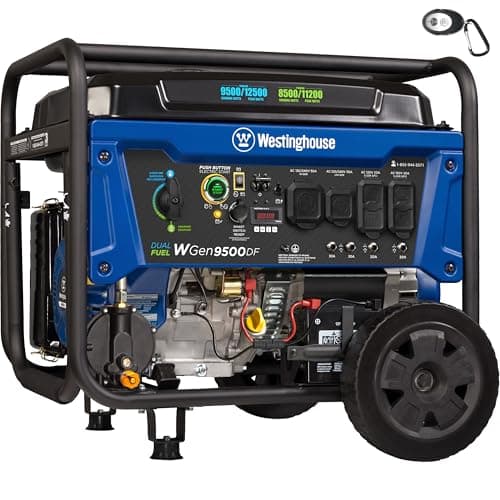
Westinghouse WGen9500DF

Best overall

Westinghouse WGen9500DF

9,500 running watts with GFCI household outlets, both 240V connectors and remote start.

A crew running several tools at once
$999.00 · Check price on Amazon

#ad how this is funded · price as of October 20, 2026

2
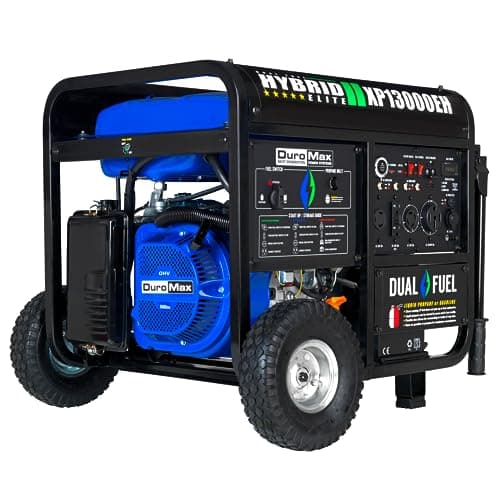
DuroMax XP13000EH

Most output

DuroMax XP13000EH

13,000 peak and 10,500 running watts with a 50A outlet.

Welding, big compressors, a crew that will grow into it
$1,299.00 · Check price on Amazon

#ad how this is funded · price as of October 20, 2026 · $1,499.00 13% off

3
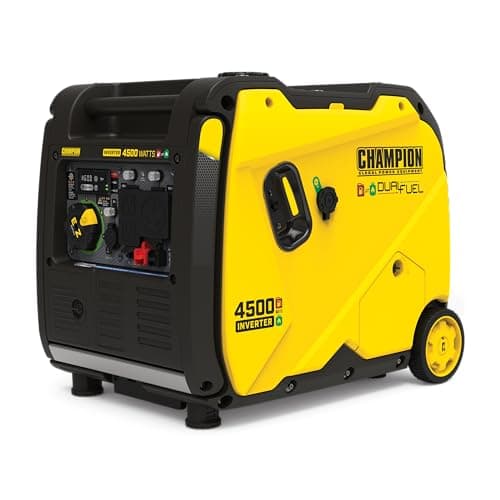
Champion 4500W dual fuel inverter generator

Best for finish work and electronics

Champion 4500W dual fuel inverter generator

4,500 peak and 3,500 running watts of inverter-clean dual fuel output.

Trim, cabinetry, and anywhere noise is a problem
$988.62 · Check price on Amazon

#ad how this is funded · price as of October 20, 2026

4
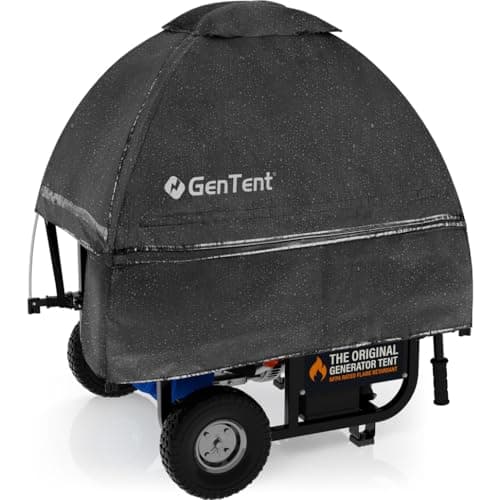
GenTent Safety Canopy, open-frame

The accessory that keeps you working

GenTent Safety Canopy, open-frame

A running cover for open-frame machines that sheds water without blocking airflow.

Rain, which stops a machine before it stops the crew
$159.99 · Check price on Amazon

#ad how this is funded · price as of October 20, 2026

Prices come from the retailer at page-build time and change constantly. Where no live price is available the button reads “Check price” rather than showing a number we cannot stand behind.

Job site is a duty-cycle problem

The specification that matters most here is not on the box. A home standby-adjacent portable runs perhaps thirty hours a year. A job site machine runs six hours a day, five days a week, and that is a completely different service life.

Three consequences follow.

Engine displacement matters more than the wattage. Two machines rated at 7,500 watts can have very different engines, and the larger one is loafing where the smaller is working. Loafing engines last.

Maintenance is on hours, not years. An oil change interval of 100 hours means monthly on a site and every three years at a house. The maintenance schedule is written for hours for exactly this reason, and a machine with an hour meter is worth more than one without.

Build quality shows up as downtime. A control panel that fills with water, a fuel tank that rusts, a frame that cracks — none of these matter at a house and all of them matter when the machine is loaded into a truck wet every evening.

GFCI is not optional

Temporary electrical power on a construction site is required to be ground-fault protected. In practice that means either GFCI receptacles on the generator itself or GFCI protection at the point of use, and an inspector will look.

Buying a machine with GFCI outlets built in is the simple route. If yours does not have them, the fix is inline GFCI adapters or a GFCI-protected temporary power box, and both are cheaper than a stop-work order.

Two practical notes. GFCI devices can nuisance-trip on long cord runs and on some inductive tools, which is a real annoyance and not a reason to bypass them. And a generator that is not bonded the way the GFCI expects can trip constantly — the grounding page covers bonded-neutral versus floating-neutral machines, which is the usual cause.

Sizing against real tool loads

ToolRunning wattsStarting
Circular saw, 7 1/4 in1,200-1,800 WBrief inrush
Table saw, 10 in1,800-2,000 WUp to about 4,500 W
Air compressor, 2 HP1,500-2,200 WMuch higher — starts against a load
Miter saw1,500-1,800 WBrief inrush
Concrete mixer800-1,500 WSeveral times running
Site lighting, LED100-400 W totalNone
Battery chargers, four of them200-400 WNone

Ranges are typical for professional tools; the plate on your own tool is authoritative. The starting watts page explains why the second column decides the machine.

Add the running watts of everything that genuinely runs simultaneously, then add the single largest starting surge. A two-person crew with a table saw, a compressor and chargers lands around 4,500 running watts plus a 4,500W start — which points at the 7,500W class rather than the 5,000W one.

Cordless has changed the arithmetic

Worth saying because it genuinely reduces what many trades need. A crew running cordless saws, drivers and nailers needs a generator for chargers, lighting and the occasional corded tool — a few hundred watts plus one spike.

For that pattern a 3,500W inverter machine is enough, and it is quieter, lighter and cheaper to run than the open-frame machine the trade traditionally buys. Trades that still need real power are the ones with compressors, concrete equipment, welding, or heating.

A power station is also now a viable site product for chargers and lighting specifically — the job site scenario page works that through.

Theft, and the rest of site reality

  • Generators are stolen constantly. Chain it, mark it, and photograph the serial number. An unattended machine overnight is an invitation.
  • Cords are the other consumable. Run the right gauge for the length or you lose voltage and burn tools — the cord page covers sizing.
  • Noise ordinances apply. Many municipalities restrict construction noise by hour, and an open-frame machine at 7am is the complaint that gets you a visit.
  • Carbon monoxide indoors kills workers. Never inside a building under renovation, never in a basement, never in a partly enclosed space — the CO safety page applies with more force here than at a house, because the space is often unfinished and unventilated.

The short version

  • Buy for duty cycle. Engine size and hour meter matter more than the wattage badge.
  • GFCI outlets, or GFCI at the cord. It is a requirement, not a preference.
  • Size for simultaneous tools plus one big start. Usually the 7,500W class for a crew.
  • If the crew is cordless, buy smaller and quieter.
The picks in full

01 — Best overall

Westinghouse WGen9500DF

9,500 running watts with GFCI household outlets, both 240V connectors and remote start.

GFCI protection on the 120V outlets is the specification that matters most on a site, because temporary power on construction work has to be ground-fault protected and an unprotected machine means adding GFCI at the cord.

9,500 running watts covers a crew: a table saw, a compressor, a couple of chargers and site lighting, with enough margin that the machine is not stalling every time somebody starts something.

240V matters for the larger trade equipment — welders, big compressors, some concrete tools.

The honest catch: it is heavy. Two people or a ramp, every day, and that is a real consideration for a machine that moves between sites.

Skip it ifyou are a one-person operation with cordless tools. That is a much smaller machine.

Westinghouse WGen9500DF
$999.00 · Check price on Amazon

#ad how this is funded · price as of October 20, 2026

Published specifications for the Westinghouse WGen9500DF
SpecificationPublished figure
Output (gasoline)9,500 running W / 12,500 peak W
FuelGasoline or propane (dual fuel)
Engine457cc 4-stroke OHV, cast iron sleeve
Tank6.6 gal (25 L)
Run timeup to 12 h on a full tank
Transfer-switch outlet120/240 V L14-30R, 30 A
RV outlet120/240 V 14-50R, 50 A
StartingPush-button electric with remote key fob
Warranty3-year limited

Source: Westinghouse — WGen9500DF product specifications. These are the manufacturer's published figures, not ours — we have not tested this unit.

02 — Most output

DuroMax XP13000EH

13,000 peak and 10,500 running watts with a 50A outlet.

Surge capability is what you are buying. A large compressor or a welder starting under load is the demand that defeats mid-size machines, and this has obvious headroom for both.

The 50A outlet means it can feed a proper temporary distribution panel rather than a daisy chain of cords.

The honest catch: a large engine running a small load has the worst fuel economy in the category. Size to the real crew, not the aspirational one.

Skip it ifyour loads fit in 7,500W. Every unused watt costs fuel per hour.

DuroMax XP13000EH
$1,299.00 · Check price on Amazon

#ad how this is funded · price as of October 20, 2026 · $1,499.00 13% off

Published specifications for the DuroMax XP13000EH
SpecificationPublished figure
Output13,000 running W / 16,000 peak W
FuelGasoline or propane (dual fuel)
Engine500cc OHV DuroMax
Transfer-switch outlet50 A
FrameAll-metal, no plastic panels
SafetyLow-oil shutoff; 5 ft propane hose with ACME connector

Source: DuroMax — XP13000EH product specifications. These are the manufacturer's published figures, not ours — we have not tested this unit.

03 — Best for finish work and electronics

Champion 4500W dual fuel inverter generator

4,500 peak and 3,500 running watts of inverter-clean dual fuel output.

Two reasons this belongs on a site. Inverter output is clean enough for battery chargers, laser levels and laptops, which conventional machines can be rough on. And it is quiet enough to work near occupied buildings and inside noise ordinances.

Remodel and finish work in occupied homes is exactly the case where a loud open-frame machine causes a complaint and a quiet inverter does not.

The honest catch: 3,500 running watts is a one or two tool machine. Be honest about how many things run at once.

Skip it ifyou run a table saw and a compressor together. That is a bigger machine.

Champion 4500W dual fuel inverter generator
$988.62 · Check price on Amazon

#ad how this is funded · price as of October 20, 2026

Published specifications for the Champion 4500W dual fuel inverter generator
SpecificationPublished figure
Output4,500 starting W / 3,500 running W (gasoline)
TypeInverter, RV ready
FuelGasoline or propane (dual fuel)
StartingElectric start
RV outlet120 V TT-30R, 30 A
Warranty3-year limited with free lifetime technical support

Source: Champion Power Equipment — 4500-watt dual fuel inverter specifications. These are the manufacturer's published figures, not ours — we have not tested this unit.

04 — The accessory that keeps you working

GenTent Safety Canopy, open-frame

A running cover for open-frame machines that sheds water without blocking airflow.

Work continues in weather that an open-frame generator should not be running in, and the improvised answer — a tarp over the top — traps heat and exhaust.

A purpose-built cover keeps water off the panel and the outlets while leaving the cooling path and the exhaust clear. The rain page covers why the distinction matters.

The honest catch: fit is model-specific. Check the frame dimensions before ordering.

Skip it ifyour machine lives in a covered trailer.

GenTent Safety Canopy, open-frame
$159.99 · Check price on Amazon

#ad how this is funded · price as of October 20, 2026

Published specifications for the GenTent Safety Canopy, open-frame
SpecificationPublished figure
FitsOpen-frame generators, 3,000–10,000 W
FabricNFPA 701 flame-certified
Wind ratingup to 110 mph
Rain ratingup to 12 in per hour
Snow loadup to 18 in
InstallationTool-free clamp mount

Source: GenTent — Safety Canopy product page. These are the manufacturer's published figures, not ours — we have not tested this unit.

How these were chosen

We did not test these. Nobody at Watt & Warden has plugged one in. What we did instead: read the manufacturer's published specifications, compile them into a table where the figures line up, and compute the numbers manufacturers leave out — runtime against a real appliance load, and what an hour of running actually costs.

Anything that could not be sourced was left out rather than estimated, and every pick names the buyer who should skip it. The full method is here, including where it is weaker than a publisher with a test bench.

Questions people actually ask

What size generator do I need for a job site?

Add the running watts of everything that genuinely runs at once, then add the single largest starting surge. A two-person crew with a table saw, a compressor and chargers lands around 4,500 running watts plus a 4,500W start, which points at the 7,500W class. A cordless crew needing only chargers and lighting can use 3,500W.

Do job site generators need GFCI outlets?

Temporary power on construction work has to be ground-fault protected, so either the generator carries GFCI receptacles or you provide GFCI protection at the point of use. Buying a machine with them built in is simpler. Nuisance tripping is usually a grounding and bonding issue rather than a reason to bypass anything.

Is an inverter generator good for a job site?

For finish trades and cordless crews, yes -- it is quieter, lighter, and produces clean power for chargers, laser levels and laptops. For anything with a compressor, a welder or concrete equipment, the output is too low and an open-frame machine is the right tool.

How often do job site generators need servicing?

On hours, not years. A 100-hour oil change interval is monthly on a site that runs six hours a day, five days a week, against every three years at a house. That makes an hour meter genuinely valuable, and it is why engine displacement relative to output matters -- a loafing engine lasts far longer than a straining one.

Can I run a generator inside a building under renovation?

No. Unfinished buildings are unventilated, and carbon monoxide from a portable generator accumulates fast in one. This kills workers every year. The machine goes outside with the exhaust pointing away from openings, and cords come in -- the same rule as at a house, with less margin because the space is often sealed up.

Sources

Every figure on this page comes from a published source. We have not tested this equipment, so the specifications are the manufacturer's and the statistics are the dataset's — the arithmetic on top of them is ours, and it is shown in full so you can check it. How we work this out.