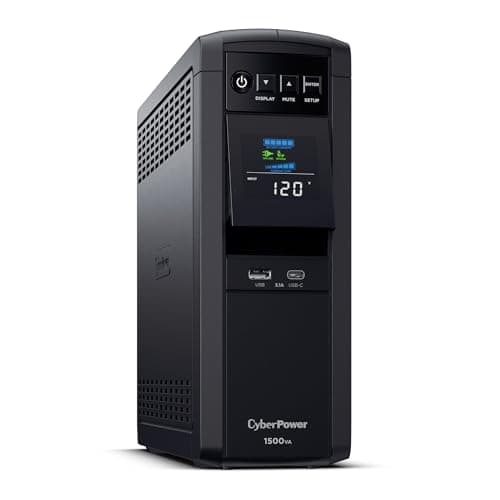
The verdict, in one paragraph
Buy line-interactive. It is the right topology for essentially every home and small-office load: AVR corrects brownouts and sags without touching the battery, and CyberPower publishes a typical 4ms transfer when it does switch — invisible to any modern power supply. Buy standby only for a modem, a router or a clean shutdown, where published transfer times run 6 to 10ms and there is no voltage regulation at all. Buy online double-conversion only for a server, lab equipment, or a load that will run on a generator: it publishes a zero-millisecond transfer because the load never touches utility power, and it costs roughly ten times a line-interactive unit of similar VA. Then check the waveform separately — topology and waveform are two decisions, and most people only make one.
The three topologies, from published specifications
| Standby | Line-interactive | Online double-conversion |
|---|
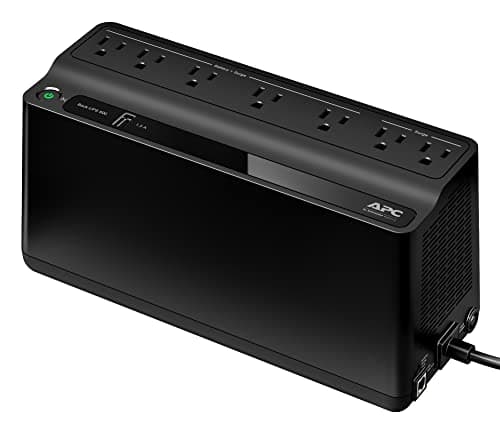
| Transfer time | 6-10 ms typical (APC BE600M1) | 4 ms typical (CyberPower) | Zero milliseconds |
|---|
| Voltage regulation | None | AVR - corrects without using the battery | Inherent - output is always re-generated |
|---|
| Load connected to utility? | Yes, until it fails | Yes, through the regulating transformer | Never - isolated 100% of the time |
|---|
| Typical waveform | Simulated sine | Both sold - check the model | Sine wave |
|---|
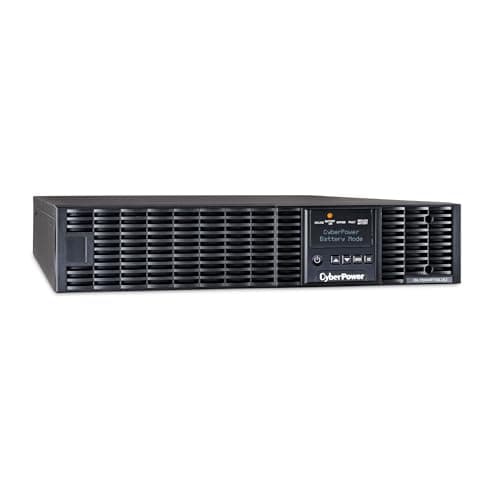
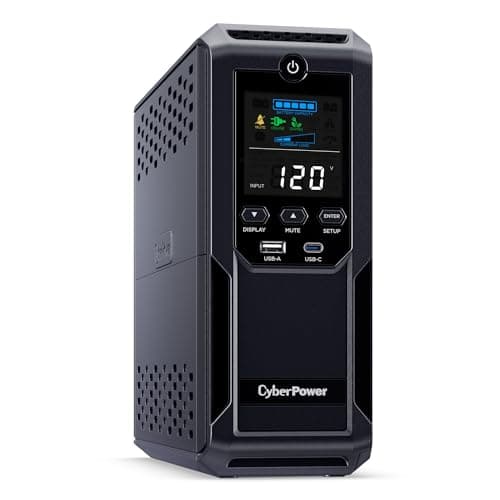
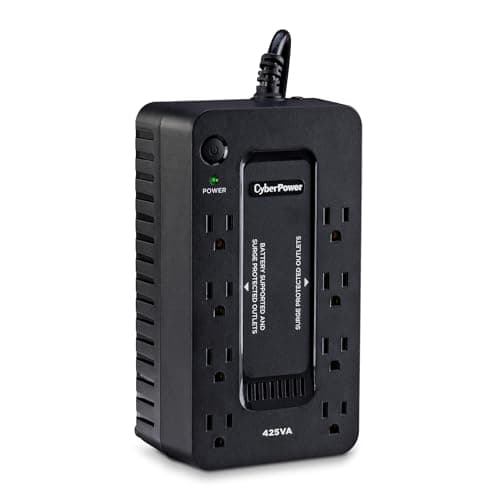
| Example and rating | CyberPower ST425, 425 VA / 260 W | CyberPower CP1500PFCLCD, 1,500 VA / 1,000 W | CyberPower OL1500RTXL2U, 1,500 VA / 1,350 W |
|---|
| Power factor | Not published | Not published | 0.9 |
|---|
| Output voltage | 120 VAC, plus or minus 5% | 120 VAC, plus or minus 5% | 100-125 V, plus or minus 2%, configurable |
|---|
| Suited to | Modem, router, clean shutdown | Desktops, NAS, networking, home entertainment | Servers, lab equipment, generator-fed loads |
|---|
Figures are CyberPower's and APC's own published specifications for the named models, cited under Sources. Where a row says a figure is not published, that is what we found on the manufacturer's page. Current prices sit inside the buy buttons above with their refresh date.
What each one actually does when the power dips
- Standby. The load runs straight off the wall. When voltage leaves an acceptable window, a relay flips the load to the inverter. Simple, cheap, and the transfer is a real gap — APC publishes 6 to 10ms typical for the BE600M1.
- Line-interactive. Same basic arrangement, with a regulating transformer in the path. CyberPower's own wording is that AVR increases the AC power and maintains a safe voltage level without switching to battery mode. Only a genuine failure triggers a transfer, typically at 4ms.
- Online double-conversion. Incoming AC is rectified to DC and inverted back to AC continuously. CyberPower publishes that this "isolates output power from input power 100% of the time" and therefore has zero transfer time, because there is nothing to transfer.
Why AVR matters more than transfer time
Transfer time is what gets argued about and voltage regulation is what actually determines how long your UPS lasts.
A standby UPS has one response to every power problem: go to battery. In a neighborhood with a weak service, a long feeder or a large motor down the street, that can mean several battery events a day. Each one consumes a cycle from a sealed lead-acid battery with a service life CyberPower and APC both put in the three-to-five-year range.
A line-interactive unit handles the same sags with its transformer and leaves the battery alone. That is why CyberPower attaches the phrase "which extends battery life" to its AVR description on both the sine and simulated-sine models, and why AVR is the specification to buy on if your voltage is unstable rather than merely absent.
Topology and waveform are two decisions
This is where most UPS purchases go wrong. The CP1500PFCLCD and the CP1500AVRLCD3 are both line-interactive, both 1,500VA, both carry a three-year warranty including the battery. The differences are:
| CP1500PFCLCD | CP1500AVRLCD3 |
|---|
| Waveform | Sine wave | Simulated sine wave |
|---|
| Watt rating | 1,000 W | 900 W |
|---|
| Active PFC compatible | Yes | Not the model for it |
|---|
| Runtime, half / full load | About 10 min / 2.5 min | 12 min / 3 min |
|---|
Both rows are CyberPower's published figures for these two models. The simulated-sine unit shows longer runtime because its watt rating is lower, not because it holds more energy.
If the load is a modern desktop, a gaming PC or anything with an 80 PLUS-rated power supply, you want the sine wave model. If it is a router, a modem, a surveillance recorder or a set-top box, the simulated waveform is fine and the saving is real.
When online double-conversion is genuinely worth it
At roughly ten times the price of a line-interactive unit of the same VA, this tier needs a specific justification. There are three:
- Generator-fed loads. CyberPower calls out generator compatibility on the OL1500RTXL2U explicitly. Generator output varies in frequency and voltage in ways a line-interactive unit will chase and an online unit simply absorbs — which is the case that matters if your outage plan involves an engine.
- Hardware that will not tolerate any gap. Some industrial controllers, medical equipment and older servers do notice four milliseconds. CyberPower positions this tier for "high-end system components, corporate servers, lab equipment."
- Output voltage control. The OL1500RTXL2U publishes a configurable output of 100, 110, 115, 120 or 125V at plus or minus 2%, against plus or minus 5% on the other two tiers. If you are running equipment specified for a tighter window, that is the only tier that offers it.
Everything else — a PC, a NAS, a network rack, a home office — is served better by spending the difference on a larger line-interactive unit or on a power station with a UPS function, which gives you hours instead of milliseconds.
Where a UPS stops and backup power starts
Every unit on this page is a bridge, not an outage plan. The published runtimes make that plain: about 10 minutes at half load on a 1,500VA line-interactive unit, roughly 23 minutes at 100W on a 600VA standby unit.
If the requirement is hours rather than minutes, the device class is wrong rather than the topology:
Who should buy which
- A desktop, a NAS, a network rack, a home office: line-interactive, sine wave. This is the default answer.
- Unstable voltage, frequent brownouts: line-interactive specifically for the AVR, regardless of what you are plugging in.
- A modem and a router only: standby. 425 to 600VA is enough and the money saved is better spent elsewhere.
- A server, lab gear, or anything that will run on a generator: online double-conversion.
- A refrigerator, a furnace or a sump pump: none of these. That is a power station or a generator, and the UPS category does not reach it.
The short version
Line-interactive is the right topology for almost every home and small-office load, and AVR rather than transfer time is the reason. Standby is honest at the low end and fine for a router. Online double-conversion earns its ten-times premium on generator-fed and zero-tolerance equipment and nowhere else. Choose the topology on how stable your voltage is, choose the waveform on whether the load has an active-PFC supply, and remember that none of these is an outage plan — they are the thirty seconds that lets you start one.