First: do you need a controller at all?
Probably not, and it is worth checking before reading further.
If you are plugging a folding panel into a portable power station, the station already has a charge controller inside it. You do not add another, and you cannot choose which type it is. What you can do is check whether the manufacturer says it is MPPT — most modern stations are, and they say so.
A separate controller is for the other case: panels wired to a battery bank in a cabin, an RV, a shed or an off-grid installation. That is where this comparison decides something.
What each one does
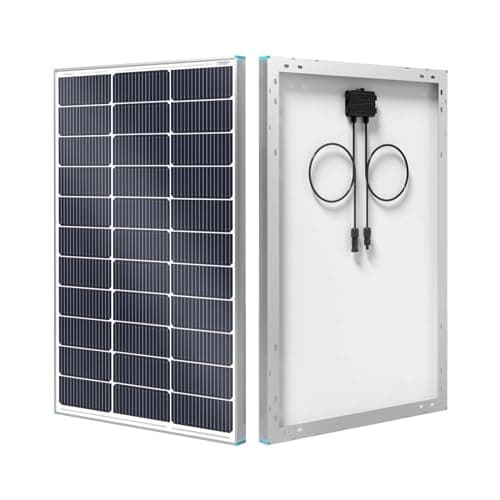
A solar panel and a battery want to sit at different voltages. A nominal "12V" panel actually produces something closer to 18 to 22 volts at its maximum power point; a 12V battery accepts roughly 12 to 14.6 volts depending on state of charge. Something has to reconcile that.
PWM — pulse width modulation. Connects the panel almost directly to the battery and switches rapidly to regulate. The panel is dragged down to battery voltage, and the difference between where the panel wanted to operate and where it is forced to operate is simply lost.
MPPT — maximum power point tracking. A DC-to-DC converter. It lets the panel operate at its own best voltage, then converts the surplus voltage into extra current at the battery's voltage. Power in roughly equals power out, minus conversion losses.
The comparison
| PWM | MPPT |
|---|
| Surplus panel voltage | Lost | Converted into current |
|---|
| Panel and battery voltage must match | Yes — a 12V panel for a 12V bank | No — higher-voltage arrays are fine |
|---|
| Series strings | Not usable | Yes, up to the input voltage limit |
|---|
| Cold, bright mornings | Worst case — the voltage gap is largest | Best case — most surplus to convert |
|---|
| Hot afternoons, battery nearly full | Gap is smallest, so the penalty is smallest | Advantage narrows |
|---|
| Cost | Much cheaper | Several times the price |
|---|
| Long cable runs | Poor — high current, high loss | Better — wire at higher voltage, lower current |
|---|
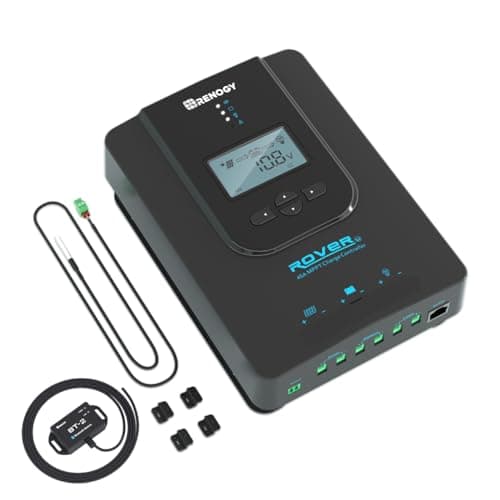
This describes how the two topologies behave rather than quantifying a gain, because the gain depends entirely on the voltage gap in your specific conditions. Manufacturers publish tracking and conversion efficiencies — Renogy quotes up to 99% and 98% for the Rover — but the real-world advantage over PWM varies with temperature, state of charge and array configuration.
Why the advantage is largest when you need it most
This is the argument that decides it for backup power specifically, and it is not the one usually made.
A panel's voltage rises as it gets colder and falls as it heats. Its maximum power point voltage is therefore highest on a cold, bright morning — exactly when a PWM controller is throwing away the most, and exactly when an MPPT controller has the most surplus to convert.
Battery state of charge compounds it. A deeply discharged battery sits at a lower voltage, which widens the gap further. So the MPPT advantage is biggest when your battery is empty and the morning is cold — which is a precise description of the second day of a winter outage.
Conversely, on a hot afternoon with a nearly full battery, panel voltage has sagged and battery voltage has risen. The gap is small and so is the difference between the two technologies.
The cold-voltage effect is the same one that makes series strings risky near an input limit.
When PWM is genuinely the right choice
- Small arrays. Below about 100-150W, the money saved buys more panel, and more panel beats better conversion of less panel.
- Matched voltages and short runs. A 12V panel on a 12V battery, a couple of feet apart.
- Trickle charging. Maintaining a vehicle or a boat battery, where total energy is trivial.
- Warm climates. The voltage gap is smaller year-round, so there is less to recover.
When MPPT earns its cost
- Arrays above about 200W. The percentage recovered is now worth real watt-hours.
- Cold climates. Where the voltage gap is widest for most of the year.
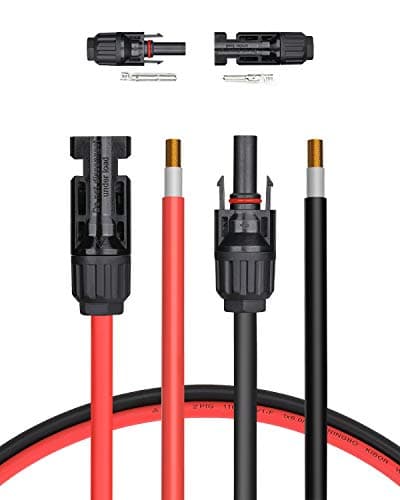
- Long cable runs. MPPT lets you wire panels in series at higher voltage and lower current, which cuts cable loss — often a bigger saving than the tracking itself.
- Panels that do not match the battery voltage. A 24V array on a 12V bank is only possible with MPPT.
- Backup power you are relying on. The advantage peaks in exactly the conditions where the system has to perform.
Sizing a controller
Three numbers, all on the controller's datasheet:
- Maximum PV input voltage. The hard limit — exceed it and you damage the controller. The Rover 40A accepts up to 100V. Leave real headroom, because panel voltage rises in the cold and a string sized at room temperature can exceed the ceiling in February.
- Maximum array wattage, by system voltage. 520W at 12V and 1,040W at 24V on the Rover — the same controller handles twice the array on a 24V bank, because it is current-limited rather than power-limited.
- Output current rating. The 40A in the name. Array watts divided by battery voltage gives roughly the current it must handle.
The battery type matters too. Lead-acid chemistries want a different charge profile from lithium, and most controllers select the common lead-acid profiles automatically while requiring lithium to be set manually. Setting it wrong is the most common way people damage a battery bank.
The short version
For a portable power station: irrelevant, because the controller is already inside and is almost certainly MPPT.
For a small trickle-charging setup: PWM, and spend the difference on panel.
For anything you would actually rely on in an outage — a cabin, a shed battery bank, an RV with a real array — MPPT, because the advantage is largest on cold mornings with a dead battery, which is the situation the system exists for.
Sizing the array itself matters more than either choice, and choosing the panels comes first.