The short answer
A 1,000Wh power station runs a typical modern refrigerator for about six hours. A 2,000Wh station runs one for about eleven and a half.
Both numbers rest on three assumptions. Here they are, so you can change them and get a better answer for your own fridge.
The formula
Hours = capacity (Wh) × inverter efficiency ÷ average draw (W)
Three inputs, and each one deserves a paragraph.
Capacity — take it from the spec sheet
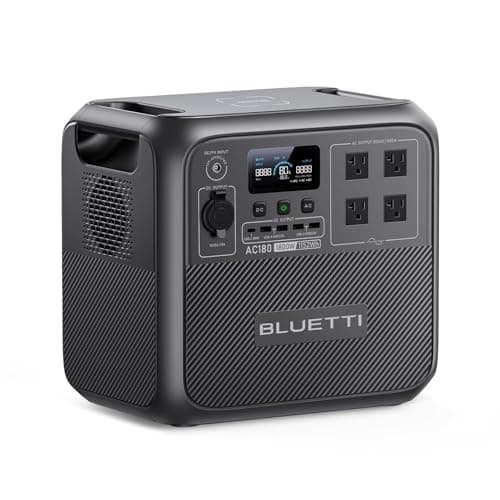
The published watt-hour figure. BLUETTI publishes 1,152Wh for the AC180; Jackery publishes 1,070Wh for the Explorer 1000 v2; Anker publishes 1,056Wh for the SOLIX C1000. Use the manufacturer's number.
Inverter efficiency — we use 85%
Converting DC battery power to AC household power is lossy, and the losses come out as heat and fan noise. 85% is conservative for a good inverter at moderate load and generous for a cheap one running near its limit.
Manufacturers rarely publish an efficiency curve, so this is a working assumption rather than a measured figure and we would rather say so. Substituting 90% raises every answer by about 6%; substituting 80% lowers it by the same.
Average draw — the assumption that matters most
This is where most published answers go wrong. Champion's reference puts a domestic refrigerator at 150–400W running, but a fridge does not run continuously. The compressor cycles — on for a while, off for a while — and in normal conditions with the door shut it runs perhaps a third of the time.
So the useful figure is the average across a full cycle, not the running draw. We use 150W for a modern refrigerator in a normal kitchen with the door kept shut.
Your own fridge publishes a better number than ours. The EnergyGuide label gives estimated annual consumption in kilowatt-hours; divide by 8,760 hours and multiply by 1,000 to get average watts. A fridge rated at 500 kWh a year averages 57W — far less than our assumption, and it would run for well over twelve hours on a 1,000Wh station. A 1,200 kWh-a-year unit from 2003 averages 137W and behaves much more like our figure.
The table
| Station capacity | Efficient fridge, 100W avg | Typical fridge, 150W avg | Older or large, 250W avg |
|---|
| 500 Wh | 4.3 h | 2.8 h | 1.7 h |
|---|
| 1,000 Wh | 8.5 h | 5.7 h | 3.4 h |
|---|
| 1,152 Wh (AC180) | 9.8 h | 6.5 h | 3.9 h |
|---|
| 1,500 Wh | 12.8 h | 8.5 h | 5.1 h |
|---|
| 2,000 Wh | 17.0 h | 11.3 h | 6.8 h |
|---|
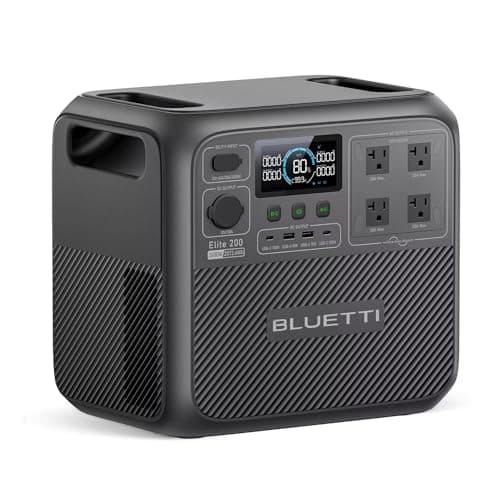
| 2,073.6 Wh (Elite 200 V2) | 17.6 h | 11.7 h | 7.1 h |
|---|
Computed as capacity × 0.85 ÷ average draw. Capacities are the manufacturers' published figures. The three average-draw columns span the realistic range for a domestic refrigerator; find yours from the EnergyGuide label rather than guessing which column you are in.
The other test: will it start at all?
Runtime is the second question. The first is whether the inverter can deliver the starting surge, and no amount of battery capacity helps with it.
Champion publishes 800–1,200W starting for a domestic refrigerator. A 300W inverter refuses that immediately and permanently. A 600W inverter refuses it too. 1,000W is marginal; 1,800W has real margin.
This is why a 500Wh station with a 300W inverter is not a “2.8-hour fridge” — it is a zero-hour fridge, because the compressor never starts. Check the inverter figure before you look at the battery.
The trick that doubles the answer
A refrigerator is a well-insulated box. FoodSafety.gov puts a sealed refrigerator at about four hours before food safety becomes a concern with no power at all, a half-full freezer at about 24 hours and a full freezer at about 48.
Which means running it continuously is wasteful. Run it in blocks instead: power it for an hour, switch it off for two, let the thermal mass hold. Cooling a fridge back down after a two-hour rest takes far less energy than keeping it at temperature the whole time, because the compressor is not fighting a small constant heat leak — it is doing one efficient run.
In practice that roughly doubles or triples what a given battery delivers. Its only real cost is that somebody has to be awake to manage it, so it is a daytime strategy rather than an overnight one.
Things that make it worse
- Opening the door. Every opening dumps cold air and adds a compressor run. In an outage, decide what you need before you open it.
- A warm room. The compressor works against ambient temperature. A kitchen at 30°C with no air conditioning is a much harder job than one at 20°C.
- An empty fridge. Thermal mass helps. A full fridge holds temperature longer than an empty one — which is why filling gaps with bottles of water before a forecast storm genuinely works.
- Ice makers and through-the-door dispensers. These add load. Switch the ice maker off during an outage.
- Age. A twenty-year-old fridge can use two to three times what a current model does for the same cooling.
If you need more than a night
Past about twelve hours, a battery stops being the efficient answer for refrigeration. A small generator run for two hours twice a day keeps a fridge and a freezer cold indefinitely for a few dollars of fuel — the arithmetic is here.
The best arrangement is both: the generator refills the battery and cools the box hard during a short run, and the battery carries the fridge silently through the night. The comparison works through when each one wins.