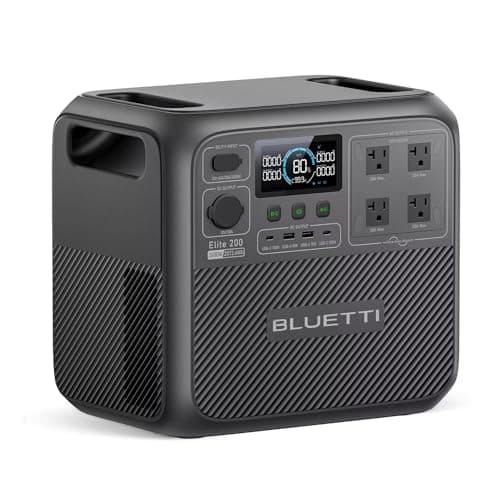
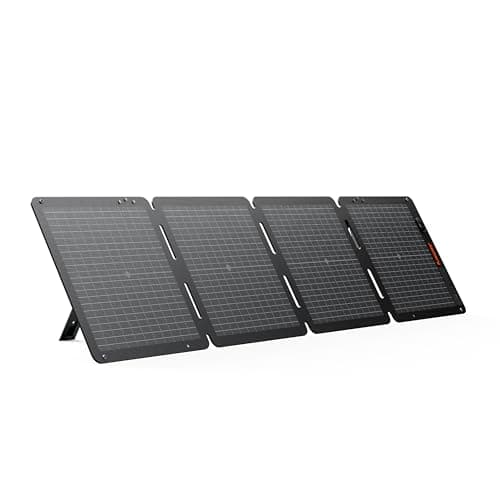
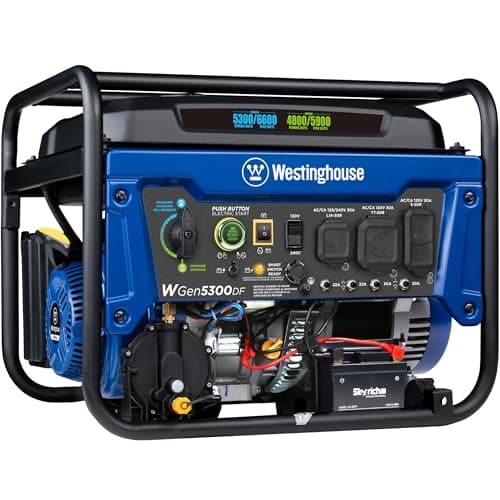
The two properties that separate them
A gas generator produces power on demand. Start it and it makes electricity, at 3am, in a snowstorm, under thick cloud, for as long as you feed it. What it charges you for that is fuel, noise, maintenance and an exhaust that can kill you indoors.
A solar generator produces power when the weather allows. It is silent, safe indoors, needs no fuel and no maintenance, and its energy costs nothing. What it charges you is dependence on daylight and a much lower ceiling on output.
Every other difference follows from those two.
Side by side
| Property | Solar generator | Gas generator |
|---|
| Typical output | 300–2,600 W | 2,200–13,000 W |
|---|
| Power on demand | Only from stored charge | Yes, whenever started |
|---|
| Refueling | Daylight | Gasoline or propane you must obtain |
|---|
| Running cost | Nothing | About $3.05/hr at half load |
|---|
| Noise | Silent | ~68–72 dB conventional, ~50–60 dB inverter |
|---|
| Indoor use | Safe | Never — carbon monoxide kills |
|---|
| Maintenance | Top up every 3–6 months | Oil changes, fuel rotation, seasonal starts |
|---|
| Winter performance | Poor — short days, cloud, snow on panels | Unaffected by weather, harder to start in cold |
|---|
| Works during the storm | Yes | No — cannot be started safely in high wind |
|---|
| Central air conditioning | No | Yes, above about 9,500 W |
|---|
Output and noise figures from the published specifications of units covered on this site. Running cost computed at 0.75 gal/hr and $4.071/gal (EIA weekly retail, U.S. average, week ending 31 August 2026). We have not measured any of it.
The running cost, computed
What it costs to actually run
The sticker price of a dual-fuel generator is a fraction of what it costs you. The sticker price of a battery is nearly all of it. Here is the arithmetic, with the inputs stated so you can redo it with your own fuel price.
| Unit | Published consumption | Cost per hour | Cost per 24 h |
|---|
| Gas generator, continuous | 0.75 gal/hr | $3.05 | $73.28 |
|---|
| Gas generator, 6 h blocks | 0.75 gal/hr × 6 h | $3.05 | $18.32 |
|---|
| Solar, sunny day | Daylight | $0.00 | $0.00 |
|---|
| Solar, heavy overcast | Daylight, heavily reduced | $0.00 | $0.00, and very little energy |
|---|
Gasoline at $4.071/gal (EIA weekly retail, week ending 31 August 2026). The last row is the honest one: solar's running cost is always zero, and on a bad day so is much of its output. Zero cost for zero energy is not a win.
Over three days of continuous running a generator costs about $220 in fuel and consumes 54 gallons — eleven five-gallon cans, more than most garages may legally store. Solar costs nothing and delivers, on a good summer day with 400W of panel, perhaps 1,600–2,000Wh — roughly what a generator produces in 45 minutes.
That comparison is the whole thing in one paragraph. Solar is free and slow; fuel is expensive and fast.
Where each one wins outright
Gas wins when: the load is large (a well pump, central air conditioning, an electric water heater); the outage is in winter; power is needed on demand rather than when the sun allows; or the outage is genuinely long and you can obtain fuel.
Solar wins when: the equipment must run indoors; noise is a constraint; nobody wants to maintain an engine; the outage is long and fuel is not obtainable; or the equipment will also be used for camping, a cabin, or anywhere without a outlet.
The fourth of those is the decisive one and it is worth stating clearly: in a genuine regional disaster, gas station pumps have no power, roads may be impassable, and there may be nowhere within driving distance with electricity. A generator with no fuel is a heavy metal object. A panel keeps working.
The combination that beats both
For a household with multi-day outages, the best arrangement is not either one. It is a generator, a battery and panels.
Run the generator for two hours in the afternoon: it carries the house at full load, cools the fridge and freezer hard, and refills the battery. Shut it down. Run the essentials off the battery overnight — silently, with nobody outside in the dark. Let the panels contribute whatever the day gives you and stretch the fuel further.
You burn roughly a quarter of the fuel of running the generator continuously, the neighbors sleep, and if the fuel runs out entirely you still have a functioning battery with a recharge path. The charging arrangement and the underlying comparison.
If it has to be one
Outages under a day: the battery, with or without a panel. Silent, safe, no maintenance, and it covers the whole event.
Outages over a day, in summer, where fuel is obtainable: the generator. More output, faster, cheaper per watt-hour delivered.
Outages over a day where fuel may not be obtainable: battery plus enough panel. This is the hurricane-region case, and it is the one where solar is not a preference but a genuine advantage.
Winter, multi-day: the generator, without much hesitation. Solar is weakest exactly when winter outages are longest — worked through here.