Yes, and it is a normal way to buy one
A home battery stores energy. Where that energy comes from is a separate question, and the grid is a perfectly good source. Charge the battery overnight, let it sit full, and when the power fails it carries the house.
Every major home battery supports grid charging, and so does every portable on this site. Solar is an input option, not a requirement.
What changes without panels is not whether it works. It is three other things: the economics, the incentives, and how long the battery lasts in a long outage.
What you lose without panels
1. The battery cannot refill during a long outage
This is the real one. With solar, a battery refills each day and a household can ride out a multi-day outage indefinitely at a reduced load. Without solar, what you have is what you stored — when it is empty, it stays empty until the grid returns.
That makes battery-only backup excellent for the outages most people actually get (hours to a day) and weak for the rare multi-day event, where a generator and a fuel supply is the more honest answer. The outage duration page has the distribution.
2. The daily economic case
A battery paired with solar earns money every day by storing cheap or self-generated energy. Without panels, the only daily earning available is arbitrage on a time-of-use tariff — charging when power is cheap, discharging when it is expensive. If your utility has a narrow peak-to-off-peak spread, that earns very little, and the battery is purely insurance.
3. Some incentives are tied to solar
Incentive programs vary by state, utility and year, and some are written around solar-plus-storage rather than storage alone. Others cover storage on its own. Do not take a general answer from any website, including this one — ask your utility and your state energy office what applies to a standalone battery this year.
What you gain
- A much smaller project. No roof work, no array layout, no shading survey, no structural questions.
- A lower price. The battery on its own is a fraction of a full solar-plus-storage installation — the cost page has the installed averages.
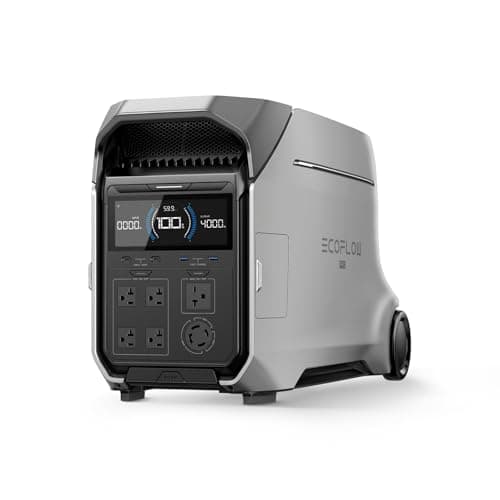
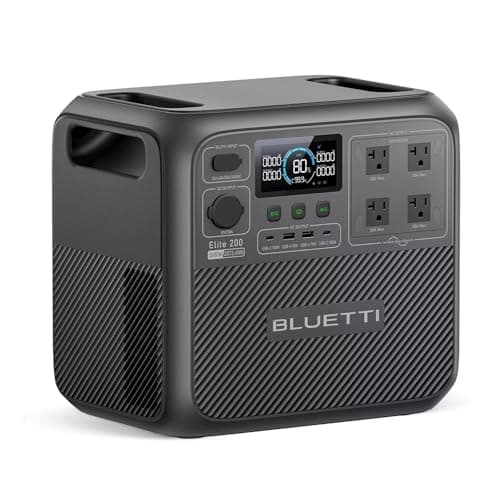
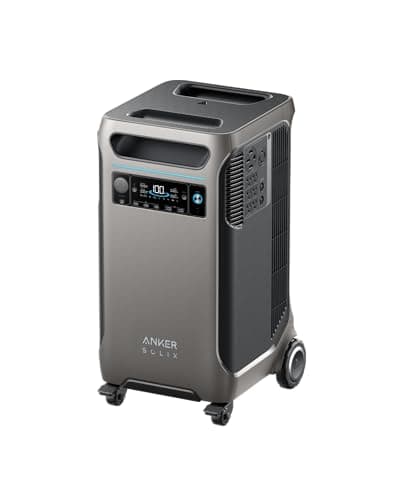
- Portability, if you choose it. A large portable battery charged from the wall does most of this job and can be taken to another property, sold, or repurposed.
- Solar later remains possible. Adding panels to an existing battery is a normal upgrade path for both installed systems and portables.
How to size it when there is nothing generating
With solar, sizing balances generation against consumption. Without it, the arithmetic is simpler and stricter: capacity divided by average draw equals hours, and that is all you get.
| What you want to run | Average draw | Capacity for 24 hours |
|---|
| Refrigerator, internet, lights, phones | ~220 W | About 6.2 kWh |
|---|
| Add a freezer | ~320 W | About 9 kWh |
|---|
| Add a gas furnace fan in winter | ~520 W | About 14.7 kWh |
|---|
| Add a well pump | ~720 W | About 20.3 kWh |
|---|
| Add central air in summer | ~4,000 W | About 113 kWh — not a battery problem |
|---|
Capacity needed is average draw x 24 hours, divided by 0.85 for inverter losses. Draw figures come from the appliance wattage chart; measure yours before spending on this scale.
That last row is the honest wall. Air conditioning through a multi-day outage is a generator problem or a solar-plus-storage problem, and no practical battery alone solves it.
The hybrid that most households should consider
Battery for the common case, generator for the rare one.
A 2 to 4kWh battery covers the overwhelming majority of outages silently, indoors, with no fuel and no starting procedure. A modest dual-fuel generator covers the once-every-few-years multi-day event, and it can recharge the battery too, which means the generator runs two hours at a time rather than continuously.
That pairing costs less than a whole-home installed battery, handles more situations, and needs no roof. The generator versus battery comparison weighs the two properly.
The short version
- A battery works fine without solar. Grid charging is supported on everything.
- What you lose is refilling during a long outage, and the daily economic case.
- Size on consumption alone: average watts x 24 / 0.85 for a day of backup.
- Check incentives locally — some are written for solar-plus-storage, some cover storage alone.
- A battery plus a small generator beats either one alone for most storm-prone households.