Skip to content
Watt Warden

Home Standby

The Best Generator Power Inlet Boxes (2026)

It is the cheapest item in a transfer switch installation and the one most likely to be the reason the whole thing does not work when you finally need it.

By Sawyer V.Updated Published How we work this out
An electrical outlet box being installed on a wall.

Watt & Warden earns a commission on qualifying purchases made through links on this page, at no extra cost to you. It never changes a ranking, and our picks include products we tell you to skip. Full disclosure.

Quick picks

#ProductBest forPrice
1
No photo

Best overall

Reliance Controls PB30 power inlet box

A NEMA 3R steel enclosure with an L14-30P inlet and a spring-loaded cap.

A 30A transfer switch, which is most houses
2
No photo

Best for a larger generator

Reliance Controls PB50

50A at 125/250V through a CS6375 inlet, rated to a 12.5 kW generator.

Machines past the 30A ceiling
3
No photo

Best enclosure

Generac 6347

A 50A aluminum box with a spring-loaded cover, built for outdoor mounting.

A coastal or exposed wall
4
No photo

The part that connects it

GearIT 30A L14-30 generator cord, 25 ft

10/4 SJTW twist-lock, L14-30P to L14-30R, rated 30A at 125/250V.

25 feet between the generator and the wall

Prices come from the retailer at page-build time and change constantly. Where no live price is available the button reads “Check price” rather than showing a number we cannot stand behind.

What an inlet box is for

It is a permanently mounted, weatherproof socket on the outside of the house that the generator plugs into. On the inside, it is wired to the transfer switch.

Without one, the connection between a generator and a transfer switch runs through a window or a door — which means an opening you cannot close, in the weather that caused the outage, with a live cord through it.

Its marginal cost as part of a transfer switch installation is small, because the electrician is already there and the run is already being made. The installation cost page sets out where it falls in the total.

Three specifications, and one of them is the whole decision

SpecificationWhat it decides
Amperage — 30A or 50AMust match the transfer switch and the generator's outlet. Getting this wrong makes the whole chain unusable
Connector — L14-30P or CS6375Determines which cord fits. These are different standards, not variants of one
Enclosure rating — NEMA 3R minimumWhether it survives the weather. 3R is rain-rated; anything less does not belong outdoors
Cover designWhether it is still dry after five idle years. This is the part that actually fails

The amperage decision is not really a decision at all — it follows from the transfer switch, which follows from the generator. All three have to be the same number.

The failure mode is water, not electricity

An inlet box does nothing for years. Then, on the worst night of the year, someone needs it to work.

What has usually gone wrong by then is not electrical. It is that the spring cover lost its tension or its gasket, water got in, and the contacts corroded — or worse, the box filled and froze.

So the cover is the part to evaluate. A spring-loaded cap that closes firmly over the inlet when unused is doing the real work, and a stiff one is a good sign rather than an annoyance.

The maintenance is trivial and almost nobody does it: open the cover twice a year, look inside, and confirm it snaps shut. Add it to the routine on the maintenance schedule page.

Where it should go

Three considerations, and they pull against each other.

Close to the panel keeps the internal cable run short, which is where the installation cost lives.

Away from windows, doors and vents, because the generator will sit near the box and its exhaust must not reach an opening. The CO safety page is the constraint that should win any argument here.

Somewhere you can reach in a storm — not behind a gate that ices shut, not down the side passage that floods, and ideally not on the windward wall.

What it does not do

An inlet box is not a transfer switch and provides no safety function on its own. It is a weatherproof connection point, nothing more.

The thing that makes backfeeding impossible — and therefore the thing that keeps a lineworker safe — is the break-before-make switching in the transfer switch or the interlock. The transfer switch page covers that side, and the interlock comparison covers the alternative.

Fitting an inlet box without one of those is not a shortcut. It is illegal everywhere in the United States and it is the specific hazard the rules exist to prevent.

The short version

  • Match all three: generator outlet, cord, inlet, switch. One number throughout.
  • NEMA 3R minimum. It lives outdoors and does nothing for years.
  • Judge the cover, not the metal. Water is the failure mode.
  • It is not a safety device. The transfer switch is.
The picks in full

01Best overall

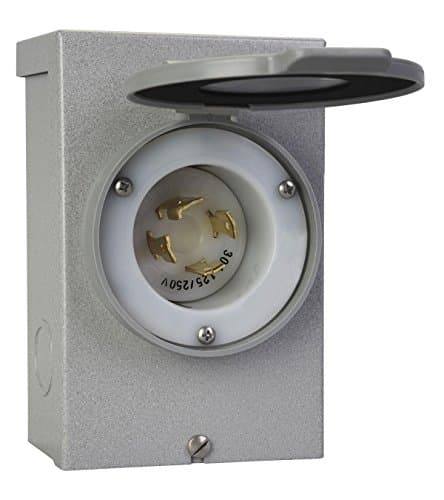
Reliance Controls PB30 power inlet box

A NEMA 3R steel enclosure with an L14-30P inlet and a spring-loaded cap.

30A is the standard residential generator connection, and this is the standard box for it. An L14-30 inlet matches the L14-30R outlet on essentially every house-backup generator sold.

NEMA 3R means genuinely rain-rated rather than merely outdoor-looking, which is the rating to insist on. It is going on an exterior wall and it will spend years doing nothing in the weather.

The honest catch: 30A caps you at 7,500W. If you already own a 9,500W machine, this box throws away two thousand watts.

Skip it ifyour generator produces more than 7,500W and you want all of it.

Published specifications for the Reliance Controls PB30 power inlet box
SpecificationPublished figure
Rating30 A, for generators up to 7,500 running watts
InletNEMA L14-30P
EnclosureNEMA 3R, outdoor watertight
ConstructionSteel with anti-corrosive powder coat
CapSpring-loaded, keeps moisture out when not in use
WiringFour combination 1/2 in and 3/4 in knockouts

Source: Reliance Controls — PB30 power inlet box product page. These are the manufacturer's published figures, not ours — we have not tested this unit.

02Best for a larger generator

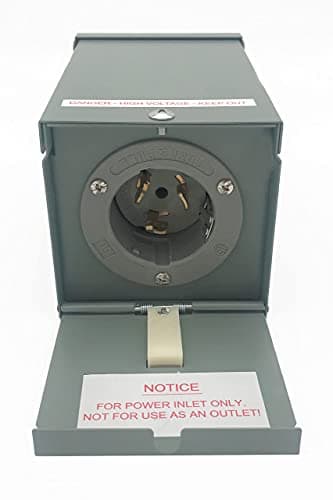
Reliance Controls PB50

50A at 125/250V through a CS6375 inlet, rated to a 12.5 kW generator.

The right box for a 9,500W or larger machine, and the point at which the whole chain has to be sized together: a 50A box behind a 30A switch buys nothing.

The CS6375 connector is a different standard from the L14-30, so check what your generator actually publishes before ordering. The inlet box explainer covers the connector families.

The honest catch: 50A cable is thick, heavy and expensive, and a 50A installation costs more at every stage. Only go here if the generator justifies it.

Skip it ifyour transfer switch is 30A. The box is not the bottleneck then.

Published specifications for the Reliance Controls PB50
SpecificationPublished figure
Rating50 A at 125/250 VAC
InletCS6375 recessed inlet
EnclosureNEMA 3R, with a spring-loaded weatherproof cover
Generator ceilingUp to 12.5 kW
Dimensions6 x 4 x 2.63 in
KnockoutsFour combination 1/2 in and 3/4 in

Source: Reliance Controls — PB50 power inlet box. These are the manufacturer's published figures, not ours — we have not tested this unit.

03Best enclosure

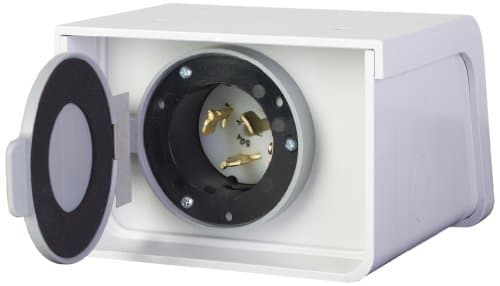
Generac 6347

A 50A aluminum box with a spring-loaded cover, built for outdoor mounting.

Aluminum does not rust, and that matters more than it sounds for a fitting that sits on a wall untouched for years at a time.

Salt air, driving rain and freeze-thaw cycles are what actually kill an inlet box, and they kill it long before anything electrical fails. Spending a little more here is spending it on the failure mode that occurs.

The honest catch: on a sheltered wall in a dry climate, a steel NEMA 3R box will do the same job for less.

Skip it ifthe box will be under a deep eave. Then steel is fine and cheaper.

Published specifications for the Generac 6347
SpecificationPublished figure
Rating50 A at 125/250 V
EnclosureAluminum, weather-resistant for outdoor mounting
CoverSpring-loaded, closes over the inlet when unused
UsePermanent exterior generator connection point

Source: Generac — 6347 50-amp aluminum power inlet box listing. These are the manufacturer's published figures, not ours — we have not tested this unit.

04The part that connects it

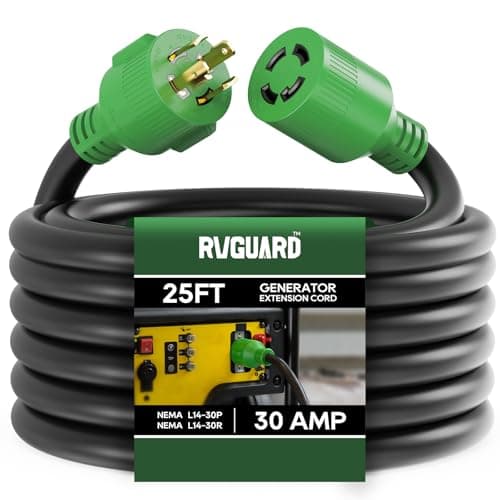
GearIT 30A L14-30 generator cord, 25 ft

10/4 SJTW twist-lock, L14-30P to L14-30R, rated 30A at 125/250V.

An inlet box with no cord is a hole in a wall. The cord is the part that has to be right, because it is the part carrying full current across wet ground.

Twenty-five feet is the useful length: it clears the twenty-foot carbon monoxide distance with enough slack to position the machine sensibly. The cord page covers gauge and length in detail.

The honest catch: buy one longer cord rather than joining two. Every joint is a potential warm spot in the rain.

Skip it ifyour inlet is 50A. Then the cord has to match that standard instead.

Published specifications for the GearIT 30A L14-30 generator cord, 25 ft
SpecificationPublished figure
ConnectorsNEMA L14-30P to L14-30R, 4-prong twist lock
Conductor10/4 SJTW copper
Rating30 A, 125/250 V, up to 7,500 W
Length25 ft
JacketOutdoor-rated SJTW, UV and oil resistant

Source: GearIT — 30A L14-30 generator cord listing. These are the manufacturer's published figures, not ours — we have not tested this unit.

How these were chosen

We did not test these. Nobody at Watt & Warden has plugged one in. What we did instead: read the manufacturer's published specifications, compile them into a table where the figures line up, and compute the numbers manufacturers leave out — runtime against a real appliance load, and what an hour of running actually costs.

Anything that could not be sourced was left out rather than estimated, and every pick names the buyer who should skip it. The full method is here, including where it is weaker than a publisher with a test bench.

Questions people actually ask

What is a generator power inlet box?

A weatherproof socket mounted permanently on the outside of the house, wired on the inside to a transfer switch. The generator plugs into it with a heavy cord, so nothing runs through a window or a partly open door during the weather that caused the outage.

Do I need an inlet box with a transfer switch?

Not strictly -- some switch kits ship with a pigtail cable instead -- but that means a cable passing through an opening in the house. An inlet box is a small marginal cost at installation, because the electrician is already there and the cable run is already being made.

What size inlet box do I need, 30A or 50A?

It follows from the transfer switch and the generator, and all three must match. 30A with an L14-30 connector is the residential standard and caps the feed at 7,500W. 50A with a CS6375 connector suits generators past that, but only if the switch is also 50A -- otherwise the box is not the bottleneck.

What makes one inlet box better than another?

The cover, more than the metal or the brand. These boxes sit untouched for years and the thing that actually fails is water getting past a tired spring cap and corroding the contacts. A firm spring-loaded cover and a NEMA 3R or better enclosure are what you are paying for.

Is an inlet box a safety device?

No. It is a weatherproof connection point and provides no protection against backfeeding on its own. The safety function comes from the break-before-make switching in a transfer switch or an interlock kit, which is what makes it mechanically impossible to energize the utility line.

Sources

Every figure on this page comes from a published source. We have not tested this equipment, so the specifications are the manufacturer's and the statistics are the dataset's — the arithmetic on top of them is ours, and it is shown in full so you can check it. How we work this out.