How this review was done
We have not run this generator. No bench, no fuel logging, no decibel meter — and our methodology page says so. What follows is Westinghouse's published specifications, the published figures for its rivals, and arithmetic shown in full.
One deliberate omission: Westinghouse publishes the gasoline output figures quoted here. Every dual-fuel machine produces less on propane than on gasoline, so if propane is your plan, read the rating plate on the unit rather than the headline number. The dual-fuel roundup explains the derate.
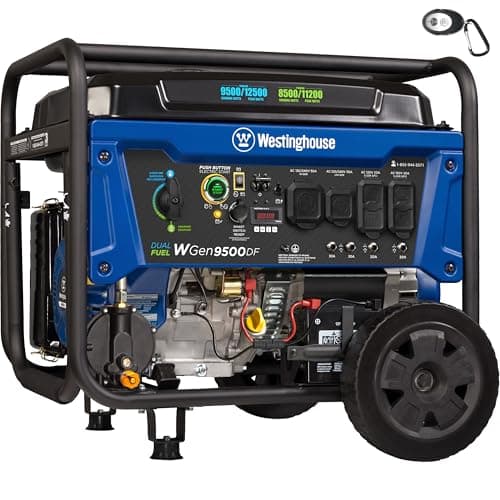
What 9,500 running watts is for
Generator sizing is not about the house. It is about the list of things you refuse to lose, and most households' lists are smaller than they assume until an air conditioner or an electric range joins them.
| Load | Running watts | Starting surge |
|---|
| Refrigerator | 150 W | 600-1,200 W |
|---|
| Chest freezer | 100 W | 500-1,000 W |
|---|
| Gas furnace blower | 300-600 W | 1,200-2,400 W |
|---|
| 1/2 hp well pump | 1,000 W | 2,000-3,000 W |
|---|
| Sump pump | 800 W | 1,300-2,900 W |
|---|
| Central air, 3 ton | 3,500 W | Up to 12,000 W without a soft starter |
|---|
| Lights, internet, chargers | 300 W | Negligible |
|---|
These are the planning ranges used across this site — the appliance wattage chart lists the sources, and starting watts vs running watts explains why the second column is the one that sizes the machine.
Add the first five rows and you land near 2,350 running watts, which a 5,000W machine covers with the surge headroom to start them one at a time. Add central air and the picture changes completely: a 3-ton compressor can ask for up to 12,000W at the instant it starts, unless a soft starter is fitted.
That is the honest case for 9,500 running watts. It is not that your house needs it — it is that a compressor start needs the headroom, and a machine sized for average draw will trip when the air conditioner kicks in.
The outlets are the real feature
Two connectors matter on a machine this size, and this one has both.
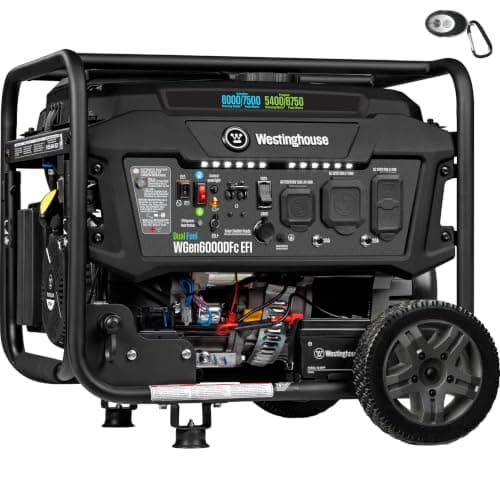
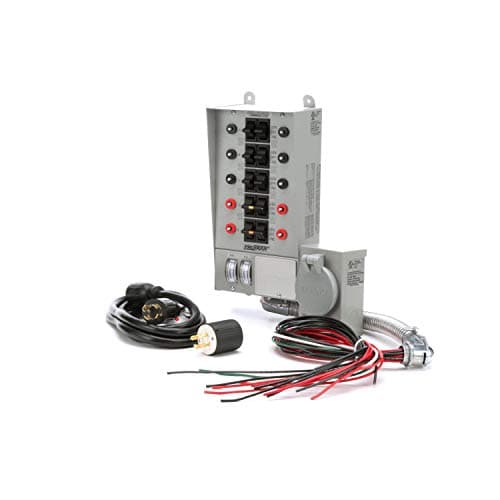
L14-30R, 120/240V, 30A. The transfer-switch outlet. One cord from the generator to an inlet box feeds a ten-circuit switch, and that switch is what makes the machine safe and legal to connect.
14-50R, 120/240V, 50A. The RV outlet, and also the connector for a 50A inlet where a household wants more than 30A of capacity.
Remote electric start with a key fob is the third practical detail, and the one you will appreciate at 2am in the rain.
Fuel, and what it costs to run
The published run time is up to 12 hours from a 6.6-gallon tank. Like every such figure it assumes a partial load — a generator at half load burns far less than one at full.
| Outage | Refuels | What that means in practice |
|---|
| 12 hours | 1 tank | No overnight refuel if you start it full |
|---|
| 3 days | About 6 tanks | ~40 gallons stored, rotated and stabilized |
|---|
| A week | About 14 tanks | Propane starts to look sensible |
|---|
Tank counts assume the published 12-hour figure holds, which depends on load. Storing that much gasoline safely is its own problem — the fuel storage guide covers stabilizer, rotation and containers.
This is where the dual-fuel capability earns its place. Propane does not go stale, stores for years in a cylinder and runs cleaner through the carburetor. Output is lower on propane, but a machine with 9,500W of gasoline headroom has room to give some back.
Who should buy it
- Houses with central air conditioning that intend to run it during an outage.
- Houses with a well pump plus a big list. Pumps are surge-hungry and headroom prevents nuisance trips.
- Anyone connecting through a transfer switch who wants both 30A and 50A options.
- Long-outage households that want propane as the storage fuel.
Who should skip it
- The refrigerator-furnace-internet household. That is a 5,000W machine and a quieter life — see the 5,000W roundup.
- Anyone in a noise-sensitive neighborhood. Open-frame machines this size are loud; inverter machines are the alternative.
- Anyone who cannot store the fuel. Six tanks for a three-day outage is a real logistics problem.
The short version
- 9,500 running / 12,500 peak watts on gasoline, dual fuel, 457cc.
- L14-30R and 14-50R outlets — the reason to buy it over a smaller machine.
- Up to 12 hours per 6.6-gallon tank, load dependent.
- Buy it for air conditioning or a pump-heavy house. Otherwise 5,000 to 7,500W is the honest size.