Skip to content
Watt Warden

Generators

How to Store Generator Fuel

The quantity is larger than people expect and the shelf life is shorter. Both facts point the same way: toward propane for the bulk of it.

By Sawyer V.Updated Published How we work this out
Red fuel cans stored in a garage.

Watt & Warden earns a commission on qualifying purchases made through links on this page, at no extra cost to you. It never changes a ranking, and our picks include products we tell you to skip. Full disclosure.

How much you actually need

Start with the quantity, because it decides everything else. A mid-sized generator consumes roughly 0.75 gallons an hour at half load. Run continuously, that is 18 gallons a day — which is almost four full five-gallon cans.

Running patternPer dayOver 3 daysFive-gallon cans
Continuous18 gal54 gal11 cans
12 hours a day9 gal27 gal6 cans
6 hours a day (blocks)4.5 gal13.5 gal3 cans
4 hours a day (fridge only)3 gal9 gal2 cans

Computed at 0.75 gal/hr, a working figure for a mid-sized generator at half load. Your machine's manual publishes its own consumption — use that number in preference to ours.

Eleven cans is not a plan. It is not legal to store in most garages, it is a serious fire load, and it costs about $220 at the EIA's reported $4.071 a gallon for the week ending 31 August 2026.

Which is why block running is the realistic strategy. Six hours a day keeps a fridge and freezer perfectly safe — FoodSafety.gov puts a sealed fridge at about four hours and a full freezer at about 48 — and needs three cans rather than eleven. The full fuel arithmetic is here.

How long gasoline actually keeps

Less time than people assume, and the ethanol in modern pump gasoline is why. Gasoline oxidizes and forms gums; ethanol absorbs water from the air and eventually separates out, leaving a layer of water and ethanol at the bottom of the tank that an engine cannot run on.

  • Untreated in a sealed can: roughly three to six months before starting problems appear.
  • Treated with a fuel stabilizer: commonly rated to around 12 to 24 months. Follow the stabilizer's own instructions — products differ and the manufacturer's figure is the one that counts.
  • Ethanol-free gasoline: keeps considerably longer, and is worth seeking out for equipment that sits. Sold at marinas and some stations.
  • Left in the carburetor: the real killer. Fuel that evaporates in a carburetor leaves varnish that blocks jets, and this is the reason most stored generators will not start.

Which produces one practical rule: rotate it. Put stored gasoline in your car every six months and refill the cans. It costs nothing, since you were going to buy the fuel anyway, and it means the cans always hold fuel that works.

Why propane changes the arithmetic

Propane does not degrade. A 20 lb cylinder bought today will run a generator in ten years exactly as well as it does now. It does not oxidize, it does not absorb water, and it leaves no varnish in a carburetor — which is why dual-fuel generators stored on propane start far more reliably than ones stored on gasoline.

It is also the fuel you can get during a regional outage. Gas station pumps are electric and stop working with the grid; propane exchange cages and pallets do not need power.

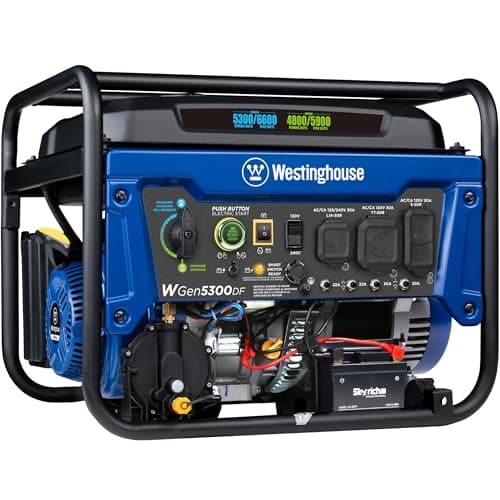
The costs are real. Propane carries roughly 10–15% less energy per unit for generator purposes, so rated output drops accordingly — Westinghouse publishes 4,800 running watts on propane against 5,300 on gasoline for the WGen5300DF. And a 20 lb cylinder holds about 4.6 gallons, so a three-day block-running plan needs three cylinders.

One buying note: refill rather than exchange where you can. Exchange cylinders are typically filled to about 15 lb rather than 20, and the price per gallon is substantially higher than the EIA's residential propane figure of $2.674 a gallon for the week ending 30 March 2026, which reflects bulk delivery.

Storing it safely

  • Approved containers only. Red, marked for gasoline, with a proper seal. Not a water jug, not an old milk container.
  • Never in the house or a basement. Gasoline vapor is heavier than air, settles at floor level, and finds ignition sources — a water heater pilot, a furnace, a light switch.
  • A detached shed or the far side of a garage, away from any appliance with a pilot light or an electric motor.
  • Check your local limits. Fire codes cap how much gasoline may be stored in a residential garage, and the limit is usually far below eleven cans. Your local fire authority publishes it.
  • Propane cylinders outdoors, upright, always. Never in a garage, never in a basement, never on their side. Shaded, on a level surface, away from ignition sources.
  • Off the ground and out of direct sun. Heat cycling drives expansion and contraction, which stresses seals on both fuel types.

The maintenance nobody does

The most common generator failure is not running out of fuel. It is a machine that will not start because it sat for a year with stale gasoline in the carburetor.

Twice a year — spring and fall — start the generator, let it run under some load for fifteen minutes, and check the oil. Rotate the stored fuel while you are there. That is the entire schedule, and it is the difference between equipment and an ornament.

If the machine will sit for months, either run the carburetor dry by shutting the fuel valve and letting it stall, or store it on propane. On a dual-fuel machine the second option is free and it is the main reason to buy one.

Quick picks

#ProductBest forPrice
1
No photo

The dual-fuel answer to the storage problem

Westinghouse WGen5300DF

5,300 running watts on either fuel, and propane keeps for years where gasoline does not.

Anyone who cannot store 50 gallons of gasoline
2
No photo

When the load justifies more fuel

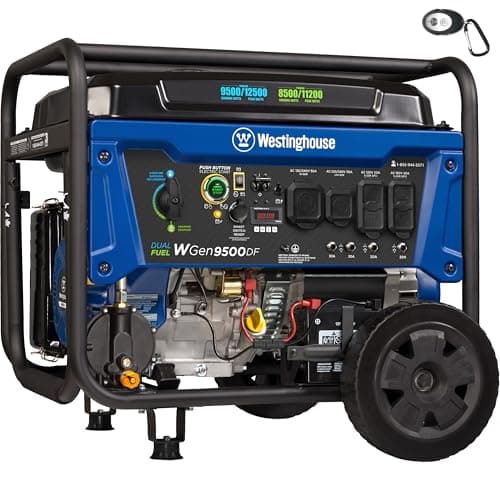
Westinghouse WGen9500DF

9,500 running watts on gasoline, with the same propane flexibility.

Larger critical loads, dual fuel

Prices come from the retailer at page-build time and change constantly. Where no live price is available the button reads “Check price” rather than showing a number we cannot stand behind.

The picks in full

01The dual-fuel answer to the storage problem

Westinghouse WGen5300DF

5,300 running watts on either fuel, and propane keeps for years where gasoline does not.

The storage problem is really a gasoline problem. Gasoline degrades in months, cannot be kept in useful quantities in a garage, and becomes unobtainable in a regional outage when station pumps have no power.

Propane solves all three at the cost of about 10% of rated output — 4,800 running watts against 5,300 on this machine. That is a good trade for fuel that keeps indefinitely and is sold from unpowered exchange cages.

Skip it ifyou have bulk gasoline storage and rotate it. Then dual fuel is a convenience rather than a solution.

Published specifications for the Westinghouse WGen5300DF
SpecificationPublished figure
Output (gasoline)5,300 running W / 6,600 peak W
Output (propane)4,800 running W / 5,900 peak W
Engine274cc 4-stroke OHV
Tank4.7 gal (18 L)
Run timeup to 14.5 h on a full tank
Transfer-switch outlet120/240 V L14-30R, 30 A
RV outlet120 V TT-30R, 30 A
StartingPush-button electric with remote key fob

Source: Westinghouse — WGen5300DF product specifications. These are the manufacturer's published figures, not ours — we have not tested this unit.

02When the load justifies more fuel

Westinghouse WGen9500DF

9,500 running watts on gasoline, with the same propane flexibility.

Size and fuel storage are directly linked, and it is the argument against over-buying. A 457cc engine consumes more per hour than a 274cc one whatever the load, so a machine bought as insurance costs you fuel logistics every day you run it.

Buy this because you genuinely need 9,500 watts — a well pump, window air conditioning, a large critical load — not as headroom.

Skip it ifyour critical load is under 3,000W. A larger engine burns more fuel to do the same job, which makes the storage problem worse.

Published specifications for the Westinghouse WGen9500DF
SpecificationPublished figure
Output (gasoline)9,500 running W / 12,500 peak W
FuelGasoline or propane (dual fuel)
Engine457cc 4-stroke OHV, cast iron sleeve
Tank6.6 gal (25 L)
Run timeup to 12 h on a full tank
Transfer-switch outlet120/240 V L14-30R, 30 A
RV outlet120/240 V 14-50R, 50 A
StartingPush-button electric with remote key fob
Warranty3-year limited

Source: Westinghouse — WGen9500DF product specifications. These are the manufacturer's published figures, not ours — we have not tested this unit.

How these were chosen

We did not test these. Nobody at Watt & Warden has plugged one in. What we did instead: read the manufacturer's published specifications, compile them into a table where the figures line up, and compute the numbers manufacturers leave out — runtime against a real appliance load, and what an hour of running actually costs.

Anything that could not be sourced was left out rather than estimated, and every pick names the buyer who should skip it. The full method is here, including where it is weaker than a publisher with a test bench.

Questions people actually ask

How long does gasoline last in a can?

Roughly three to six months untreated, and commonly 12 to 24 months with a stabilizer -- follow the stabilizer's own rating. Ethanol-free gasoline keeps considerably longer. The most reliable approach is to rotate: put stored fuel in your car every six months and refill the cans.

How much fuel do I need for a 3-day power outage?

Running continuously at 0.75 gallons an hour, about 54 gallons -- eleven five-gallon cans, which is more than most garages may legally hold. Running six-hour blocks, which keeps a fridge and freezer safe, about 13.5 gallons or three cans.

Is it safe to store gasoline in a garage?

In small quantities, in approved containers, away from anything with a pilot light or an electric motor. Fire codes cap the amount and the limit is usually well below what three days of continuous running would need -- check with your local fire authority.

Does propane go bad?

No. Propane does not oxidize or absorb water, so a cylinder bought today will run a generator in ten years exactly as well as now. That, plus availability when gas station pumps have no power, is the main argument for a dual-fuel machine.

Should I exchange or refill propane cylinders?

Refill where you can. Exchange cylinders are typically filled to about 15 lb rather than 20, and the effective price per gallon is substantially higher. Exchange is for convenience; refilling is for value.

Sources

Every figure on this page comes from a published source. We have not tested this equipment, so the specifications are the manufacturer's and the statistics are the dataset's — the arithmetic on top of them is ours, and it is shown in full so you can check it. How we work this out.