Skip to content
Watt Warden

Power Stations

The Best Power Stations for an RV (2026)

An RV day without air conditioning is roughly 1,000 to 1,400Wh - well inside a mid-sized battery. The roof unit is a different universe, and pretending otherwise is how people waste money.

By Sawyer V.Updated Published How we work this out
The interior of an RV lit warmly at night.

Watt & Warden earns a commission on qualifying purchases made through links on this page, at no extra cost to you. It never changes a ranking, and our picks include products we tell you to skip. Full disclosure.

Quick picks

#ProductBest forPrice
1
No photo

Best all-round RV battery

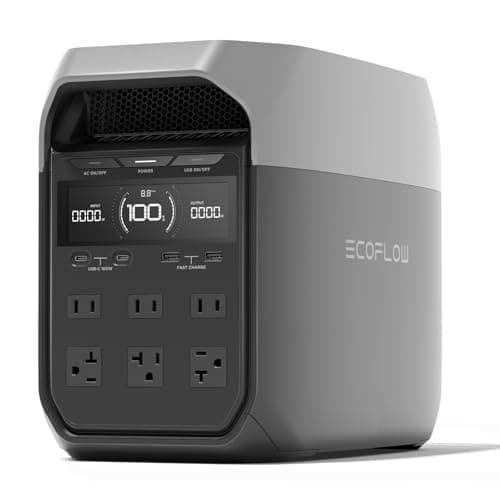
EcoFlow DELTA 2

1,024Wh and 1,800W with 500W of solar input and expansion to 3kWh.

A day of boondocking, expandable
2
No photo

Best for longer trips

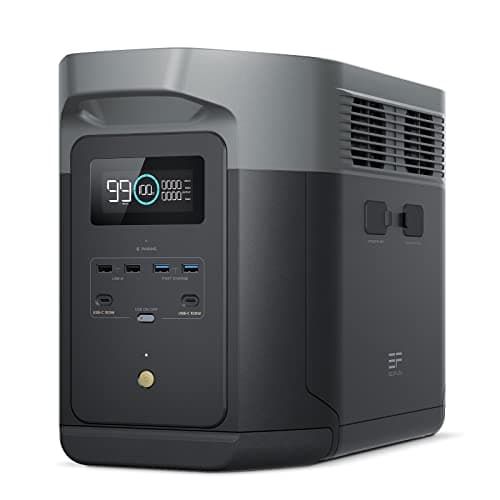
EcoFlow DELTA 2 Max

2,048Wh and 2,400W, expandable to 6,144Wh, with a 43-minute recharge to 80%.

Several days off-grid
3
No photo

What makes it sustainable

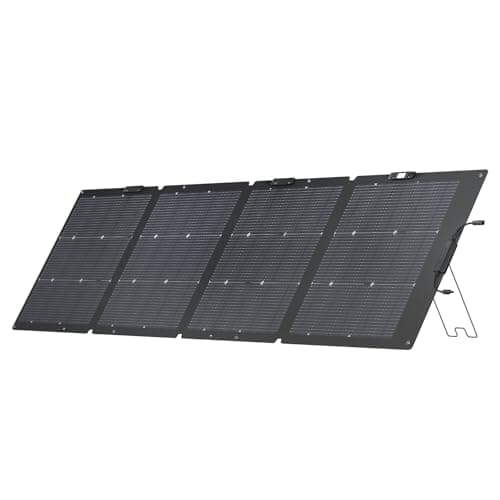
EcoFlow 220W Bifacial Solar Panel

220W front and 155W rear bifacial, IP68, 20.9 lb, with an adjustable stand.

Turning a fixed battery into a daily allowance
4
No photo

For campgrounds with limits

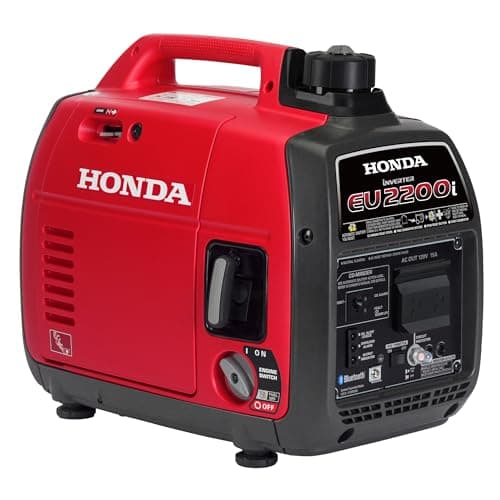
Honda EU2200i

2,200W at a published 48–57 dB(A), 47.4 lb, and 8.1 hours on 0.95 gallons.

Where a generator is allowed but noise is capped

Prices come from the retailer at page-build time and change constantly. Where no live price is available the button reads “Check price” rather than showing a number we cannot stand behind.

What an RV day actually costs

Much less than people expect, as long as the roof unit stays off.

LoadTypical drawPer day
12V compressor fridge40–60 W cycling~400 Wh
LED lighting30–60 W~200 Wh
Water pump50–100 W intermittent~50 Wh
Laptop and devices45–90 W~350 Wh
Fan overnight20–40 W~250 Wh
Roof AC, 13,500 BTU1,200–1,700 W running, 3,000–3,500 W startingThousands of Wh

Rows other than the air conditioner are working estimates from typical equipment ratings and duty cycles rather than measurements. The marked row is the one that changes the purchase entirely, and its starting figure is the industry-standard sizing basis for RV generators.

Everything above the marked row totals roughly 1,000–1,400Wh. A 1,024Wh battery covers most of that and a 2,048Wh one covers two days.

The air conditioner is a different purchase

A 13,500 BTU roof unit typically needs 3,000–3,500 starting watts. That exceeds the inverter rating of every portable battery in this class, and even if it started, its 1,200–1,700W running draw would empty a 2,000Wh station in about an hour.

The honest options are:

  • Shore power. The simplest answer, and free at most sites.
  • A 3,500W-class inverter generator. The conventional RV solution, and why that size exists.
  • Two small inverter generators in parallel. Quieter and easier to carry than one large machine.
  • A soft-start device on the air conditioner. Reduces the starting surge substantially and can bring it inside what a smaller generator handles. Fitted to the AC, not to the battery.

What is not an option is a bigger folding panel. Solar refills a battery over a day; it does not carry an air conditioner in real time.

Battery versus RV generator

Power stationInverter generator
Campground rulesPermitted everywhere, any hourOften restricted to set hours, sometimes banned
NoiseAround 30 dB under load48 dB(A) at best, usually more
Fuel in the vehicleNoneGasoline or propane, stored and rotated
Can be used insideYesNever
Roof air conditionerNoYes, at 3,500W class
Multiple overcast daysLimited by capacityLimited only by fuel

The 30 dB and 48 dB(A) figures are manufacturers' published numbers under their own test conditions. Because decibels are logarithmic, that gap is much larger than it looks.

Solar sizing for an RV

For a daily use of roughly 1,000–1,400Wh, a rough rule gets you close: a panel rated at about a third of your daily watt-hours will keep pace in good summer conditions.

Which lands around 400W of panel — two 200W folding panels, or one 220W panel accepting that you will draw the battery down slowly across a stretch of poor weather.

Check your station's maximum solar input in both watts and volts before buying panels. The full solar arithmetic and the connector guide cover the details.

The arrangement that works

A mid-sized battery inside the vehicle, one or two folding panels, and a small inverter generator only if you genuinely need air conditioning or travel in the shoulder season.

That combination is legal at more sites, silent overnight, produces no exhaust in a small sealed space, and gives you a unit that is also a capable home backup battery for the eleven months a year you are not travelling.

The camping and RV scenario page works through the tiers by budget.
The picks in full

01Best all-round RV battery

EcoFlow DELTA 2

1,024Wh and 1,800W with 500W of solar input and expansion to 3kWh.

1,024Wh covers a full day of everything an RV does except air conditioning — 12V fridge, lighting, water pump, devices, a laptop — with room left over.

500W of solar input is what makes it sustainable rather than finite. At that input a single good day of sun replaces most of a day of use, which is the whole point of boondocking equipment.

Expandable to 3kWh, so a first purchase does not become the wrong purchase when trips get longer.

Skip it ifyour trips are weekends with hookups. Then shore power does this for nothing.

Published specifications for the EcoFlow DELTA 2
SpecificationPublished figure
Usable capacity1,024 Wh (expandable to 3 kWh)
Cell chemistryLiFePO4 (LFP)
AC output1,800 W continuous / 2,700 W surge
X-Boost output2,200 W for resistive loads
Weight27 lb
Cycle life3,000+ cycles
Max solar input500 W
Warranty5 years

Source: EcoFlow — DELTA 2 product specifications. These are the manufacturer's published figures, not ours — we have not tested this unit.

02Best for longer trips

EcoFlow DELTA 2 Max

2,048Wh and 2,400W, expandable to 6,144Wh, with a 43-minute recharge to 80%.

Two days of ordinary use unaided, or indefinite with a couple of panels. This is the size at which the battery stops being the constraint on where you park.

The 43-minute 0–80% recharge earns its keep on the road: a short stop somewhere with shore power or a generator refills most of it.

2,400W of output also covers a microwave or an induction hob — the two loads people most often discover they cannot run.

Skip it ifyou are buying it to run a roof air conditioner. It will not carry that load for a useful time.

Published specifications for the EcoFlow DELTA 2 Max
SpecificationPublished figure
Capacity2,048 Wh, expandable to 6,144 Wh
Output2,400 W continuous
ChemistryLiFePO4, 3,000+ cycles to 80%
AC recharge0–80% in 43 minutes
Solar inputup to 1,000 W
Outlets15 total
Noiseas low as 30 dB

Source: EcoFlow — DELTA 2 Max published specifications. These are the manufacturer's published figures, not ours — we have not tested this unit.

03What makes it sustainable

EcoFlow 220W Bifacial Solar Panel

220W front and 155W rear bifacial, IP68, 20.9 lb, with an adjustable stand.

The bifacial rear face collects light reflected off whatever is underneath. Sand, gravel and concrete contribute usefully; grass and dark asphalt very little.

One 220W panel realistically returns something in the region of 900–1,100Wh across a good summer day, which covers most of a typical day's use. Two panels comfortably keep pace with margin for cloud.

The carry case doubling as an adjustable stand matters more than it sounds — angle is one of the biggest levers on real output.

Skip it ifyou move every day. A panel needs to be set out, aimed and collected.

Published specifications for the EcoFlow 220W Bifacial Solar Panel
SpecificationPublished figure
Rated output220 W front, 155 W rear (bifacial)
Cell typeN-type monocrystalline
Conversion efficiencyUp to 25%
Ingress ratingIP68
Weight20.9 lb (9.5 kg)
ConstructionOne-piece tempered glass
StandCarry case doubles as an adjustable kickstand

Source: EcoFlow — 220W Bifacial Solar Panel published specifications. These are the manufacturer's published figures, not ours — we have not tested this unit.

04For campgrounds with limits

Honda EU2200i

2,200W at a published 48–57 dB(A), 47.4 lb, and 8.1 hours on 0.95 gallons.

Where a site permits generators but caps decibels, this is the machine the rules were effectively written around, and 0.117 gallons an hour makes a week's fuel a small thing to carry.

Two in parallel will start a roof air conditioner, which is the standard way people solve that problem without carrying one large machine.

Skip it ifyou need to start a 13,500 BTU roof air conditioner. 1,800W rated will not do it alone.

Published specifications for the Honda EU2200i
SpecificationPublished figure
Output2,200 W max / 1,800 W rated
TypeInverter (pure sine wave)
Noise48–57 dB(A)
Weight47.4 lb
Tank0.95 gal
Run timeup to 8.1 h on a full tank
FeaturesEco Throttle, CO-Minder, Bluetooth app monitoring

Source: Honda Power Equipment — EU2200i specifications. These are the manufacturer's published figures, not ours — we have not tested this unit.

How these were chosen

We did not test these. Nobody at Watt & Warden has plugged one in. What we did instead: read the manufacturer's published specifications, compile them into a table where the figures line up, and compute the numbers manufacturers leave out — runtime against a real appliance load, and what an hour of running actually costs.

Anything that could not be sourced was left out rather than estimated, and every pick names the buyer who should skip it. The full method is here, including where it is weaker than a publisher with a test bench.

Questions people actually ask

Can a power station run an RV air conditioner?

Not realistically. A 13,500 BTU roof unit typically needs 3,000-3,500 starting watts, which exceeds every portable battery inverter here, and its 1,200-1,700W running draw would empty a 2,000Wh station in about an hour. That is a generator, shore power, or a soft-start device.

What size power station do I need for an RV?

Without air conditioning, an RV day is roughly 1,000-1,400Wh -- a 1,000Wh station covers most of a day and a 2,000Wh one covers two. Add solar if you want that to be sustainable rather than finite.

How much solar do I need for RV boondocking?

One 220W folding panel realistically returns something in the region of 900-1,100Wh across a good summer day, which covers most of a typical day's use. Two panels comfortably keep pace and give margin for cloud. Check your station's maximum solar input first.

Is a power station or a generator better for an RV?

A battery for everything except air conditioning and long overcast stretches. It is permitted at sites that restrict generators, silent, produces no exhaust in a small sealed space, and doubles as home backup. A generator is what you add when the roof unit has to run.

Can I use a power station inside my RV?

Yes -- that is one of the main reasons to own one. There is no combustion and no exhaust, so it can sit inside the vehicle while you sleep, which is never true of a generator regardless of how it is vented.

Sources

Every figure on this page comes from a published source. We have not tested this equipment, so the specifications are the manufacturer's and the statistics are the dataset's — the arithmetic on top of them is ours, and it is shown in full so you can check it. How we work this out.