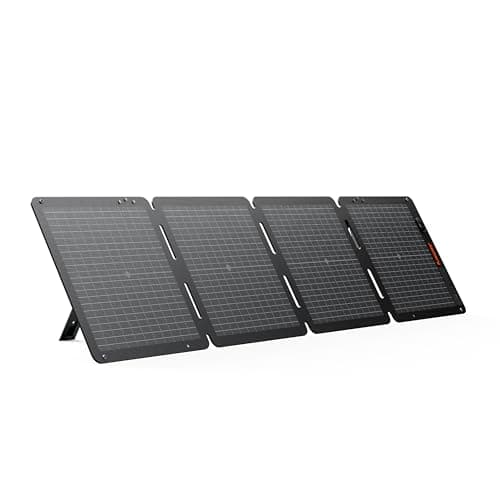
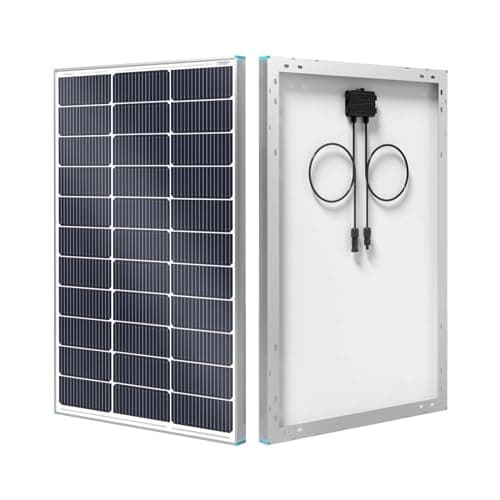
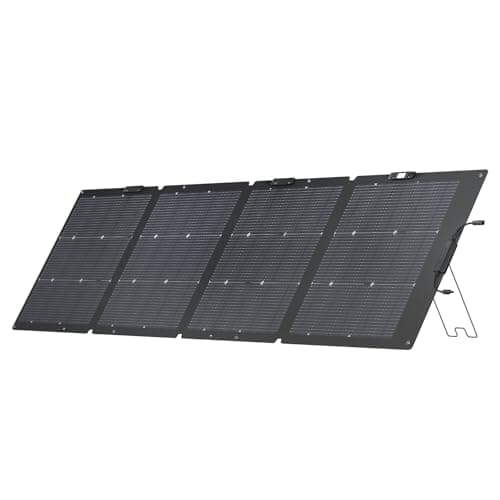
What bifacial actually means
A conventional panel has an opaque backsheet. Light that misses the cells or passes between them is absorbed and lost.
A bifacial panel has a transparent rear — usually glass — and cells that can generate from light arriving on either face. Light reflected up from the surface beneath the panel reaches the back of the cells and adds to the output.
The construction requirement follows: bifacial panels are generally glass-on-glass rather than glass-on-backsheet, which is why they tend to be heavier and more rigid than an equivalent conventional panel.
The rear rating is conditional
EcoFlow rates its 220W panel at 220W front and 155W rear. Read carefully: that is not 375W. It is 220W plus whatever proportion of 155W the surface behind the panel actually delivers.
And that proportion is entirely down to what is underneath:
| Surface under the panel | Rear-face contribution |
|---|
| Fresh snow | Best case — highly reflective |
|---|
| Light sand or gravel | Good |
|---|
| Light concrete | Good |
|---|
| Light-colored roof membrane | Moderate, if the panel is raised above it |
|---|
| Grass | Poor |
|---|
| Dark asphalt | Very poor |
|---|
| Nothing — flush against a roof | None at all |
|---|
This ranks surfaces by how much visible light they reflect, which is what the rear face responds to. Manufacturers measure the rear rating under defined laboratory reflectance conditions rather than over a lawn, so treat the published figure as a ceiling that your deployment either approaches or does not.
Two things you control, and they are free
1. Height off the ground. A panel lying flat has nothing reaching its back. Raise it on a stand and reflected light can get underneath. This is the single biggest factor after surface color, and it is another reason an adjustable stand matters.
2. What you put underneath. A light tarp, a foil emergency blanket, a white sheet, a sheet of plywood painted white — any of these turns grass into a reflector for the cost of nothing.
It is a slightly absurd-looking piece of setup and it is the difference between paying for a bifacial panel and using one.
Where bifacial genuinely earns its money
- Snow country in winter. The best case there is, and it coincides with when you most need the output. Fresh snow is highly reflective and it sits right where the reflection is useful.
- Deserts and beaches. Light sand reflects well and there is rarely anything shading it.
- Concrete driveways and patios. The common suburban case, and a good one.
- Ground-mounted arrays with light gravel underneath. Deliberate, and a real design choice in larger installations.
- Raised RV and boat mounts over a white roof, where there is a gap for light to reach.
Where it does nothing
- Flush roof mounts. Nothing reaches the back. This is the most common way a bifacial panel gets bought and wasted.
- On grass or dark ground. Low reflectance, and the panel usually sits low as well.
- In heavy shade. No direct light means little to reflect, and shade is a much bigger problem than any of this.
- Vertical against a wall. Unless the ground in front is bright, which it usually is not.
The trade-offs
| Bifacial | Conventional |
|---|
| Output over a reflective surface | Higher | Same as anywhere |
|---|
| Output over grass or flush-mounted | Same as conventional | Same |
|---|
| Construction | Glass-on-glass, rigid | Glass or laminate on backsheet |
|---|
| Weight | Generally heavier | Lighter for the same rating |
|---|
| Durability | Glass both sides resists abrasion well | Backsheet can degrade with UV over time |
|---|
| Price | Higher | Lower |
|---|
| Deployment sensitivity | High — the surface matters | None |
|---|
The one row that is not conditional is durability. Glass on both faces resists the abrasion and UV degradation that eventually affects polymer backsheets, which is a real longevity argument independent of the output question. How long panels last covers it.
Is it worth paying for?
Yes, if you will deploy it on gravel, concrete, sand or snow, on a stand that raises it off the surface — which describes a lot of portable outage and camping use.
Yes, incidentally, if the panel you want for other reasons happens to be bifacial. The construction is durable and the rear face costs you nothing when it is not contributing.
No, if the panel will be flush-mounted on a roof, or always set on grass. You are paying for a specification your deployment cannot use.
And to keep it in proportion: the rear face is a bonus on top of a correctly aimed panel. Angle, shade and simply owning enough panel all matter more than whether the back of it is doing anything.