Why it is always 1,500 watts
Pick up any plug-in electric heater sold in the United States and the high setting is 1,500 watts. That uniformity is a regulatory and electrical fact rather than a design coincidence.
A standard household branch circuit is 15 amps at 120 volts, which is 1,800 watts. Continuous loads are conventionally limited to 80% of a circuit's rating, and 80% of 1,800 is 1,440 — so 1,500W is the practical ceiling for a device intended to run continuously from an ordinary outlet.
Which means the settings on the dial are not efficiency modes. They are just less heat.
| Setting | Draw | Heat produced |
|---|
| High | 1,500 W | About 5,100 BTU per hour |
|---|
| Low | 750 W | About 2,600 BTU per hour |
|---|
| Eco / thermostat | Cycles between 1,500 W and 0 W | Averages lower, in bursts |
|---|
| Fan only | Under 50 W | None |
|---|
Heat output is the direct conversion of electrical watts to BTU per hour (1 W equals about 3.41 BTU/h). Resistance heating is essentially 100% efficient, which is why the two columns track each other exactly.
The efficiency claim that is not one
Ceramic, oil-filled, infrared, quartz, micathermic, tower — the marketing differences are real and the energy consumption is identical.
Every one of them converts electricity to heat at essentially 100% efficiency, because there is nowhere else for the energy to go. A 1,500W ceramic heater and a 1,500W oil-filled radiator produce the same heat and cost the same to run.
What genuinely differs is how the heat is delivered — radiant heaters warm objects and people directly, convection heaters warm air, and oil-filled units keep releasing heat after they switch off. Those affect comfort and how long the thermostat stays satisfied, not the wattage.
The one exception worth knowing: a heat pump is not a resistance heater. It moves heat rather than making it, and can deliver two to four times the heat per watt. That is why heat pumps matter and why no plug-in space heater can match one.
What it actually costs to run
A 1,500W heater running continuously uses 1.5 kilowatt-hours per hour — 36 kWh across a day. For most households that is a substantial fraction of normal daily consumption from one appliance.
| Use | Energy |
|---|
| One hour on high | 1.5 kWh |
|---|
| Eight hours overnight on high | 12 kWh |
|---|
| Eight hours on a thermostat, cycling half the time | About 6 kWh |
|---|
| A month of eight-hour nights | Roughly 180-360 kWh |
|---|
Your own rate per kilowatt-hour appears on your electricity bill; multiply it by these figures. This site does not quote electricity prices because they vary by an order of magnitude across the United States.
The thermostat row is the useful one. A heater with a working thermostat in a reasonably insulated room is off a good share of the time, and that roughly halves both the cost and the backup-power problem.
Why this defeats every portable battery
Set the 1,500W figure against stored energy and the outcome is not close.
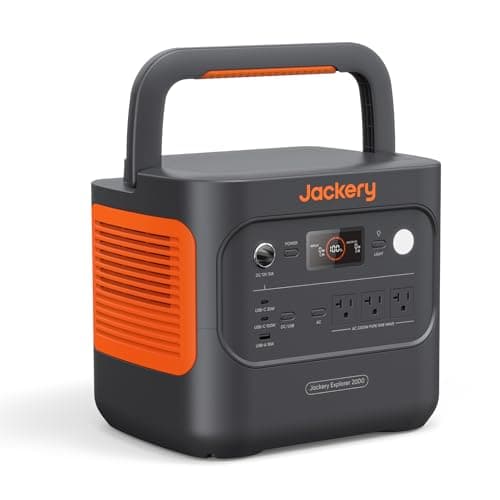
| Battery | On high, 1,500 W | On low, 750 W |
|---|
| 1,056 Wh | About 36 minutes | About 72 minutes |
|---|
| 2,042 Wh | About 69 minutes | About 2.3 hours |
|---|
| 3,840 Wh | About 2.2 hours | About 4.4 hours |
|---|
Calculated as capacity x 0.85 / heater watts, using the inverter efficiency figure documented on the methodology page.
The space heater backup page works through what to do instead, and the short answer is to burn something rather than store electricity.
Two safety facts that follow from the wattage
One heater per circuit. At 1,500W a heater occupies most of a 15A circuit on its own. Two on the same circuit will trip the breaker at best, and at worst heat the wiring.
No extension cord unless it is rated for it. Space heaters cause a significant share of home heating fires, and undersized cords are a recurring factor. Plug it straight into the wall, and if a cord is unavoidable use heavy-gauge cord rated well above 15 amps — the cord page covers gauge properly.
The short version
- 1,500W on high, always. It is the outlet's ceiling, not a design choice.
- All types cost the same to run. Ceramic, oil, infrared — identical watts, identical heat.
- 1.5 kWh per hour, 12 kWh a night. A thermostat roughly halves it.
- One per circuit, straight into the wall.