What has grace, and what does not
The useful first move is triage, because farm loads differ enormously in how long they can wait.
| System | Grace period | Load |
|---|
| Barn ventilation, closed housing in heat | Minutes to an hour | Hundreds of watts to several kW, continuous |
|---|
| Milk cooling | An hour or two before quality is at risk | Compressor — large surge, continuous cycling |
|---|
| Water for livestock | Hours, and less in heat | Well pump, intermittent but high surge |
|---|
| Heat lamps, young stock | Hours, depending on weather | 250 W each, continuous |
|---|
| Electric fencing | Hours — many are battery or solar anyway | Trivial |
|---|
| Feed augers and mixers | A feeding cycle | Motors, high surge |
|---|
| The farmhouse | Days | The usual critical list |
|---|
Grace periods are general guidance; your own stocking density, housing and climate change them substantially. Equipment plates are the authoritative source for load figures.
The top two rows are the ones that justify serious spending. Everything below them can be managed with a portable machine and a person.
Ventilation is the one that kills
In closed housing — poultry barns especially, but also confined swine and dairy — ventilation is not comfort, it is survival. Heat and ammonia build quickly in a full barn with the fans stopped, and the timescale in summer is minutes to an hour rather than hours.
Two consequences follow, and both are about architecture rather than product choice.
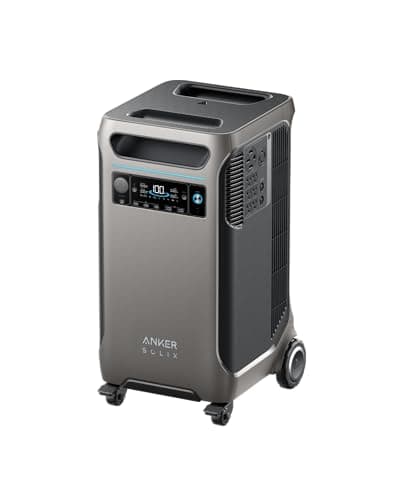
It has to be automatic. A portable generator that somebody starts is not an answer for a load whose grace period is shorter than the time it takes to notice. That points at an automatic standby unit, or a battery with passthrough sitting permanently on the ventilation circuit.
It needs an alarm that reaches you. A barn alarm that calls or texts is standard equipment for a reason, and it needs its own power and its own communications path.
The standby versus portable comparison is the relevant decision, and on a livestock operation it usually falls on the standby side for this one circuit even if everything else is portable.
Water is the load most people underestimate
A single dairy cow drinks 30 to 50 gallons a day, and more in heat. A modest herd is therefore hundreds of gallons, and none of it arrives without the well pump.
The reassuring part is that pumping is cheap in energy terms. A well pump runs briefly to refill a pressure tank and costs a fraction of a kilowatt-hour across a day — the well pump page has the arithmetic. What it costs is surge capability at unpredictable moments.
The practical move is storage. Filling troughs and tanks while the generator is running decouples the animals' drinking schedule from the machine's running schedule, which lets you run in blocks.
Run in blocks, and plan the fuel
Continuous running at farm scale is a fuel logistics problem before it is anything else. A large machine burns through cans faster than you can fetch them during a regional outage when the local station has no power either.
Blocks work for most farm loads: run for a couple of hours, fill water storage, cool the milk, cycle the ventilation, then stop. The exception is ventilation in heat, which is why that circuit wants its own automatic source.
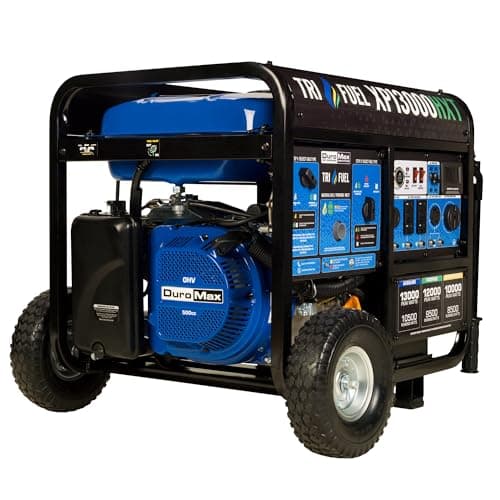
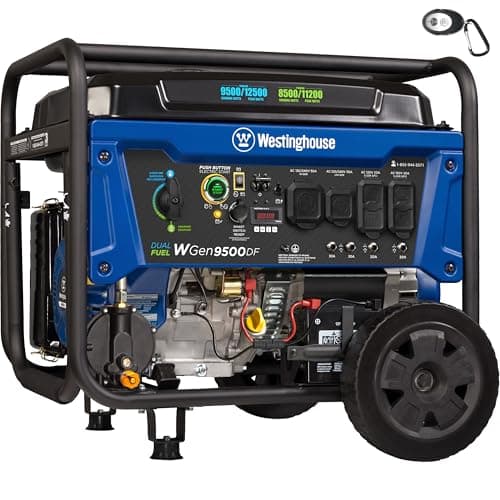
Bulk propane on the property changes this completely, which is the strongest argument for a tri-fuel or propane machine here — the propane page covers the trade.
Safety, with animals in the picture
- Never in the barn. Carbon monoxide affects livestock as it affects people, and a barn is exactly the enclosed space that concentrates it.
- Never backfeed. Rural properties sit at the end of long distribution lines, and the lineworkers restoring them are often working alone. A transfer switch is not optional.
- Cords and animals do not mix. Run them overhead or in conduit rather than across a yard where hooves and curiosity will find them.
- Fuel storage limits still apply and are easy to exceed at farm scale — the fuel storage page covers what is reasonable to keep.
The architecture that usually works
Most operations of any size end up with three layers rather than one machine.
Automatic, for the load that cannot wait. Ventilation, and milk cooling where it applies. Standby or a permanently connected battery.
Portable, for everything else. Water, feed, the house. Run in blocks by a person.
Storage, to make blocks work. Water tanks, full troughs, and a cold chain that can coast.
The rural property page covers the household half of this, which fails at the same moment.
The short version
- Triage by grace period. Ventilation is minutes; the house is days.
- Automate the load that cannot wait for a person. Usually ventilation.
- Store water so the pump can run in blocks.
- Bulk propane beats cans once the machine gets large.