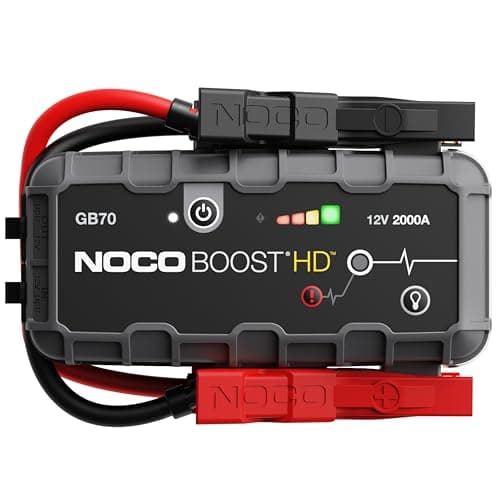
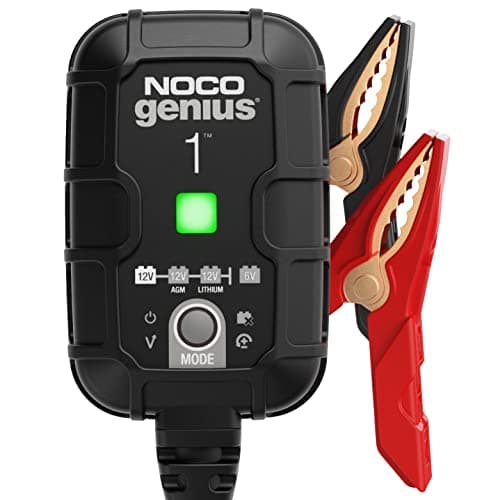
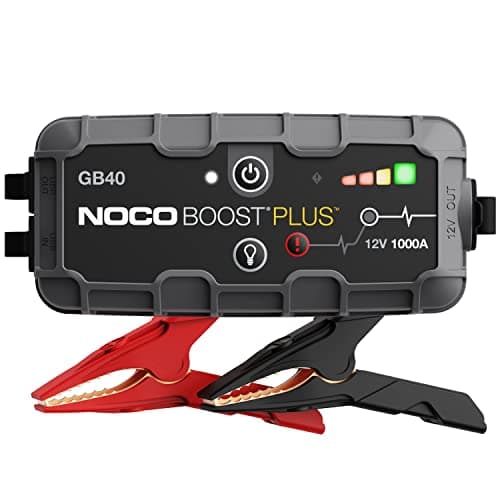
Why this belongs in an outage kit
It looks like an automotive product and it earns its place here for three reasons.
Cold kills marginal batteries. A lead-acid battery loses a substantial fraction of its cranking ability at freezing, and the engine needs more to turn over because the oil is thick. The morning after an ice storm is when weak batteries fail, and that is the same morning the power is out.
The car is part of the plan. Getting to a warming center, a relative's house or a pharmacy, or simply running an inverter — all of it assumes the vehicle starts.
Your electric-start generator has a battery too. The commonest reason a standby or electric-start portable will not run is a flat starting battery, and a jump pack with the right adapter or the maintainer above addresses it.
Peak amps is the headline. Engine size is the spec.
Every jump pack leads with a peak amp figure — 1,000, 2,000, 4,000 — and those numbers are measured in ways that differ between manufacturers and are not directly comparable.
The number worth reading is the published engine displacement rating, because it is the manufacturer stating what the unit will actually start.
| Vehicle | Rating to look for | Class |
|---|
| Compact car, motorcycle, ATV | Up to 4.0 L gasoline | Around 1,000 peak amps |
|---|
| Family car, small SUV | Up to 6.0 L gasoline, 3.0 L diesel | Around 1,000 peak amps |
|---|
| Pickup, large SUV, van | Up to 8.0 L gasoline, 6.0 L diesel | Around 2,000 peak amps |
|---|
| Tractor, heavy diesel equipment | Check the specific rating | 2,000 amps or a dedicated unit |
|---|
Diesels need substantially more than their displacement suggests, because of high compression and the glow plug load that runs before cranking. If you have a diesel, size up.
The mistake that kills them
A lithium jump pack bought, put in a glovebox and forgotten is a paperweight within a couple of years.
Lithium cells self-discharge slowly but continuously, and most packs also draw a small standby current for their own electronics. Left alone, a pack drains over months; left deeply discharged, the cells degrade permanently and some protection circuits will refuse to accept a charge at all.
The fix is trivial and almost nobody does it. Charge it twice a year — pick two dates you already remember, like the clock changes — and it will work when you need it. Write the date on it in marker, the same habit that works for UPS batteries.
Heat accelerates this. A pack that lives in a car through a Phoenix summer will not last as long as one in a hall closet.
Lithium jump pack or jumper cables?
| Lithium jump pack | Jumper cables |
|---|
| Needs another vehicle | No | Yes — and a willing driver |
|---|
| Wrong connection | Protected — does nothing | Can damage both vehicles' electronics |
|---|
| Maintenance | Charge twice a year | None |
|---|
| Cost | Meaningfully more | Very little |
|---|
| Other uses | USB power bank, work light, 12V output | None |
|---|
The honest answer is that cables are fine if you live somewhere with neighbors and a second vehicle, and a pack is the right buy if you might be alone, rural, or in a parking lot at night. Carrying both costs almost nothing extra.
Using one without damaging anything
- Red to positive, black to a bare metal ground away from the battery — a bolt on the engine block is ideal. Grounding away from the battery keeps any spark away from hydrogen.
- Wait for the ready light before cranking. Most units will not deliver current until they confirm the connection.
- Crank in short bursts. Five seconds, then thirty seconds off. Continuous cranking overheats both the starter and the pack.
- Drive for twenty minutes afterwards, or put the vehicle on a maintainer. Starting it once does not recharge the battery, and you will be doing this again tomorrow.
- A battery that needs jumping twice is failing. Replace it rather than carrying a jump pack as a permanent workaround.
The short version
- Match the engine displacement rating, not the peak amp headline.
- Diesels need the larger class. Compression and glow plugs.
- Charge it twice a year. This is the whole maintenance requirement and it is the thing people skip.
- A maintainer prevents what a jump pack fixes, and costs less.