Skip to content
Watt Warden

Generators

The Best Propane Generators (2026)

The most likely reason a generator fails you is not a broken engine. It is stale gasoline in a machine that sat for a year - and propane simply does not have that failure mode.

By Sawyer V.Updated Published How we work this out
Red gas cylinders standing in a row.

Watt & Warden earns a commission on qualifying purchases made through links on this page, at no extra cost to you. It never changes a ranking, and our picks include products we tell you to skip. Full disclosure.

Quick picks

#ProductBest forPrice
1
No photo

Best overall

Westinghouse WGen9500DF

8,500 running watts on propane, with both 240V outlets and remote start.

House backup on stored propane
2
No photo

Best if a gas line is available

DuroMax XP13000HXT tri-fuel generator

Published ratings on all three fuels — 10,500 gas, 9,500 propane, 8,500 natural gas.

A property with natural gas as well as propane
3
No photo

Best mid-size

Westinghouse WGen5300DF

5,300 running watts on gasoline, dual fuel, with the 240V outlet a switch needs.

A critical-load list rather than a whole house
4
No photo

Best quiet option

Champion 200988 4500W dual fuel inverter

4,500 peak and 3,500 running watts of inverter-clean dual fuel output.

Propane operation without the noise

Prices come from the retailer at page-build time and change constantly. Where no live price is available the button reads “Check price” rather than showing a number we cannot stand behind.

Why propane fixes the real failure mode

The commonest way a backup generator fails is not mechanical. It is that the machine sat for eleven months with gasoline in it, the fuel oxidized and left varnish in the carburetor jets, and it will not start on the one morning it is needed.

Propane does not do this. It is stored under pressure in a sealed cylinder, it does not oxidize, it does not absorb water, and it leaves no residue when it burns. A generator that has only ever run propane has a clean carburetor by default.

For a machine that runs a handful of hours a year, that single property outweighs most of the specification sheet. The fuel storage page covers what stabilized gasoline can and cannot do about the same problem.

What propane costs you

Three things, and being straight about them matters.

1. Output, by roughly 10%. Propane has lower energy density per unit of volume delivered to the cylinder, so every dual fuel machine publishes a lower propane figure.

MachineGasoline runningPropane running
Westinghouse WGen9500DF9,500 W8,500 W
DuroMax XP13000HXT10,500 W9,500 W
Westinghouse WGen7500DF7,500 W6,750 W
Champion 1001657,500 W6,750 W

2. Run time per container. A 20 lb barbecue cylinder is the standard unit, and on a mid-size machine under load it is a matter of hours rather than a day. Plan on several cylinders for a multi-day outage, or a larger tank.

3. Cold-weather behavior. Propane vaporizes less readily as temperature drops, and a cylinder drawn hard in deep cold can frost and lose pressure. Where winters are severe this is a real consideration — the cold weather page covers it properly.

Cylinders, tanks and lines

Three supply arrangements, and they suit very different situations.

20 lb cylinders. The barbecue tank. Cheap, exchangeable almost anywhere, and the right answer for occasional use and for RVs. The drawback is how often you swap them under sustained load.

A 100 lb cylinder or a residential tank. If the property already has propane for heating or cooking, tapping that supply removes the swapping problem entirely and is usually the best arrangement available. It needs a regulator and a fitting done properly.

Natural gas. Not propane, but the same family of argument taken further: a supply line that never runs out and needs no storage. The natural gas versus propane page works through the trade for standby units, and most of it applies here.

Propane storage is easier and still not free

Propane cylinders store outdoors, upright, away from ignition sources and never inside a house or an attached garage. They do not degrade, so buying them out of season is genuinely a store of readiness rather than a thing that expires.

Compare that with gasoline, where quantity limits, stabilizer and rotation all apply. The fuel storage page covers the gasoline side.

Dual fuel is almost always the right buy

There is very little market for propane-only portable generators, and that is rational. A dual fuel machine costs slightly more than a gasoline-only equivalent and gives you both failure modes covered: run propane by default for storage reasons, and burn gasoline when propane runs out or the cold reduces its output.

The dual fuel roundup covers the switching mechanics, and the tri-fuel page covers adding natural gas to that.

The short version

  • Propane never goes stale. That fixes the commonest real-world failure.
  • Expect about 10% less output. Size against the propane figure.
  • Count cylinders, not just watts. A 20 lb tank is hours, not days.
  • Buy dual fuel. The premium over gasoline-only is small and it covers both problems.
The picks in full

01Best overall

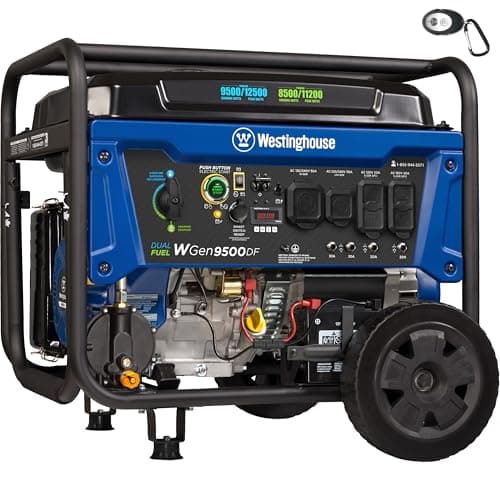
Westinghouse WGen9500DF

8,500 running watts on propane, with both 240V outlets and remote start.

8,500 running watts on propane is a lot of derated output, which is the point: it means the propane figure alone still covers a full house backup list rather than being a fallback mode.

Both 240V outlets are present, so the machine can feed a transfer switch and reach the well pump and the furnace on either fuel.

The honest catch: propane costs 1,000 watts against gasoline here, and a large machine on cylinders means changing tanks often. Plan the cylinder count, not just the machine.

Skip it ifyou have a 30A transfer switch. It caps this machine well below its propane rating.

Published specifications for the Westinghouse WGen9500DF
SpecificationPublished figure
Output (gasoline)9,500 running W / 12,500 peak W
FuelGasoline or propane (dual fuel)
Engine457cc 4-stroke OHV, cast iron sleeve
Tank6.6 gal (25 L)
Run timeup to 12 h on a full tank
Transfer-switch outlet120/240 V L14-30R, 30 A
RV outlet120/240 V 14-50R, 50 A
StartingPush-button electric with remote key fob
Warranty3-year limited

Source: Westinghouse — WGen9500DF product specifications. These are the manufacturer's published figures, not ours — we have not tested this unit.

02Best if a gas line is available

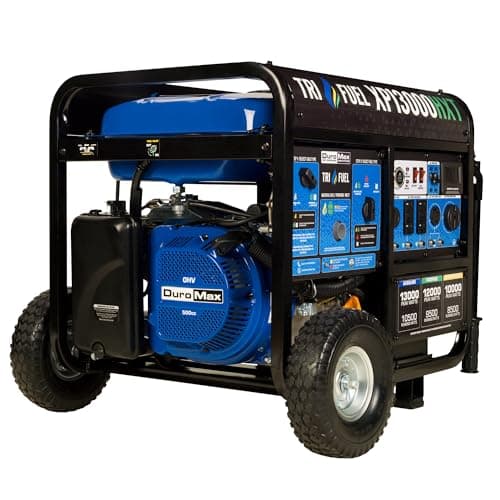
DuroMax XP13000HXT tri-fuel generator

Published ratings on all three fuels — 10,500 gas, 9,500 propane, 8,500 natural gas.

Publishing all three figures is what makes this machine honest. Most dual and tri-fuel generators advertise the gasoline number and leave you to discover the rest.

A natural gas connection changes backup power fundamentally, because a supply line does not run out and needs no storage at all. Where one exists, that is the fuel to plan around.

The honest catch: natural gas is the lowest output of the three, and connecting a portable to a gas line is a plumber and a permit rather than a hose from a cylinder.

Skip it ifyou have no natural gas supply. Then tri-fuel is a capability you are paying for twice.

Published specifications for the DuroMax XP13000HXT tri-fuel generator
SpecificationPublished figure
Gasoline13,000 peak W / 10,500 running W
Propane12,000 peak W / 9,500 running W
Natural gas10,000 starting W / 8,500 running W
Engine500cc OHV, 100% copper windings
Tank8.3 gal
Run time8.82 h on gasoline at 50% load, 7.63 h on propane
OutletsTransfer-switch-ready 50 A outlet
StartingPush-button electric with remote start
SafetyBuilt-in CO Alert shutdown

Source: DuroMax — XP13000HXT tri-fuel generator listing. These are the manufacturer's published figures, not ours — we have not tested this unit.

03Best mid-size

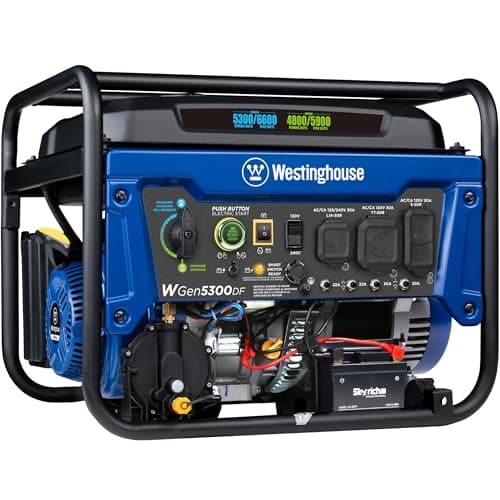
Westinghouse WGen5300DF

5,300 running watts on gasoline, dual fuel, with the 240V outlet a switch needs.

The right size for the list most people actually back up: fridge, freezer, furnace fan, sump pump, lighting and the network.

A mid-size machine also has the best relationship with propane cylinders, because a 20 lb tank lasts a useful number of hours rather than being consumed in an evening.

The honest catch: the roughly 10% propane derate bites harder here than on a larger machine, because there is less margin to give away.

Skip it ifyou need to start a 1 HP well pump. Derated on propane it is marginal.

Published specifications for the Westinghouse WGen5300DF
SpecificationPublished figure
Output (gasoline)5,300 running W / 6,600 peak W
Output (propane)4,800 running W / 5,900 peak W
Engine274cc 4-stroke OHV
Tank4.7 gal (18 L)
Run timeup to 14.5 h on a full tank
Transfer-switch outlet120/240 V L14-30R, 30 A
RV outlet120 V TT-30R, 30 A
StartingPush-button electric with remote key fob

Source: Westinghouse — WGen5300DF product specifications. These are the manufacturer's published figures, not ours — we have not tested this unit.

04Best quiet option

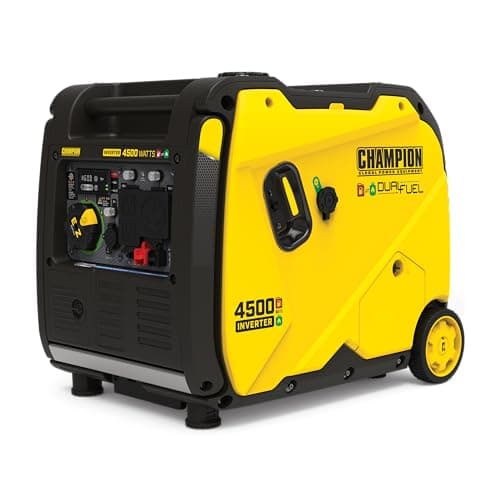
Champion 200988 4500W dual fuel inverter

4,500 peak and 3,500 running watts of inverter-clean dual fuel output.

Dual fuel and inverter architecture together is a less common combination and a genuinely good one: propane's storage advantages with an inverter's noise floor and clean waveform.

For an RV, a tailgate or a household that already carries propane for cooking, it means one fuel and a machine you can hold a conversation next to.

The honest catch: 3,500 running watts on gasoline and less on propane. Check your list against the derated figure, not the headline.

Skip it ifyou need a full house-backup wattage. This is a critical-loads machine.

Published specifications for the Champion 200988 4500W dual fuel inverter
SpecificationPublished figure
Output4,500 starting W / 3,500 running W (gasoline)
TypeInverter, RV ready
FuelGasoline or propane (dual fuel)
StartingElectric start
RV outlet120 V TT-30R, 30 A
Warranty3-year limited with free lifetime technical support

Source: Champion Power Equipment — 4500-watt dual fuel inverter specifications. These are the manufacturer's published figures, not ours — we have not tested this unit.

How these were chosen

We did not test these. Nobody at Watt & Warden has plugged one in. What we did instead: read the manufacturer's published specifications, compile them into a table where the figures line up, and compute the numbers manufacturers leave out — runtime against a real appliance load, and what an hour of running actually costs.

Anything that could not be sourced was left out rather than estimated, and every pick names the buyer who should skip it. The full method is here, including where it is weaker than a publisher with a test bench.

Questions people actually ask

Are propane generators better than gasoline?

For a machine that sits unused most of the year, yes. Propane does not oxidize, absorb water or leave varnish in a carburetor, which is the commonest reason a backup generator will not start when needed. The trade is roughly 10% less output and shorter run time per container.

How long does a 20 lb propane tank run a generator?

Hours rather than a day, and the exact figure depends on the load. A mid-size machine running a household critical list will work through a barbecue cylinder over an evening or a night, so a multi-day outage means several cylinders or a larger tank tapped from the property supply.

How much output do you lose running on propane?

About 10% on most dual fuel machines. A 9,500W gasoline rating typically becomes 8,500W on propane, and 7,500W becomes 6,750W. Size your load list against the propane figure if propane is going to be your normal fuel, not against the headline gasoline number.

Do propane generators work in cold weather?

They work, but propane vaporizes less readily as temperature falls, and a cylinder drawn hard in deep cold can frost over and lose pressure. Where winters are severe, either use a larger tank -- which has more surface area to vaporize from -- or keep gasoline as the cold-weather fuel on a dual fuel machine.

Can I connect a portable generator to my house propane tank?

Usually yes, and it is often the best arrangement available if the property already has propane for heating or cooking. It needs the correct regulator and a fitting done properly, which is a propane technician's job rather than a hardware store hose.

Sources

Every figure on this page comes from a published source. We have not tested this equipment, so the specifications are the manufacturer's and the statistics are the dataset's — the arithmetic on top of them is ours, and it is shown in full so you can check it. How we work this out.