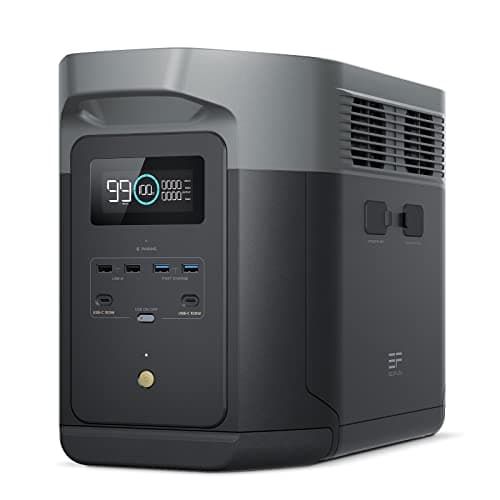
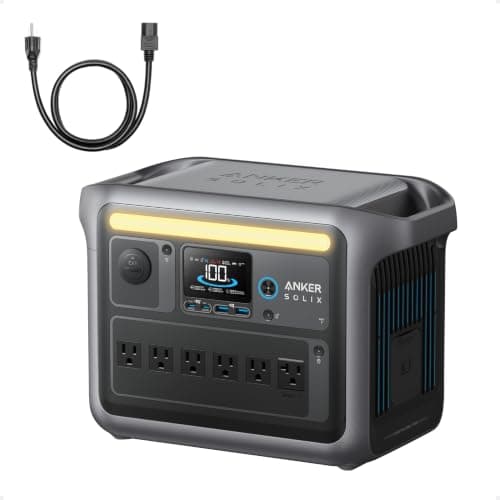
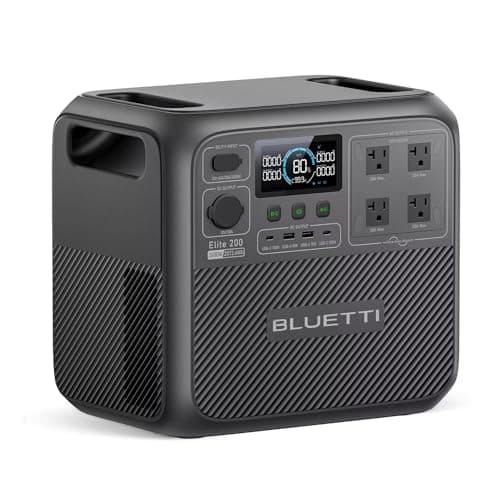
What the inverter is doing
The cells inside a power station store direct current at a fixed voltage. Your appliances want alternating current at 120 volts, 60 times a second. The inverter is the electronics that converts between them.
Four specifications describe how well it does that, and only one of them appears on the front of the box.
1. Waveform
A true sine wave is the smooth curve utility power produces. A modified sine wave — sometimes called modified square — is a stepped approximation that is cheaper to generate.
Anything worth buying today produces a pure sine wave, and the reason matters:
- Motors run hotter on a stepped waveform and can be noisy or inefficient.
- Power-factor-corrected supplies — in modern desktops, some appliance control boards, some medical devices — may refuse to run on it at all.
- Sensitive electronics can be damaged over time.
If a station does not state pure sine wave, treat that as a statement. The same specification is what separates an inverter generator from a cheap conventional one — the same argument applies there.
2. Continuous output, and 3. surge
Continuous output is what the inverter can supply indefinitely. Surge is what it can supply for a fraction of a second while a motor spins up.
Both matter, and they fail differently:
- Exceed continuous output and the station shuts down shortly after, sometimes with an overload warning first.
- Exceed surge and nothing happens at all — the protection trips instantly and the appliance never starts.
The second is the one people meet, because motor starting surges are several times the running figure. Why the gap is so large covers the mechanism.
Not every manufacturer publishes a separate surge figure, and where they do the duration it applies for is often unstated. Treat a published surge number as a specification to verify against your actual appliance rather than a guarantee.
4. Efficiency and idle draw — the two nobody reads
These are where usable capacity quietly disappears, and neither appears in marketing.
Conversion efficiency. Turning DC into AC costs energy as heat. This site uses 85% as its stated planning assumption, listed on the methodology page. So a 1,000Wh battery delivers roughly 850Wh to an AC appliance, and every runtime figure on this site already has that deduction applied.
Idle draw. The inverter costs energy simply being switched on — running its own control electronics, cooling fans and display. On a small load this can be a substantial fraction of the total.
| What you are running | Why idle draw matters |
|---|
| A phone charger, 5W | The inverter's own consumption can exceed the load. Use the USB ports or a power bank instead |
|---|
| A router, 20W | Meaningful over 24 hours — DC output is better where possible |
|---|
| A fridge, 150W average | Proportionally small, but it runs while the compressor rests |
|---|
| A furnace blower, 500W | Negligible as a fraction |
|---|
Manufacturers rarely publish idle draw and we do not have measured figures, so this table describes the shape of the effect rather than quantifying it. The practical rule stands on its own: the smaller the load, the more the inverter's own consumption matters.
Which produces the single most useful habit in this whole area: use the DC and USB outputs for small loads and save the AC inverter for things that need it. A CPAP on 12V DC, a phone on USB, and lighting on DC all skip the conversion entirely.
Why batteries handle surges worse than generators
Two machines with the same headline output do not behave the same way under a brief overload.
A generator has a spinning alternator with real rotational inertia. A momentary overload pulls the engine speed down slightly and it recovers.
An inverter has no inertia — it has semiconductors with hard thermal and current limits, and it protects itself by shutting off rather than sagging.
Practically: be more generous with headroom on a battery than you would be on a generator for the same load. Where a 5,000W generator will grudgingly start something, a 5,000W inverter simply will not.
What to check before buying
- Pure sine wave stated explicitly. If it is not stated, assume it is not.
- Continuous output in watts, and whether it is sustained or a short-term rating.
- Surge figure and its duration, where published.
- Whether there are DC and USB outputs sized for what you would otherwise run on AC.
- Whether the inverter can be switched off independently while the DC rails stay live. This is a real feature and it saves meaningful energy on a long outage.
Then size against your largest motor rather than your total load — the sizing method works the arithmetic through.