The verdict, in one paragraph
If what you want is a system that automatically turns off heavy breakers during an outage, two companies publish it plainly. Lumin publishes three named shedding triggers for its Off Grid Manager — a detected grid outage, demand exceeding a power limit, and the battery's state of charge falling — and publishes an “Essential” category whose circuits are never shed. SPAN publishes 16 to 48 controllable circuits and states that, off-grid, PowerUp “uses the Backup Overload Protection set point to dynamically adjust which circuits stay on to avoid battery overloads”, operating automatically in the background. EcoFlow publishes three priority tiers that pause unnecessary loads, but does not publish what triggers the pause. Leviton publishes monitoring and control, not shedding. And for Tesla and Enphase we have nothing to report, because neither company's relevant pages would load for us — we will not describe a feature we could not read.
What each brand actually publishes
| System | Published circuit count | Automatic outage shedding? | Published trigger |
|---|
| Lumin | Not published | Yes, explicitly | Outage detected; demand over a limit; battery state of charge |
|---|
| SPAN | 16-48 controllable circuits; MAIN 40 has 40 | Yes, off-grid | Backup Overload Protection set point |
|---|
| EcoFlow Smart Home Panel 2 | 12-circuit sub-panel | Partly — priority tiers that pause loads | Not published |
|---|
| FranklinWH | Not published on the pages we read | Not stated as automatic | Smart Circuits can be shut off to extend backup time |
|---|
| Leviton smart breakers | Not published | No shedding claim | Monitoring, alerts and remote control only |
|---|
| Tesla, Enphase | Not read | Not read | Their pages did not load for us |
|---|
Every entry is what the manufacturer publishes on its own site, cited under Sources. “Not published” means we looked and the figure was not there; “not read” means the page returned an error when we fetched it. We have not inferred either company's behavior from a third party.
Lumin publishes the clearest specification in the category
Most smart panel copy is written in the language of apps. Lumin's Off Grid Manager page is written in the language of a control system, and it lists the conditions under which it will shed an individual circuit:
- “As soon as a grid outage is detected.”
- “As soon as the power demanded by circuits in the house exceeds a power limit.”
- “Once the state of charge of a home's battery decreases (only available with selected battery brands).”
The third of those is the one worth noticing, and the parenthesis is the catch. Shedding on state of charge is the behavior people actually want — hold the heavy loads until the battery is half empty, then protect what is left — and Lumin says plainly that it depends on which battery brand you own. That is a compatibility question to settle before you buy either half.
Lumin also publishes the inverse rule: circuits set to “Essential” “will not be shed when an outage occurs”. A shedding system without a never-shed category is not a system anybody would trust with a sump pump.
SPAN: automatic in the background, and candid about the limits
SPAN publishes both a circuit count and a mechanism. The panel page states “16 - 48 controllable circuits”, and the MAIN 40 specification lists “Controllable circuit spaces: 40” with a 225A bus bar rating and a main breaker rating of 100 to 200A.
The off-grid behavior is published directly: PowerUp “uses the Backup Overload Protection set point to dynamically adjust which circuits stay on to avoid battery overloads”, and SPAN states that PowerUp “operates automatically in the background when on-grid and off-grid”. On-grid it does something different, using a Firm Service Rating setpoint to throttle large loads.
What makes SPAN's documentation genuinely useful is a line in its own FAQ that most marketing would omit: of the automatic pausing of pre-selected circuits, SPAN says “Today, this functionality is available primarily for EV charger loads.” That is a real scope limit, published by the company, and it should change how you read the rest of the page.
Priority tiers are not the same thing as shedding
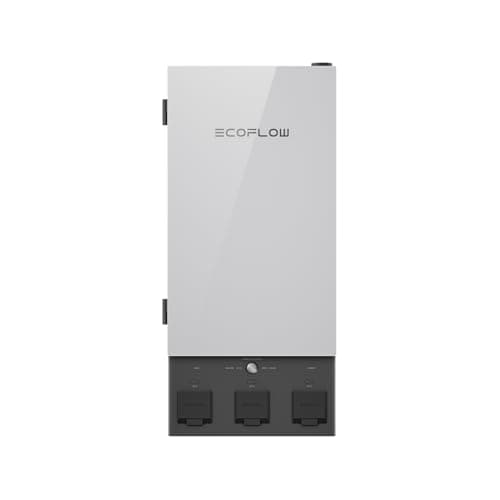
EcoFlow's Smart Home Panel 2 publishes a three-level Circuit Control mode and states that circuit control “pauses unnecessary loads to extend backup time”. It also publishes a 20ms automatic switchover from the grid and an automatic Storm Warnings mode in which “batteries fully recharge 24 hours before an extreme weather event”.
All of that is useful and none of it is the same specification as Lumin's. A priority ordering tells the system which circuit to drop; a published trigger tells you when it will do it without being asked. If the distinction sounds academic, it is exactly the difference between a system that protects your battery while you are asleep and one that waits for you to open an app.
Monitoring is the most oversold word in this category
Leviton's smart circuit breaker page describes “advanced electrical protection, real-time monitoring, and enhanced control” — tracking, alerts and remote management. There is no shedding claim and no outage behavior on the page we read. That is not a criticism of the product; it is a warning about the vocabulary. A breaker you can switch from a phone is not a breaker that switches itself when your battery is at 20%.
The same caution applies to app quality generally. Home battery backup apps compared found the same pattern on the monitoring side: brands publish a great deal about dashboards and very little about what the system does on its own.
Do you actually need load management?
Honest answer: it depends entirely on whether your continuous output is comfortably above your worst-case simultaneous demand. If it is, load management is insurance. If it is not, it is the only thing standing between you and a system that trips every time the well pump and the microwave coincide.
- Add up the worst five minutes of your day. Not the average — the moment when the fridge restarts, the furnace calls and somebody runs a kettle.
- Compare that with the system's published continuous output, not its surge rating.
- If the gap is thin, you need shedding and you need it to be automatic, because nobody is awake at 3am to triage circuits.
- If the gap is wide, buy capacity instead. Hours of runtime are more useful than a cleverer panel.
The highest continuous output home backup has the published kilowatt figures to compare against, and what size home battery backup you need covers the capacity side.
What to ask an installer
- Does it shed automatically, or only on command? Ask for the published trigger, not a reassurance.
- Will it shed on battery state of charge? Lumin says this depends on the battery brand. Get your specific pairing confirmed.
- Which circuits can never be shed? Sump pump, medical equipment, and anything that causes damage when it stops.
- How many circuits are actually controllable? SPAN publishes a range of 16 to 48, which is a wide spread, and the model matters.
- What happens if the panel itself loses communications? Nobody publishes this and everybody should.
The short version
Lumin and SPAN publish genuine automatic load shedding during an outage, with Lumin naming three triggers including battery state of charge and SPAN publishing 16 to 48 controllable circuits with automatic backup overload protection. EcoFlow publishes priority tiers that pause loads but does not publish the trigger. Leviton publishes monitoring and control, not shedding. Treat “smart” as a word that needs a published mechanism behind it, and ask what the system does when nobody is looking at the app.