Skip to content
Watt Warden

Accessories

The Generator Maintenance Kit

The tank runs a generator for eight to fourteen hours. The oil is what decides whether it survives day three, and nobody buys oil during a storm.

By Sawyer V.Updated Published How we work this out
An oil bottle and funnel on a workbench.

Watt & Warden earns a commission on qualifying purchases made through links on this page, at no extra cost to you. It never changes a ranking, and our picks include products we tell you to skip. Full disclosure.

Oil is the real limit, not the tank

People plan fuel carefully and never think about oil, which is backwards for any outage longer than a day.

A tank gives eight to fourteen hours. Manuals commonly specify the first oil change within the first 5 to 25 hours on a new machine, with intervals of anywhere from 50 to 200 hours thereafter. Run continuously, an outage passes the break-in figure inside a day, and a multi-day event will reach a service interval.

Small air-cooled engines also consume oil under sustained load. The level you checked on day one is not the level on day three.

The shelf list

ItemWhyHow much
Correct-grade oilThe limit on a long outage, and unavailable during a stormTwo bottles
Fuel stabilizerPrevents the most common no-start causeOne bottle covers a season
Spare air filterCheap, model-specific, and never in stock locallyOne
Spare spark plugSame reasoning; annual service itemOne
Funnel and drain panAn oil change without them is a spillOne each

Air filters and spark plugs are model-specific, so we cannot recommend a part number that fits your machine — take the numbers from your manual. The reason they are on the list is availability, not cost.

The schedule that keeps it working

Twice a year — spring and fall. Start the generator, run it under some load for fifteen minutes, check the oil, and rotate the stored fuel while you are there. That is the entire maintenance routine for a machine used in emergencies, and it takes under an hour.

During an extended outage. Check the oil level every 8 to 12 running hours. If the machine is new, the first oil change comes early — manuals commonly specify somewhere between the first 5 and the first 25 running hours — so plan it rather than discovering it. Shut down and let the engine cool before refueling, every time: gasoline on a hot muffler is a fire.

Before long storage. Either run the carburetor dry by shutting the fuel valve and letting the engine stall, or store the machine on propane if it is dual fuel. On a dual-fuel generator the second option is free and it is the main practical reason to own one.

The full schedule, by interval goes into more detail.

Low-oil shutdown is not a schedule

Most modern generators have automatic low-oil shutdown, and it gets mistaken for a maintenance system. It is not. It is a last-resort protection that stops the engine when the level is already dangerously low — which during an outage means the machine stops without warning, possibly at 3am, possibly with nothing on the shelf to refill it.

Treat it as the alarm it is. Check the level on a schedule so it never fires.

Grade matters more in cold weather

SAE 30 is the standard grade above about 40°F. Below that it thickens enough to make starting hard and to slow circulation at exactly the moment the engine needs it.

If your outages are winter events — ice storms, snow — check your manual's temperature table and keep the multigrade it specifies instead. A machine that will not start in February is not backup power. The winter kit covers the rest of that season's differences.

Where the used oil goes

Used engine oil is accepted free by most auto parts stores and municipal recycling centers — drain it into a sealed container, label it, and drop it off. Never pour it down a drain or onto ground.

The empty bottle the new oil came in is the obvious container, which is another small argument for keeping two.

If you own a battery instead

None of this applies. A power station has no oil, no filter, no plug and no fuel, and needs no storage preparation. Recharge it every six months or so and that is the whole routine.

If maintenance is what puts you off owning backup power, that is a real argument for a battery rather than an engine.

Quick picks

#ProductBest forPrice
1
No photo

The oil to keep on the shelf

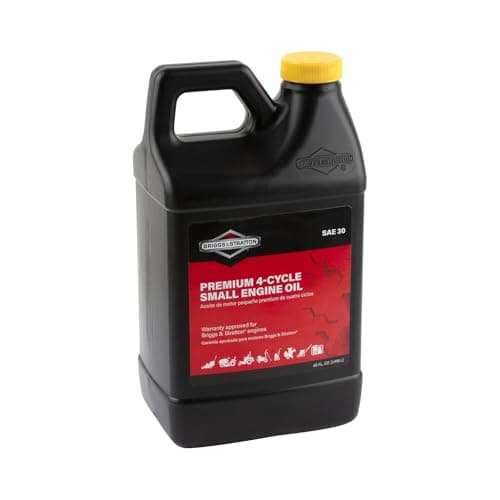
Briggs & Stratton SAE 30 engine oil, 48 oz

48 oz of SAE 30 detergent oil to API SJ or higher — roughly one change on most portable generators.

Warm-weather running
2
No photo

The fuel half of the kit

STA-BIL 360 Protection fuel stabilizer

One ounce treats up to five gallons; the label claims 12 months of storage protection.

Any gasoline that will sit
3
No photo

The low-maintenance machine

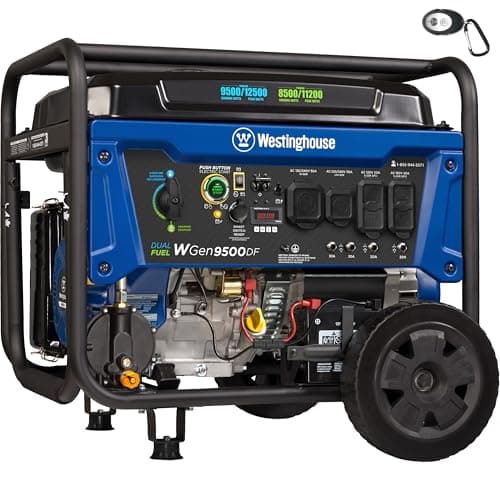
Westinghouse WGen9500DF

9,500 running watts with dual-fuel capability that removes most of the fuel-storage problem.

Anyone who will not do storage prep

Prices come from the retailer at page-build time and change constantly. Where no live price is available the button reads “Check price” rather than showing a number we cannot stand behind.

The picks in full

01The oil to keep on the shelf

Briggs & Stratton SAE 30 engine oil, 48 oz

48 oz of SAE 30 detergent oil to API SJ or higher — roughly one change on most portable generators.

Most portable generators take between 0.6 and 1.2 quarts, so one 48 oz bottle is about one change. Buy two, so a change never waits on a shop being open.

SAE 30 detergent is the standard warm-weather grade for a small air-cooled engine. Detergent matters — it holds combustion byproducts in suspension rather than letting them deposit inside the engine.

Check your own manual's grade table before buying. This is the common specification, not a universal one.

Skip it ifyour machine runs below 40°F. SAE 30 is too thick to start and circulate well in cold; use the multigrade your manual specifies.

Published specifications for the Briggs & Stratton SAE 30 engine oil, 48 oz
SpecificationPublished figure
GradeSAE 30 detergent, 4-cycle
Volume48 oz
SpecificationAPI SJ/CD or higher
TemperatureAbove 40°F; use a multigrade below that
CoversAbout one change on most portable generators

Source: Briggs & Stratton — engine oil product page. These are the manufacturer's published figures, not ours — we have not tested this unit.

02The fuel half of the kit

STA-BIL 360 Protection fuel stabilizer

One ounce treats up to five gallons; the label claims 12 months of storage protection.

Stale fuel and low oil are the only two things that reliably stop a stored generator, and both cost a few dollars to prevent.

Add it to fresh fuel as you buy it and run the engine five minutes so treated fuel reaches the carburetor. It cannot undo gum that has already formed.

Skip it ifyou run the tank and cans dry between seasons. Both approaches work; doing neither does not.

Published specifications for the STA-BIL 360 Protection fuel stabilizer
SpecificationPublished figure
Treats40 gallons (8 fl oz bottle)
Storage lifeKeeps ethanol-blended fuel fresh up to 12 months
Dose1 oz treats up to 5 gallons of fuel
Also doesFuel-system cleaning, corrosion and water-absorption protection
UseAdd before filling, then run the engine 5 minutes

Source: STA-BIL — 360 Protection product page. These are the manufacturer's published figures, not ours — we have not tested this unit.

03The low-maintenance machine

Westinghouse WGen9500DF

9,500 running watts with dual-fuel capability that removes most of the fuel-storage problem.

The maintenance argument for dual fuel is rarely made and it is the strongest one. Store and exercise it on propane and the fuel half of this kit stops applying — propane does not oxidize, gum or absorb water.

You still need oil. Nothing removes that.

Skip it ifyou already own a machine that works. This is not a reason to replace it.

Published specifications for the Westinghouse WGen9500DF
SpecificationPublished figure
Output (gasoline)9,500 running W / 12,500 peak W
FuelGasoline or propane (dual fuel)
Engine457cc 4-stroke OHV, cast iron sleeve
Tank6.6 gal (25 L)
Run timeup to 12 h on a full tank
Transfer-switch outlet120/240 V L14-30R, 30 A
RV outlet120/240 V 14-50R, 50 A
StartingPush-button electric with remote key fob
Warranty3-year limited

Source: Westinghouse — WGen9500DF product specifications. These are the manufacturer's published figures, not ours — we have not tested this unit.

How these were chosen

We did not test these. Nobody at Watt & Warden has plugged one in. What we did instead: read the manufacturer's published specifications, compile them into a table where the figures line up, and compute the numbers manufacturers leave out — runtime against a real appliance load, and what an hour of running actually costs.

Anything that could not be sourced was left out rather than estimated, and every pick names the buyer who should skip it. The full method is here, including where it is weaker than a publisher with a test bench.

Questions people actually ask

How often should I change generator oil?

Follow your manual. Manuals commonly specify a first change within the first 5 to 25 hours on a new machine and intervals of anywhere from 50 to 200 hours afterwards. During an extended outage, check the level every 8 to 12 running hours.

What oil does a portable generator take?

SAE 30 detergent oil to API SJ or higher is the common specification above about 40F. Below that it is too thick for easy starting and quick circulation, so your manual will specify a multigrade instead. Most portables take between 0.6 and 1.2 quarts.

What should I keep on the shelf for my generator?

Two bottles of the correct-grade oil, a bottle of fuel stabilizer, a spare air filter and spark plug for your specific model, and a funnel and drain pan. The filter and plug are on the list for availability rather than cost -- they are never in stock locally when you need them.

Does low-oil shutdown mean I do not need to check the oil?

No. Low-oil shutdown is a last-resort protection that stops the engine when the level is already dangerously low, which during an outage means the machine dies without warning. Check the level every 8 to 12 running hours so it never fires.

How do I prepare a generator for storage?

Either run the carburetor dry by closing the fuel valve and letting the engine stall, or fill the tank with stabilized fuel and run it several minutes so treated fuel reaches the carburetor. On a dual-fuel machine, running the gasoline system dry and exercising on propane removes the problem entirely.

Sources

Every figure on this page comes from a published source. We have not tested this equipment, so the specifications are the manufacturer's and the statistics are the dataset's — the arithmetic on top of them is ours, and it is shown in full so you can check it. How we work this out.