Skip to content
Watt Warden

Generators

The Best Generators for a Small House (2026)

Small houses get sold the same generators as large ones, and they do not need them. The machine that matches a short critical list is quieter, cheaper to feed and easier to store.

By Sawyer V.Updated Published How we work this out
Westinghouse WGen5300DF

Watt & Warden earns a commission on qualifying purchases made through links on this page, at no extra cost to you. It never changes a ranking, and our picks include products we tell you to skip. Full disclosure.

Quick picks

#ProductBest forPrice
1
Westinghouse WGen5300DF

Best overall for a small house

Westinghouse WGen5300DF

5,300 running watts of dual fuel, transfer-switch ready.

A furnace, a well pump, a fridge and lights
$649.00 · Check price on Amazon

#ad how this is funded · price as of October 21, 2026

2
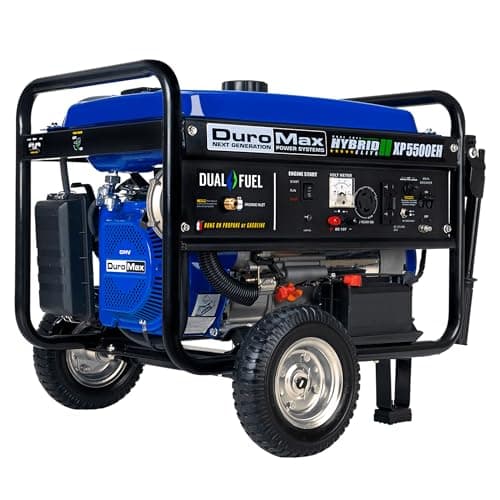
DuroMax XP5500EH

Best 120/240V selector

DuroMax XP5500EH

4,500 running watts of dual fuel with a 120/240V selector switch.

Feeding a switch without wasting capacity
$769.95 · Check price on Amazon

#ad how this is funded · price as of October 21, 2026

3
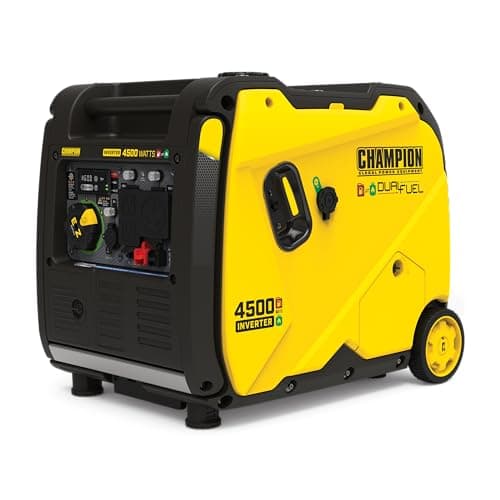
Champion 4500W dual fuel inverter generator

Best quiet option

Champion 4500W dual fuel inverter generator

4,500 starting / 3,500 running watts of dual-fuel inverter power with electric start.

Close neighbors and a shorter list
$988.62 · Check price on Amazon

#ad how this is funded · price as of October 21, 2026

4
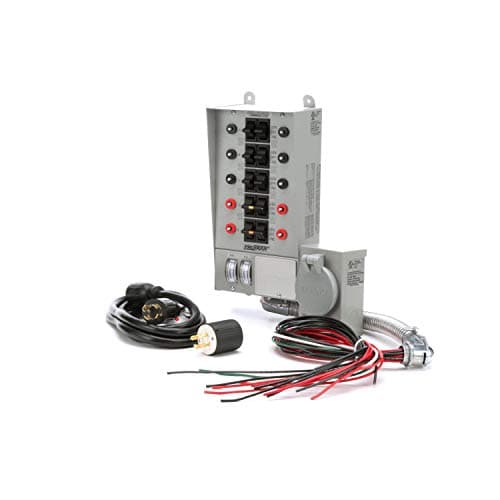
Reliance Controls 31410CRK Pro/Tran

The purchase that matters more than watts

Reliance Controls 31410CRK Pro/Tran

A 10-circuit manual transfer switch kit.

Running the furnace and hardwired circuits
$475.20 · Check price on Amazon

#ad how this is funded · price as of October 21, 2026

5
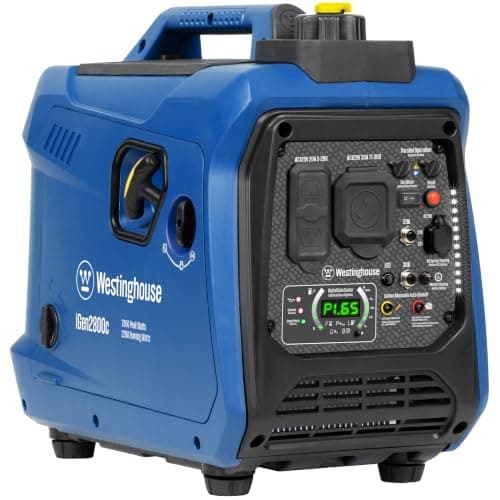
Westinghouse iGen2800

Best if the list is genuinely short

Westinghouse iGen2800

2,200 running watts at 52 dBA and 46.3 lb, with under 3% THD.

A fridge, the internet and lights
$499.00 · Check price on Amazon

#ad how this is funded · price as of October 21, 2026

Prices come from the retailer at page-build time and change constantly. Where no live price is available the button reads “Check price” rather than showing a number we cannot stand behind.

Square footage is the wrong question

Generator listings love to quote house sizes, and the number is nearly meaningless: two 1,100 square foot houses can differ by a factor of three in backup requirement depending on whether the heat is gas or electric and whether the water comes from a well or a main.

What actually sets the size is the critical load list. Here is what a small house typically has on it.

LoadRunning wattsStarting surge
Refrigerator150 W600-1,200 W
Chest freezer100 W500-1,000 W
Gas furnace blower300-600 W1,200-2,400 W
Well pump, 1/2 hp1,000 W2,000-3,000 W
Sump pump800 W1,300-2,900 W
Lights, internet, chargers300 WNegligible

Figures from the appliance wattage chart. Add the running column and a well-equipped small house lands near 2,650W; the largest single surge is the well pump at up to 3,000W.

That is why 4,000 to 5,500 running watts is the right band. It carries the list and absorbs the biggest start with room left, and it is roughly half what the same household is usually sold.

The two things that change the answer

Electric heat. If the house is heated by baseboard or an electric furnace, the arithmetic above collapses — those loads are measured in kilowatts and no small machine carries them. The electric heat page covers what to do instead.

Air conditioning. A window unit is manageable; central air is not, at this size. A 3-ton compressor can demand up to 12,000W to start without a soft starter, which is a different class of machine — or a soft starter.

Why buying bigger costs you twice

  • Fuel. A larger engine burns more at the same load, and in a multi-day outage that is the cost you actually feel — the fuel-use page has the figures.
  • Noise. Bigger open-frame machines are louder, and a small house usually sits on a small lot with close neighbors.
  • Storage. A 200 lb machine in a small garage is a genuine inconvenience for 360 days a year.
  • Money not spent on the connection. A transfer switch does more for usability than 4,000 extra watts.

Spend it in this order

  1. Work out the list — the sizing page turns it into a number.
  2. Buy the machine that fits the list, with surge headroom for the largest motor.
  3. Buy the transfer switch and have it fitted properly.
  4. Buy the fuel plan — propane cylinders or stabilized gasoline, stored safely.

The short version

  • 4,000-5,500 running watts suits most small houses with gas heat.
  • The well pump sets the surge requirement, not the total.
  • Electric heat or central air changes everything — read those pages first.
  • Spend the difference on the transfer switch, not on watts you will never use.

The picks in full

01 — Best overall for a small house

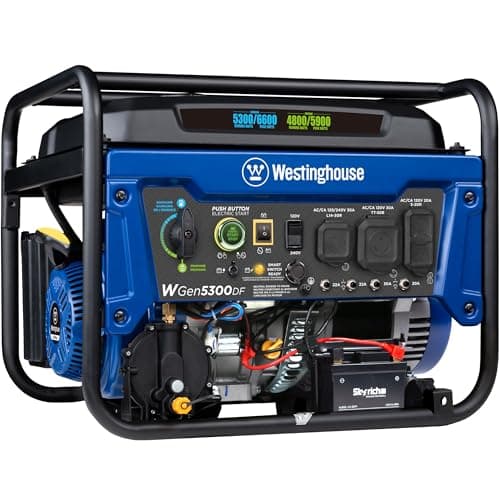
Westinghouse WGen5300DF

5,300 running watts of dual fuel, transfer-switch ready.

This is the size that fits the critical list of a house under about 1,200 square feet with headroom to start a well pump — and it connects to a transfer switch properly.

Dual fuel is the feature that suits a machine run a handful of times a year: propane does not degrade between storm seasons.

The honest catch: open-frame, so it is loud and it wants a surge protector for anything with a control board.

Skip it ifcentral air conditioning is on the list.
Westinghouse WGen5300DF
$649.00 · Check price on Amazon

#ad how this is funded · price as of October 21, 2026

Published specifications for the Westinghouse WGen5300DF
SpecificationPublished figure
Output (gasoline)5,300 running W / 6,600 peak W
Output (propane)4,800 running W / 5,900 peak W
Engine274cc 4-stroke OHV
Tank4.7 gal (18 L)
Run timeup to 14.5 h on a full tank
Transfer-switch outlet120/240 V L14-30R, 30 A
RV outlet120 V TT-30R, 30 A
StartingPush-button electric with remote key fob

Source: Westinghouse — WGen5300DF product specifications. These are the manufacturer's published figures, not ours — we have not tested this unit.

02 — Best 120/240V selector

DuroMax XP5500EH

4,500 running watts of dual fuel with a 120/240V selector switch.

The selector lets a modest machine put all its output on 120V when nothing needs 240V, which is a genuinely useful feature on a small house with a gas furnace.

Dual fuel again, and a price that reflects the smaller engine.

The honest catch: 4,500 running watts is tight if a well pump and a freezer start together.

Skip it ifyou want the quietest machine on the street.

DuroMax XP5500EH
$769.95 · Check price on Amazon

#ad how this is funded · price as of October 21, 2026

Published specifications for the DuroMax XP5500EH
SpecificationPublished figure
Gasoline output5,500 peak / 4,500 running W
Propane output5,225 peak / 4,275 running W
Engine224cc, electric start
Run time9 h on gasoline, 8 h on propane
Voltage120V / 240V selector switch
PanelCircuit breakers, voltmeter, low oil light, DC charging posts

Source: DuroMax — XP5500EH dual fuel generator listing. These are the manufacturer's published figures, not ours — we have not tested this unit.

03 — Best quiet option

Champion 4500W dual fuel inverter generator

4,500 starting / 3,500 running watts of dual-fuel inverter power with electric start.

Enclosed inverter machines are the polite choice on a small lot, and 3,500 running watts covers a gas furnace, a refrigerator and lights comfortably.

Electric start makes a 3am outage considerably less unpleasant.

The honest catch: without a 240V outlet it feeds cords rather than a transfer switch, which rules out hardwired loads.

Skip it ifyou need a 120/240V transfer-switch outlet. This does not have one.

Champion 4500W dual fuel inverter generator
$988.62 · Check price on Amazon

#ad how this is funded · price as of October 21, 2026

Published specifications for the Champion 4500W dual fuel inverter generator
SpecificationPublished figure
Output4,500 starting W / 3,500 running W (gasoline)
TypeInverter, RV ready
FuelGasoline or propane (dual fuel)
StartingElectric start
RV outlet120 V TT-30R, 30 A
Warranty3-year limited with free lifetime technical support

Source: Champion Power Equipment — 4500-watt dual fuel inverter specifications. These are the manufacturer's published figures, not ours — we have not tested this unit.

04 — The purchase that matters more than watts

Reliance Controls 31410CRK Pro/Tran

A 10-circuit manual transfer switch kit.

In a small house the critical list is short enough that ten circuits covers nearly all of it — which makes a switch better value here than in a larger home.

It is also what lets a smaller machine do more, because the furnace and the pump become reachable.

The honest catch: electrician labor, usually about what the switch costs.

Skip it ifyou already have an interlock kit fitted.

Reliance Controls 31410CRK Pro/Tran
$475.20 · Check price on Amazon

#ad how this is funded · price as of October 21, 2026

Published specifications for the Reliance Controls 31410CRK Pro/Tran
SpecificationPublished figure
Circuits10 — six 15 A and four 20 A single-pole breakers
Rating30 A, up to 7,500 W
MeteringTwo watt meters for balancing the load
SwitchingBreak-before-make double-throw, Line / Off / Gen
BackfeedMechanically prevented — the grid cannot be energized
InstallationLicensed electrician; a permit is usually required

Source: Reliance Controls — Pro/Tran 31410CRK product page. These are the manufacturer's published figures, not ours — we have not tested this unit.

05 — Best if the list is genuinely short

Westinghouse iGen2800

2,200 running watts at 52 dBA and 46.3 lb, with under 3% THD.

Worth naming because plenty of small houses with gas heat and city water genuinely need nothing more than this.

It is quiet enough to run in a suburban street without an argument, and light enough for one person to move.

The honest catch: 2,200 running watts is a short list. Add a pump or a blower and it is the wrong machine.

Skip it ifa well pump or a furnace blower is on the list.

Westinghouse iGen2800
$499.00 · Check price on Amazon

#ad how this is funded · price as of October 21, 2026

Published specifications for the Westinghouse iGen2800
SpecificationPublished figure
Output2,800 peak W / 2,200 running W
Noise52 dBA
Weight46.3 lb (21 kg)
Tank0.98 gal (3.7 L)
Run timeUp to 10 hours at 25% load
Outlets2x 120V 5-20R household, 2x USB
WaveformLess than 3% THD
StartingRecoil with manual choke
Warranty3-year limited residential with lifetime technical support

Source: Westinghouse — iGen2800 product specifications. These are the manufacturer's published figures, not ours — we have not tested this unit.

How these were chosen

We did not test these. Nobody at Watt & Warden has plugged one in. What we did instead: read the manufacturer's published specifications, compile them into a table where the figures line up, and compute the numbers manufacturers leave out — runtime against a real appliance load, and what an hour of running actually costs.

Anything that could not be sourced was left out rather than estimated, and every pick names the buyer who should skip it. The full method is here, including where it is weaker than a publisher with a test bench.

Questions people actually ask

What size generator does a small house need?

For a house under about 1,200 square feet with gas heat, 4,000 to 5,500 running watts covers the critical list -- refrigerator, freezer, furnace blower, well pump, lights and internet -- with headroom to start the largest motor. That is roughly half what households of this size are usually sold.

Is a 9,500 watt generator too big for a small house?

Usually, unless you run central air conditioning or have electric heat. A larger machine burns more fuel at the same load, makes more noise on a small lot and takes more space to store. The money is better spent on a transfer switch and a fuel plan.

Does square footage decide generator size?

No, and listings that claim it does are misleading. Two houses of identical size can differ threefold in backup requirement depending on whether the heat is gas or electric and whether water comes from a well or a main. Size against your own load list instead.

Can a small house run on a 2,000 watt inverter generator?

If the list is short -- a refrigerator, lights, internet and device charging -- yes, and it is quiet enough to run in a suburban street. Add a furnace blower or a well pump and the starting surges exceed it, which is where the 4,000 to 5,500 watt band becomes necessary.

What should I buy first, the generator or the transfer switch?

Buy them together and budget for both. A generator without a switch reaches only what an extension cord reaches, which excludes the furnace and the well pump -- the two loads that most justify owning a generator in the first place.

Sources

Every figure on this page comes from a published source. We have not tested this equipment, so the specifications are the manufacturer's and the statistics are the dataset's — the arithmetic on top of them is ours, and it is shown in full so you can check it. How we work this out.