Skip to content
Watt Warden

Sizing

How Much Power Does an Air Conditioner Use?

Air conditioning is the largest load in most houses and the one that decides what generator you buy. BTU is not watts, and the gap between them is where people go wrong.

By Sawyer V.Updated Published How we work this out
Air conditioning condenser units outside a building.

Watt & Warden earns a commission on qualifying purchases made through links on this page, at no extra cost to you. It never changes a ranking, and our picks include products we tell you to skip. Full disclosure.

BTU is not watts

The confusion that starts most of the wrong answers in this category.

BTU per hour is a cooling capacity — how much heat the unit can move. Watts is electrical consumption — how much power it takes to do it. They are related but not interchangeable, and the ratio between them is the unit's efficiency.

A 5,000 BTU window unit does not consume 5,000 watts. It consumes somewhere in the region of 450 to 600, because a heat pump moves several times more heat energy than the electrical energy it uses. That is the whole point of refrigeration.

Which means you cannot convert BTU to watts with a fixed factor. Two units of identical BTU rating and different efficiency draw different amounts, and the only reliable source is the nameplate on your own machine.

Published figures

UnitRunning wattsStarting wattsRatio
Window AC, 5,000 BTU450-600900-1,2002x
Window AC, 10,000 BTU900-1,2001,800-2,4002x
Central AC, 2 ton2,000-2,5003,500-4,500~1.8x
Central AC, 3 ton3,000-3,5005,000-6,000~1.7x
Central AC, 4 ton4,000-5,0006,500-8,000~1.6x
RV roof AC, 13,500 BTU1,200-1,7003,000-3,500~2.3x

All figures are Champion Power Equipment's published ranges. Ratios are calculated from the midpoints. A "ton" of cooling is 12,000 BTU per hour, so a 3 ton system is 36,000 BTU — the units are conventional in the trade rather than intuitive.

Duty cycle: the number that decides watt-hours

Like a refrigerator, an air conditioner cycles. It runs until the thermostat is satisfied and then stops, so its average consumption across a day is well below its running figure.

Unlike a refrigerator, the duty cycle varies enormously — with outdoor temperature, insulation, sun exposure, how many people are in the house and what the thermostat is set to. On a mild day it might run a quarter of the time; on a 100°F afternoon with a system sized tightly, close to continuously.

Which is why this page gives you starting and running watts and does not give you a daily kilowatt-hour figure. Any number we published would be wrong for most readers, and your own nameplate plus your own thermostat behavior is the only honest route to one.

Why the starting surge is so large

A compressor is a motor starting under load — it has to begin compressing refrigerant against system pressure from a standing start.

Two consequences worth knowing:

  • Restarting soon after shutdown is hardest. If the system has not equalized, the compressor starts against full head pressure. This is why a unit can start fine ten times and trip on the eleventh, and why short-cycling is bad for the equipment as well as for your generator.
  • A three-minute delay helps. Many systems have a built-in anti-short-cycle timer for exactly this reason. If yours does not, giving it a few minutes between stop and start makes a real difference.

The mechanism, in full.

Two ways to make a surge fit

If the running figure fits your machine but the starting figure does not — which is common — there are two real fixes.

1. A soft starter. Micro-Air publishes a 65-75% reduction in starting current against the compressor's locked-rotor amperage. On a 3 ton system needing 5,000-6,000 starting watts, that is the difference between needing a 9,500W machine and a smaller one.

It fits to the air conditioner, is a common RV and marine retrofit, and for a residential system is work for an HVAC technician.

2. Load management. Standby generator installations often include a module that holds the air conditioner off while other large loads run, then lets it start. Everything works; it just does not all work at once. Sizing a standby unit covers what that saves.

Inverter air conditioners behave differently

The one place the arithmetic on this page is genuinely improving.

A conventional air conditioner runs its compressor at full speed and cycles on and off. An inverter-driven unit varies compressor speed continuously, so it starts gently rather than slamming on, and settles to a partial load once the space is at temperature.

Both effects help backup power: a much lower starting surge, and an average draw below the nameplate. If you are replacing an air conditioner and expect to run it on backup power at some point, that is a specification worth paying for.

What this means for equipment

You want to runWhat that takes
A 5,000 BTU window unit for a few hoursA 2kWh battery with 2,000W+ of inverter
A 10,000 BTU window unitMarginal on a battery; comfortable on a 3,500W generator
An RV roof unitA 3,500W-class inverter generator, or two smaller ones in parallel
Central air, 2-3 tonA 7,500-9,500W generator, or a smaller one plus a soft starter
Central air on a batteryNot viable at any portable size

Derived from the published wattage ranges above with margin for the surge. Your system's own nameplate is the figure to size against, and an older system draws more than a current one of the same capacity.

Cheaper than powering it

Worth saying because air conditioning is the load that makes backup power expensive.

  • Cool one room, not the house. A single small window unit in a bedroom is a fraction of the load and most of the benefit.
  • Pre-cool before the outage if you have warning. Thermal mass is free storage.
  • Fans instead of cooling. A 20-40W fan makes a warm room tolerable for a fiftieth of the energy. This is the highest-value substitution available.
  • Close blinds on the sun side. Free, and it reduces the load you would otherwise be paying to remove.

Can a power station run an air conditioner works the battery case through in detail.

Quick picks

#ProductBest forPrice
1
No photo

Makes a smaller machine work

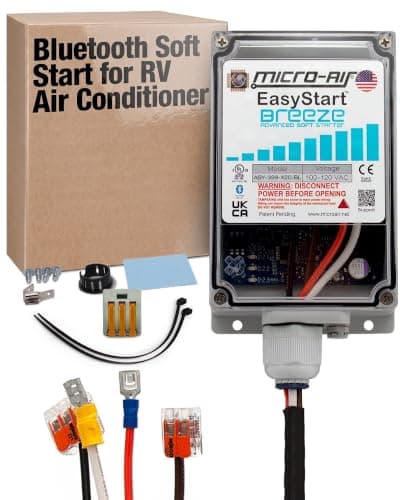
Micro-Air EasyStart 364 soft starter

65-75% start current reduction against locked-rotor amperage, up to 3 ton.

A compressor that will not start
2
No photo

Enough for central air

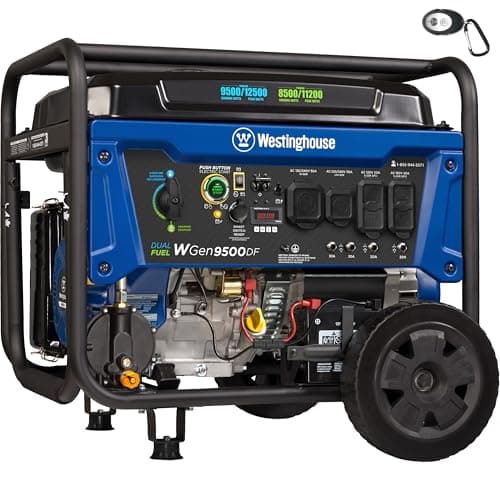
Westinghouse WGen9500DF

9,500 running watts, dual fuel, with a 30A transfer-switch outlet.

A 3 ton system plus the rest of the house
3
No photo

For a window unit, for hours

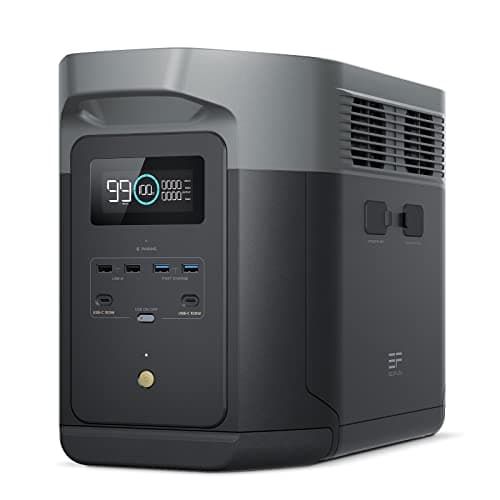
EcoFlow DELTA 2 Max

2,048Wh and 2,400W, expandable to 6,144Wh, 0-80% in 43 minutes.

Making one bedroom sleepable

Prices come from the retailer at page-build time and change constantly. Where no live price is available the button reads “Check price” rather than showing a number we cannot stand behind.

The picks in full

01Makes a smaller machine work

Micro-Air EasyStart 364 soft starter

65-75% start current reduction against locked-rotor amperage, up to 3 ton.

The only product that changes the arithmetic on this page. Reducing the starting surge by 65-75% can bring a unit inside a generator that would otherwise be a tier too small.

It is fitted to the air conditioner rather than the generator, and it changes nothing about the running draw.

Skip it ifyour problem is runtime rather than starting. This does nothing for consumption.

Published specifications for the Micro-Air EasyStart 364 soft starter
SpecificationPublished figure
Reduction65-75% start current reduction vs compressor LRA
CapacityUp to 36,000 BTU (3 ton) compressor
Method4-part self-optimizing start ramp
EnclosureWater resistant, UV protected, integrated mounting flange
Fitted toThe air conditioner, not the generator

Source: Micro-Air — EasyStart 364 product page. These are the manufacturer's published figures, not ours — we have not tested this unit.

02Enough for central air

Westinghouse WGen9500DF

9,500 running watts, dual fuel, with a 30A transfer-switch outlet.

Champion publishes 5,000-6,000 starting watts for a 3 ton central system, which is why central air pushes households into this size bracket and not a smaller one.

The transfer switch matters here too — central air is hardwired, so no extension cord reaches it.

Skip it ifyou only need a window unit. That is a much smaller machine.

Published specifications for the Westinghouse WGen9500DF
SpecificationPublished figure
Output (gasoline)9,500 running W / 12,500 peak W
FuelGasoline or propane (dual fuel)
Engine457cc 4-stroke OHV, cast iron sleeve
Tank6.6 gal (25 L)
Run timeup to 12 h on a full tank
Transfer-switch outlet120/240 V L14-30R, 30 A
RV outlet120/240 V 14-50R, 50 A
StartingPush-button electric with remote key fob
Warranty3-year limited

Source: Westinghouse — WGen9500DF product specifications. These are the manufacturer's published figures, not ours — we have not tested this unit.

03For a window unit, for hours

EcoFlow DELTA 2 Max

2,048Wh and 2,400W, expandable to 6,144Wh, 0-80% in 43 minutes.

2,400W clears the 900-1,200W starting surge Champion publishes for a 10,000 BTU window unit, and handles a 5,000 BTU unit easily.

Runtime is the limit rather than starting: 2,048Wh at a 5,000 BTU unit's 450-600W is roughly three hours after inverter losses.

Skip it ifyou want to cool a house. No portable battery does that.

Published specifications for the EcoFlow DELTA 2 Max
SpecificationPublished figure
Capacity2,048 Wh, expandable to 6,144 Wh
Output2,400 W continuous
ChemistryLiFePO4, 3,000+ cycles to 80%
AC recharge0–80% in 43 minutes
Solar inputup to 1,000 W
Outlets15 total
Noiseas low as 30 dB

Source: EcoFlow — DELTA 2 Max published specifications. These are the manufacturer's published figures, not ours — we have not tested this unit.

How these were chosen

We did not test these. Nobody at Watt & Warden has plugged one in. What we did instead: read the manufacturer's published specifications, compile them into a table where the figures line up, and compute the numbers manufacturers leave out — runtime against a real appliance load, and what an hour of running actually costs.

Anything that could not be sourced was left out rather than estimated, and every pick names the buyer who should skip it. The full method is here, including where it is weaker than a publisher with a test bench.

Questions people actually ask

How many watts does an air conditioner use?

Champion publishes 450-600 running and 900-1,200 starting watts for a 5,000 BTU window unit, 900-1,200 and 1,800-2,400 for a 10,000 BTU unit, and 3,000-3,500 running with 5,000-6,000 starting for a 3 ton central system. Your own nameplate is the figure to size against.

How do I convert BTU to watts for an air conditioner?

You cannot with a fixed factor. BTU per hour is cooling capacity -- how much heat is moved -- while watts is electrical consumption. A heat pump moves several times more heat energy than the electricity it uses, and the ratio is the unit's efficiency, so two units of the same BTU can draw different amounts.

Why does an air conditioner need so many starting watts?

The compressor is a motor starting under load, beginning to compress refrigerant against system pressure from standstill. Restarting soon after shutdown is hardest because pressures have not equalized -- which is why a unit can start fine ten times and trip on the eleventh, and why an anti-short-cycle delay helps.

Can a soft starter let me use a smaller generator?

Often, yes. Micro-Air publishes a 65-75% reduction in starting current against the compressor's locked-rotor amperage, which on a 3 ton system needing 5,000-6,000 starting watts can be the difference between a 9,500W machine and something smaller. It does nothing for the running draw.

Are inverter air conditioners better for generators and batteries?

Yes, on both counts. They vary compressor speed rather than cycling at full output, so they start gently -- much lower surge -- and settle to a partial load once the space is at temperature, giving a lower average draw than the nameplate. Worth paying for if you expect to run one on backup power.

Sources

Every figure on this page comes from a published source. We have not tested this equipment, so the specifications are the manufacturer's and the statistics are the dataset's — the arithmetic on top of them is ours, and it is shown in full so you can check it. How we work this out.