Skip to content
Watt Warden

Outage Prep

How to Stay Cool Without Power

Cooling a house electrically is a losing fight against physics and a battery. Cooling a person is a 30 watt problem, and that difference is the whole strategy.

By Sawyer V.Updated Published How we work this out
The shadow of an electric fan cast across a floor.

Watt & Warden earns a commission on qualifying purchases made through links on this page, at no extra cost to you. It never changes a ranking, and our picks include products we tell you to skip. Full disclosure.

Why cooling is harder than heating

In winter you can burn something. Propane, wood and natural gas all make heat directly, which is why staying warm without power has good answers that do not involve electricity at all.

There is no equivalent for cold. Refrigeration requires a compressor, a compressor requires a motor, and a motor requires electricity. Every route to a cooler room runs through watts.

So the strategy has to change: stop trying to cool the room, and start trying to cool the person.

The numbers that force the decision

ApproachDrawHours from 1,056 Wh
USB or battery personal fan5-15 WDays
Box or pedestal fanAbout 50 WAbout 18 hours
Ceiling fan15-90 W10 hours to days, but usually hardwired
Evaporative cooler, small50-200 W4-18 hours, and only useful in dry climates
Window air conditioner1,200 W running, more to startAbout 45 minutes
Central air conditioning3,000-5,000 W to startWill not start at all

Hours are 1,056 Wh x 0.85 / draw. Fan and air conditioner figures are the ranges used across this site; see the appliance wattage chart.

The gap between rows two and five is a factor of twenty-four. That is the entire argument for fans, and it is why a modest battery plus a fan outperforms a large battery plus an air conditioner for every hour after the first.

Why a fan works when it makes no cold

A fan does not lower air temperature — it slightly raises it, because the motor produces heat. What it does is move air across skin, which speeds evaporation of sweat and carries heat away from the body.

The practical effect is a perceived temperature drop of several degrees for a load of fifty watts. That is the best efficiency available anywhere in this problem.

Two consequences worth acting on. A fan pointed at a person does far more than a fan pointed at a room, so aim it. And a fan in an empty room is pure waste, so turn it off when you leave.

The free moves, in order

1. Close the house during the day. Windows, blinds and curtains shut on the sunny side. Most summer heat gain is solar through glass, and blocking it costs nothing.

2. Open it at night. Once outside is cooler than inside, open windows on opposite sides and put a fan in one of them pointing out. A whole house can be flushed in an hour this way.

3. Move downstairs. Heat stratifies. A basement can be ten degrees cooler than an upstairs bedroom without anything being done to it.

4. Stop making heat. No oven, no stove, no dryer. Cook outdoors on a propane stove instead — the cooking page covers that.

5. Cool the person. Damp towel on the neck, cool shower, feet in cold water, loose clothing. These are genuinely effective and cost nothing.

The part that is actually dangerous

Heat kills more people in the United States in a typical year than any other weather hazard, and a summer outage removes cooling from exactly the households least able to manage without it.

  • Know the warning signs. Heavy sweating that stops, confusion, a rapid pulse and a very high body temperature are heat stroke and are a medical emergency, not something to manage at home.
  • Check on older neighbors. Older adults lose heat less efficiently and are less likely to feel thirsty.
  • A fan alone stops helping above about 95 degF. Past that, moving hot air over skin does little, and the right move is to go somewhere air conditioned — a cooling center, a library, a relative.
  • Drink water before you feel thirsty, and remember a well pump will not be running. The water storage page covers what to keep.

The refrigerator is the other summer problem

Summer outages are the ones where food spoils fastest, and the ambient temperature makes a closed refrigerator lose its four-hour margin more quickly than in winter.

If you have to choose what the battery runs, the refrigerator beats the fan — the freezer page covers the food-safety timings. A fan on a separate battery solves both.

The short version

  • Cool the person, not the house. 50W versus 1,200W.
  • Close up by day, flush the house at night. Free, and the biggest single effect.
  • A window unit is about 45 minutes on a 1,000Wh battery. Plan for bursts, not sessions.
  • Above about 95 degF a fan stops being enough. Go somewhere cooled.

Quick picks

#ProductBest forPrice
1
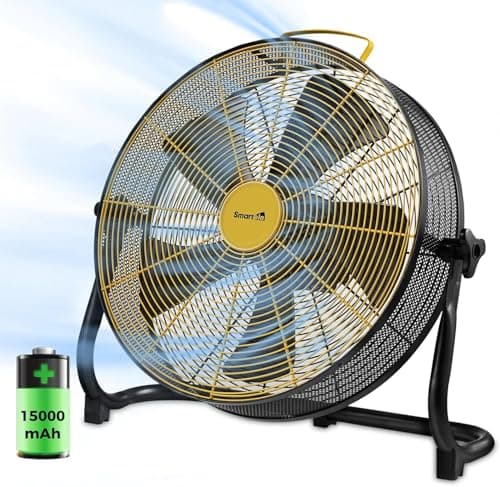
Smartele QF16 16 in Battery Floor Fan

Best overall

Smartele QF16 16 in Battery Floor Fan

2,500 CFM from a 15,000mAh rechargeable pack, with fast charging between outages.

Moving real air in a room with nothing plugged in
$169.00 · Check price on Amazon

#ad how this is funded · price as of October 21, 2026

2
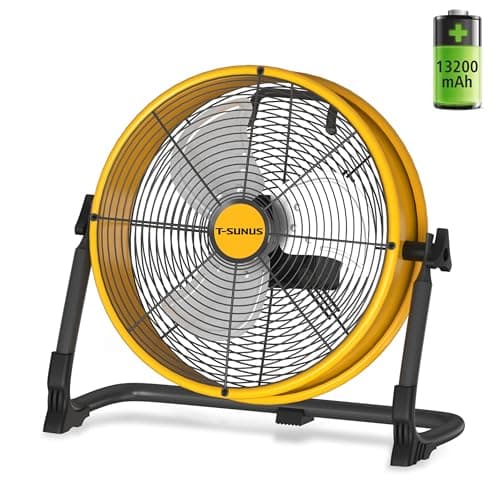
T-SUNUS 12 in Battery Floor Fan

Best for a bedroom

T-SUNUS 12 in Battery Floor Fan

1,500 CFM from a 13,200mAh battery, in a size you can carry one-handed.

Enough air for one person to sleep
$47.06 · Check price on Amazon

#ad how this is funded · price as of October 21, 2026 · $52.15 10% off

3
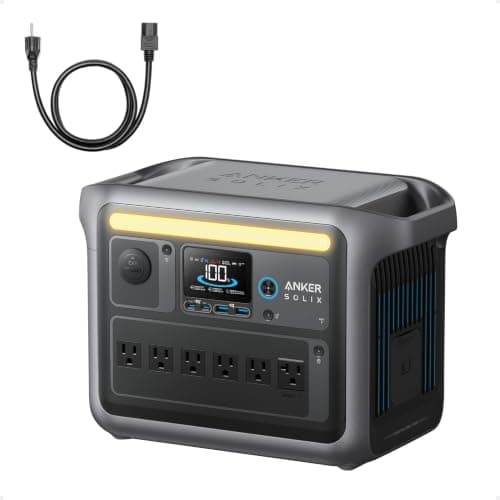
Anker SOLIX C1000

Best if you own a battery already

Anker SOLIX C1000

1,056Wh and 1,800W — many days of a box fan, or a window unit for under an hour.

Running ordinary fans, and everything else
$499.99 · Check price on Amazon

#ad how this is funded · price as of October 21, 2026 · $599.99 17% off

4
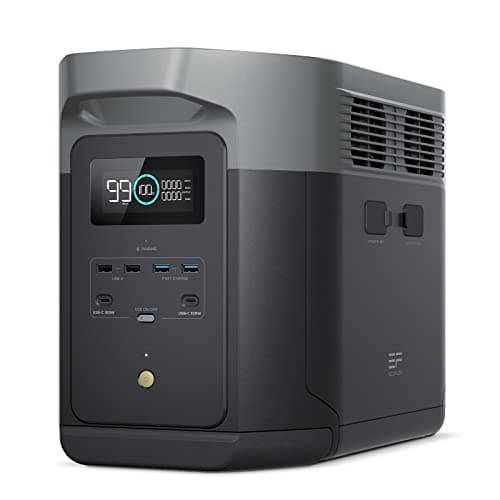
EcoFlow DELTA 2 Max

The realistic air conditioning answer

EcoFlow DELTA 2 Max

2,048Wh and 2,400W — roughly 1.4 hours of a 1,200W window unit.

A window unit, in short bursts, to knock the peak off
$1,049.00 · Check price on Amazon

#ad how this is funded · price as of October 21, 2026 · $1,399.00 25% off

Prices come from the retailer at page-build time and change constantly. Where no live price is available the button reads “Check price” rather than showing a number we cannot stand behind.

The picks in full

01 — Best overall

Smartele QF16 16 in Battery Floor Fan

2,500 CFM from a 15,000mAh rechargeable pack, with fast charging between outages.

2,500 CFM is genuine airflow rather than the desk-fan breeze most battery products manage. That matters because air movement is what makes a warm room tolerable.

A 15,000mAh pack is a real battery rather than a token one, and fast charging is the feature that matters across a flickering multi-day event — every window where the grid returns is a refill.

Sixteen inches is the size at which a battery fan stops being a gadget and starts behaving like the box fan it is replacing.

The honest catch: Smartele publishes the airflow and the battery capacity but no runtime at all, so there is no manufacturer figure for how long 2,500 CFM lasts. Expect high speed to drain the pack quickly.

Skip it ifyou already own a big power station. Then an ordinary box fan is cheaper.

Smartele QF16 16 in Battery Floor Fan
$169.00 · Check price on Amazon

#ad how this is funded · price as of October 21, 2026

Published specifications for the Smartele QF16 16 in Battery Floor Fan
SpecificationPublished figure
Size16 in, high velocity
Airflow2,500 CFM
Battery15,000 mAh, rechargeable
ChargingFast charging, per the listing
RuntimeNot stated in the listing we checked
UseListed for patio, gym, camping, travel and backyard use

Source: Smartele — QF16 16 in battery operated floor fan listing. These are the manufacturer's published figures, not ours — we have not tested this unit.

02 — Best for a bedroom

T-SUNUS 12 in Battery Floor Fan

1,500 CFM from a 13,200mAh battery, in a size you can carry one-handed.

Sleeping is where an outage in summer actually hurts, and a fan beside the bed solves that for one person at a fraction of the cost of solving it for a house.

Being carryable matters more than it sounds — this follows you from the kitchen to the bedroom rather than living in one place.

The honest catch: 1,500 CFM will not move air through a whole floor. It is a personal cooling device with a metal blade.

Skip it ifyou want to cool a living room full of people.

T-SUNUS 12 in Battery Floor Fan
$47.06 · Check price on Amazon

#ad how this is funded · price as of October 21, 2026 · $52.15 10% off

Published specifications for the T-SUNUS 12 in Battery Floor Fan
SpecificationPublished figure
Size12 in
Airflow1,500 CFM
Battery13,200 mAh, rechargeable
MotorBrushless
Adjustment360 degree tilt
RuntimeNot stated in the listing we checked
UseCordless, for camping, tents, RV, garage and outages

Source: T-SUNUS — 12 in battery powered floor fan listing. These are the manufacturer's published figures, not ours — we have not tested this unit.

03 — Best if you own a battery already

Anker SOLIX C1000

1,056Wh and 1,800W — many days of a box fan, or a window unit for under an hour.

An ordinary 50W box fan on a 1,056Wh battery runs for about eighteen hours. Two of them run for nine. That is a much better use of a general-purpose battery than trying to run a compressor.

The same battery also covers the refrigerator, which in a summer outage is the thing actually at risk.

The honest catch: 1,800W will start a small window air conditioner and then empty in well under an hour. Do not plan around that.

Skip it ifa fan is genuinely all you need. A dedicated battery fan is far cheaper.

Anker SOLIX C1000
$499.99 · Check price on Amazon

#ad how this is funded · price as of October 21, 2026 · $599.99 17% off

Published specifications for the Anker SOLIX C1000
SpecificationPublished figure
Usable capacity1,056 Wh
Cell chemistryLiFePO4 (LFP)
AC output1,800 W continuous / 2,400 W SurgePad
Cycle life3,000 cycles
Wall recharge80% in 43 min, full in 58 min
Max solar input600 W (full solar recharge ~1.8 h)
Ports11 total, including 6 AC on panel-equipped bundles

Source: Anker — SOLIX C1000 product specifications. These are the manufacturer's published figures, not ours — we have not tested this unit.

04 — The realistic air conditioning answer

EcoFlow DELTA 2 Max

2,048Wh and 2,400W — roughly 1.4 hours of a 1,200W window unit.

If air conditioning is non-negotiable, this is the honest shape of it: an hour or so on a small window unit, used deliberately to cool one room before bed rather than run continuously.

The air conditioner page works the arithmetic through properly, including starting surge.

The honest catch: that single burst is most of the battery, and it leaves nothing for the refrigerator.

Skip it ifyou expect to run air conditioning overnight. Nothing portable does that.

EcoFlow DELTA 2 Max
$1,049.00 · Check price on Amazon

#ad how this is funded · price as of October 21, 2026 · $1,399.00 25% off

Published specifications for the EcoFlow DELTA 2 Max
SpecificationPublished figure
Capacity2,048 Wh, expandable to 6,144 Wh
Output2,400 W continuous
ChemistryLiFePO4, 3,000+ cycles to 80%
AC recharge0–80% in 43 minutes
Solar inputup to 1,000 W
Outlets15 total
Noiseas low as 30 dB

Source: EcoFlow — DELTA 2 Max published specifications. These are the manufacturer's published figures, not ours — we have not tested this unit.

How these were chosen

We did not test these. Nobody at Watt & Warden has plugged one in. What we did instead: read the manufacturer's published specifications, compile them into a table where the figures line up, and compute the numbers manufacturers leave out — runtime against a real appliance load, and what an hour of running actually costs.

Anything that could not be sourced was left out rather than estimated, and every pick names the buyer who should skip it. The full method is here, including where it is weaker than a publisher with a test bench.

Questions people actually ask

How do you stay cool during a power outage?

Close the house against the sun during the day, flush it with cooler air at night using a fan in an open window, move to the lowest floor, stop using the oven and stove, and cool yourself directly with damp towels and cool showers. A battery-powered fan aimed at a person does most of the remaining work for about fifty watts.

Can a power station run an air conditioner?

A window unit, for about 45 minutes from a 1,056Wh battery or roughly 1.4 hours from a 2,048Wh one, and only if the inverter can absorb the compressor's starting surge. Central air conditioning needs 3,000 to 5,000W just to start and will not run on any portable battery.

Are battery powered fans worth it?

For an outage in summer, yes -- more so than almost anything else you can buy. A dedicated battery fan moving 1,500 to 2,500 CFM runs for hours on its own pack, with no power station involved. If you already own a large battery, an ordinary 50W box fan on it runs about eighteen hours and costs far less.

How many watts does a fan use?

About 50W for a box or pedestal fan, 5 to 15W for a small personal or USB fan, and 15 to 90W for a ceiling fan depending on speed. Compare that with 1,200W for a window air conditioner -- a factor of twenty-four, which is why fans are the whole strategy.

When is a fan not enough?

Above roughly 95 degrees Fahrenheit, moving hot air across skin does little and can make things worse. At that point the correct move is to go somewhere air conditioned -- a cooling center, a library, a relative's house. Heat stroke, marked by confusion and sweating that stops, is a medical emergency rather than something to manage at home.

Sources

Every figure on this page comes from a published source. We have not tested this equipment, so the specifications are the manufacturer's and the statistics are the dataset's — the arithmetic on top of them is ours, and it is shown in full so you can check it. How we work this out.