Skip to content
Watt Warden

Sizing

How Much Power Does a Microwave Use?

A microwave is labeled with what it puts into the food, not what it takes from the outlet. The gap between those two numbers is about 50%, and it is what trips undersized inverters.

By Sawyer V.Updated Published How we work this out
A contemporary kitchen with granite countertops.

Watt & Warden earns a commission on qualifying purchases made through links on this page, at no extra cost to you. It never changes a ranking, and our picks include products we tell you to skip. Full disclosure.

Two numbers, and the label shows the wrong one

This is the single most useful thing on the page, and it catches almost everyone.

Cooking power is what the microwave delivers into the food. It is the number on the door, in the manual and in the listing — 700W, 900W, 1,000W, 1,200W.

Input power is what it draws from the outlet. A magnetron is roughly two-thirds efficient, and the turntable motor, fan, light and control board add a little more.

Cooking power on the doorTypical draw at the wallInverter needed
700 WAround 1,000-1,100 W1,200 W or more
900 WAround 1,300-1,400 W1,500 W or more
1,000 WAround 1,400-1,600 W1,800 W or more
1,200 WAround 1,700-1,900 W2,000 W or more

Input figures are typical ranges based on the roughly two-thirds efficiency of a magnetron plus accessories. Your own unit prints its input rating on a plate at the back or inside the door — reading a nameplate explains where to look.

So the rule of thumb is: add about 50% to the door number, then buy an inverter above that. A 1,000W microwave on a 1,200W inverter will not run, and that is exactly the disappointment this page exists to prevent.

The energy cost is trivial

Having established that the power draw is large, here is the other half: a microwave uses almost no energy, because it runs for minutes.

TaskRun timeEnergy at 1,500 W input
Reheat a mug of coffee1 minute25 Wh
Reheat a plate of food3 minutes75 Wh
Cook a frozen meal8 minutes200 Wh
Boil two cups of water4 minutes100 Wh

Energy is input watts x minutes / 60. Times vary with the food and the unit.

A 1,056Wh battery therefore holds roughly a dozen plate reheats. The constraint is never capacity — it is whether the inverter can deliver 1,500W for those three minutes.

Standby draw, which is the annoying part

A microwave with a clock and a touch panel draws something in the region of 2 to 7 watts continuously, whether or not you use it.

Trivial on the grid. On a battery during an outage it is roughly 50 to 170 watt-hours a day — comparable to leaving a lightbulb on, for a clock you are not looking at.

The fix is to unplug it between uses when you are running on stored power. The same applies to the television, the cable box and anything else with a standby light.

Where it sits against the alternatives

Worth framing honestly, because a microwave is one of the better outage cooking options and one of the worst.

Better than it looks: it uses very little energy per meal, it heats food quickly, it produces no combustion products, and it works indoors — which none of the fuel-burning alternatives do.

Worse than it looks: it needs a large instantaneous draw, which is exactly what small batteries and small inverters cannot provide.

For a household with a 1,000Wh-plus battery, a microwave is a genuinely good outage cooking plan. The cooking without power page covers the propane alternatives for everyone else, and the camping watts page works the same arithmetic for a smaller setup.

The short version

  • Add 50% to the door number. 1,000W cooking is about 1,500W at the wall.
  • Size the inverter, not the battery. Energy per meal is tiny.
  • 1,800W of inverter is the practical threshold for a standard household microwave.
  • Unplug it between uses on battery — the clock costs more than the cooking.

Quick picks

#ProductBest forPrice
1
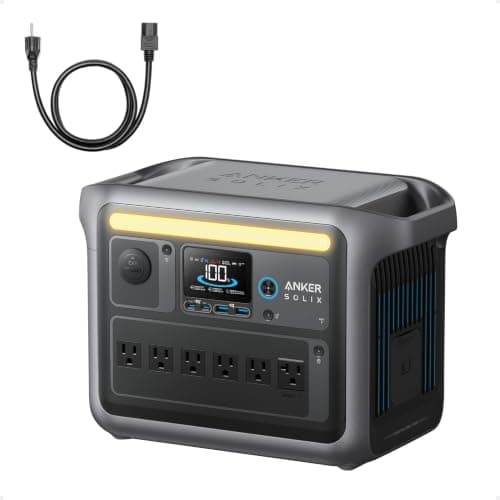
Anker SOLIX C1000

The smallest battery that runs one

Anker SOLIX C1000

1,056Wh with an 1,800W inverter and 2,400W of surge headroom.

Reheating, not cooking
$499.99 · Check price on Amazon

#ad how this is funded · price as of October 20, 2026 · $599.99 17% off

2
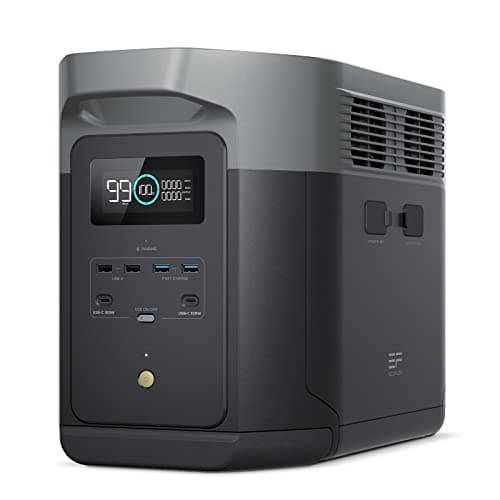
EcoFlow DELTA 2 Max

Best headroom

EcoFlow DELTA 2 Max

2,048Wh and 2,400W continuous — margin over any household microwave.

A larger microwave, and everything else running
$1,049.00 · Check price on Amazon

#ad how this is funded · price as of October 20, 2026 · $1,399.00 25% off

3
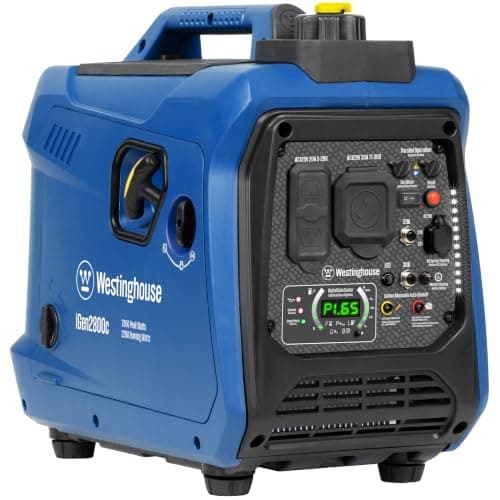
Westinghouse iGen2800

The generator answer

Westinghouse iGen2800

2,200 running watts of inverter output at as low as 52 dBA.

Cooking during a long outage
$499.00 · Check price on Amazon

#ad how this is funded · price as of October 20, 2026

4
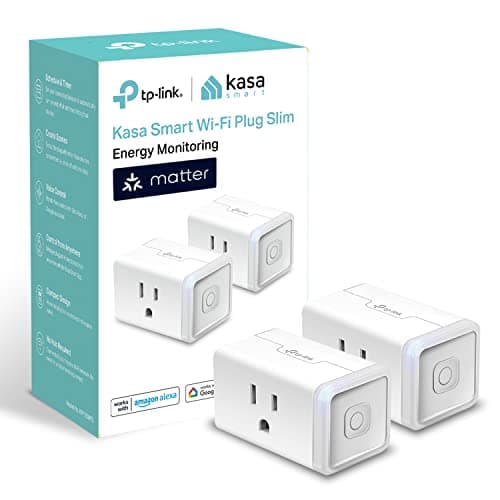
Kasa KP125M Smart Plug

Settle it for your own kitchen

Kasa KP125M Smart Plug

A 15A / 1,800W smart plug that logs real and historical draw.

Measuring input watts rather than reading the door
$29.99 · Check price on Amazon

#ad how this is funded · price as of October 20, 2026

Prices come from the retailer at page-build time and change constantly. Where no live price is available the button reads “Check price” rather than showing a number we cannot stand behind.

The picks in full

01 — The smallest battery that runs one

Anker SOLIX C1000

1,056Wh with an 1,800W inverter and 2,400W of surge headroom.

1,800W of continuous inverter output is the threshold that runs a typical 1,000W microwave, which draws around 1,500W at the wall.

Capacity barely matters here because a microwave runs in minutes, not hours — the arithmetic below shows how little energy a reheat actually costs.

The honest catch: at 1,500W draw this battery is delivering close to its limit. Do not run the fridge and the microwave at the same instant.

Skip it ifyour microwave is a 1,200W model. Check the input rating on the back first.

Anker SOLIX C1000
$499.99 · Check price on Amazon

#ad how this is funded · price as of October 20, 2026 · $599.99 17% off

Published specifications for the Anker SOLIX C1000
SpecificationPublished figure
Usable capacity1,056 Wh
Cell chemistryLiFePO4 (LFP)
AC output1,800 W continuous / 2,400 W SurgePad
Cycle life3,000 cycles
Wall recharge80% in 43 min, full in 58 min
Max solar input600 W (full solar recharge ~1.8 h)
Ports11 total, including 6 AC on panel-equipped bundles

Source: Anker — SOLIX C1000 product specifications. These are the manufacturer's published figures, not ours — we have not tested this unit.

02 — Best headroom

EcoFlow DELTA 2 Max

2,048Wh and 2,400W continuous — margin over any household microwave.

2,400W means a 1,200W microwave at roughly 1,800W input still leaves room for the refrigerator to cycle without the inverter complaining.

That margin is what makes a battery feel like power rather than like rationing.

The honest catch: it is heavier and costs more for capability you only need in the few minutes a day the microwave runs.

Skip it ifyou only ever reheat coffee. That is a smaller purchase.

EcoFlow DELTA 2 Max
$1,049.00 · Check price on Amazon

#ad how this is funded · price as of October 20, 2026 · $1,399.00 25% off

Published specifications for the EcoFlow DELTA 2 Max
SpecificationPublished figure
Capacity2,048 Wh, expandable to 6,144 Wh
Output2,400 W continuous
ChemistryLiFePO4, 3,000+ cycles to 80%
AC recharge0–80% in 43 minutes
Solar inputup to 1,000 W
Outlets15 total
Noiseas low as 30 dB

Source: EcoFlow — DELTA 2 Max published specifications. These are the manufacturer's published figures, not ours — we have not tested this unit.

03 — The generator answer

Westinghouse iGen2800

2,200 running watts of inverter output at as low as 52 dBA.

2,200 running watts covers a standard 1,000W microwave with a little to spare, and inverter output matters because a microwave's control board and inverter-drive magnetron are electronics.

Under 3% total harmonic distortion is the published figure, which is the kind of number a conventional machine does not print.

The honest catch: one appliance at a time. A microwave on this machine means nothing else large is running.

Skip it ifyour microwave draws more than 2,200W at the wall.

Westinghouse iGen2800
$499.00 · Check price on Amazon

#ad how this is funded · price as of October 20, 2026

Published specifications for the Westinghouse iGen2800
SpecificationPublished figure
Output2,800 peak W / 2,200 running W
Noise52 dBA
Weight46.3 lb (21 kg)
Tank0.98 gal (3.7 L)
Run timeUp to 10 hours at 25% load
Outlets2x 120V 5-20R household, 2x USB
WaveformLess than 3% THD
StartingRecoil with manual choke
Warranty3-year limited residential with lifetime technical support

Source: Westinghouse — iGen2800 product specifications. These are the manufacturer's published figures, not ours — we have not tested this unit.

04 — Settle it for your own kitchen

Kasa KP125M Smart Plug

A 15A / 1,800W smart plug that logs real and historical draw.

The fastest way to end the cooking-versus-input confusion is to put a meter between the microwave and the wall and run it for two minutes.

It also shows the standby draw, which is small, constant and surprisingly annoying on a battery.

The honest catch: rated to 1,800W. A large over-the-range unit can exceed that, and those are hardwired anyway.

Skip it ifyour microwave is built in or over the range. Those are hardwired.

Kasa KP125M Smart Plug
$29.99 · Check price on Amazon

#ad how this is funded · price as of October 20, 2026

Published specifications for the Kasa KP125M Smart Plug
SpecificationPublished figure
Rating100-120 V, 15 A, 1,800 W maximum
MonitoringReal-time and historical consumption, per outlet
BillingRate entry for single or time-of-use estimates
ControlSchedules, auto-off timers and presets in the Kasa app
StandardsMatter, 2.4 GHz Wi-Fi, UL certified
VoiceAlexa, Google Assistant and Siri
Size2.6 x 1.5 x 1.6 in

Source: TP-Link — Kasa KP125M product specifications. These are the manufacturer's published figures, not ours — we have not tested this unit.

How these were chosen

We did not test these. Nobody at Watt & Warden has plugged one in. What we did instead: read the manufacturer's published specifications, compile them into a table where the figures line up, and compute the numbers manufacturers leave out — runtime against a real appliance load, and what an hour of running actually costs.

Anything that could not be sourced was left out rather than estimated, and every pick names the buyer who should skip it. The full method is here, including where it is weaker than a publisher with a test bench.

Questions people actually ask

How many watts does a microwave use?

More than the label says. The number on the door is cooking power delivered into the food; the draw at the wall is roughly 50% higher because a magnetron is about two-thirds efficient. A 1,000W microwave typically pulls 1,400 to 1,600W from the outlet, and a 1,200W model approaches 1,900W.

What size inverter do I need for a microwave?

At least 1,800W continuous for a standard 1,000W household microwave, and 2,000W or more for a 1,200W model. Sizing against the door number rather than the input rating is the commonest mistake -- a 1,000W microwave on a 1,200W inverter simply will not run.

Can a power station run a microwave?

Yes, if the inverter is large enough -- 1,800W continuous is the practical threshold. Capacity is rarely the issue, because a three-minute reheat uses only about 75 watt-hours, so a 1,056Wh battery holds roughly a dozen of them. The constraint is delivering 1,500W for those three minutes.

How much electricity does a microwave use per month?

Very little for the cooking itself -- a few hundred watt-hours a week for typical use. The standby draw is more interesting: a microwave with a clock and touch panel uses 2 to 7 watts continuously, which is 1.5 to 5 kWh a month for a clock. On battery power during an outage, unplug it between uses.

Is a microwave a good way to cook during a power outage?

If you have a 1,000Wh-plus battery with an 1,800W inverter, yes -- it uses very little energy per meal, heats quickly, produces no combustion products and works indoors, which none of the fuel alternatives do. Without that inverter capacity it will not run at all, and propane is the answer instead.

Sources

Every figure on this page comes from a published source. We have not tested this equipment, so the specifications are the manufacturer's and the statistics are the dataset's — the arithmetic on top of them is ours, and it is shown in full so you can check it. How we work this out.