CFM is the specification. Nothing else is close.
Cubic feet per minute is how much air a fan actually moves, and it is the only number that predicts whether a room feels better.
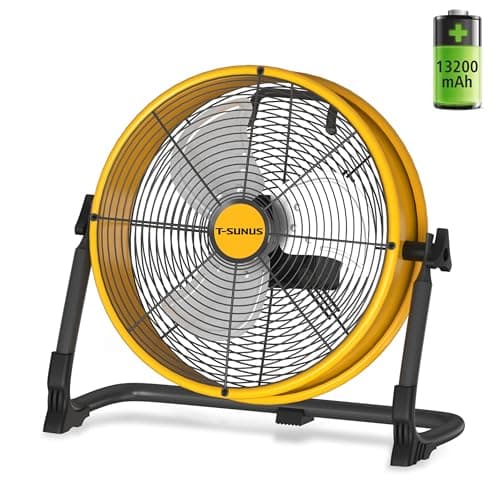
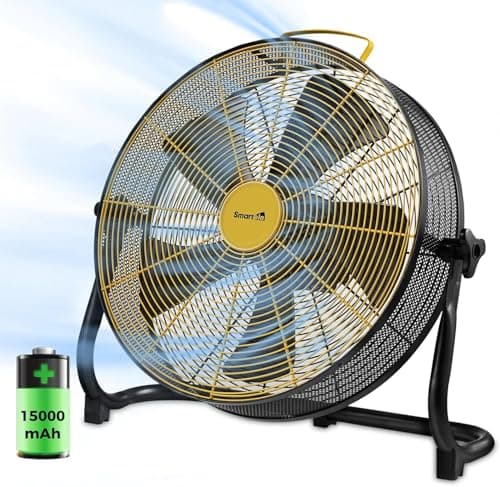
The category is full of products advertised on battery capacity — 10,000 mAh, 15,000 mAh — which tells you how long a fan runs and nothing about whether it is worth running. A 5W desk fan with an enormous battery will run for two days and move no useful air.
| Class | Typical CFM | What it actually does |
|---|
| USB clip or personal fan | Under 200 | Cools a face at close range |
|---|
| Small tabletop battery fan | 200-500 | One person, sitting still, nearby |
|---|
| 12 in battery floor fan | About 1,170 | A bedroom, or one corner of a living room |
|---|
| 16 in battery floor fan | About 1,900 | A room, or a window for flushing a house |
|---|
| Mains box fan, for comparison | 1,500-2,500 | The same job, tethered to an outlet |
|---|
Note the bottom row. A good battery floor fan is in the same airflow class as an ordinary mains box fan — which is the correct expectation to have, and a much higher bar than most of the category clears.
Nobody publishes a runtime you can rely on
Neither fan on this page carries a manufacturer runtime figure, and where the category does quote one it is always measured at the lowest speed.
That is not dishonest — the low setting is a real setting people use — but it means a headline runtime and a headline CFM are two numbers from opposite ends of the same dial, and you cannot have both at once. On high, expect a small fraction of any quoted figure.
The practical consequence: buy for the airflow you need at the speed you will actually run, use the battery capacity in mAh as your runtime proxy, and treat any quoted hours as a range rather than a promise.
Dedicated battery fan, or a power station and a box fan?
A genuine fork, and the answer depends on what else you own.
| Dedicated battery fan | Power station plus box fan |
|---|
| Best if | The fan is the only thing you want backed up | You want the fridge and the network too |
|---|
| Portability | One object, carry it outside | Two objects and a cord |
|---|
| Runtime | Longer — the pack is matched to the motor | About 18 hours per 1,000 Wh at 50 W |
|---|
| Flexibility | It is a fan. That is all it is | Runs anything with a plug |
|---|
| Recharges from solar | Generally not | Yes |
|---|
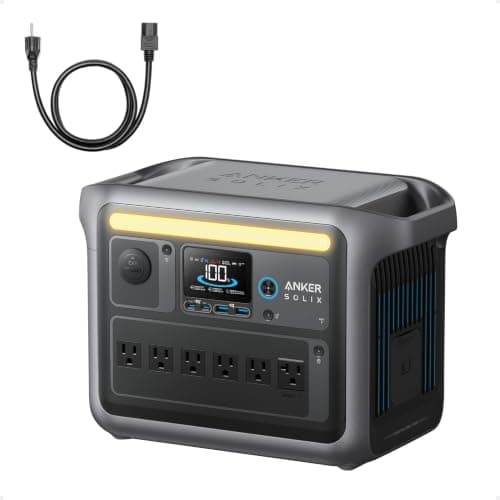
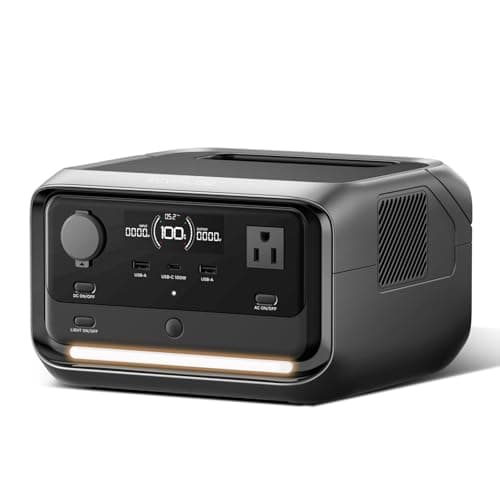
The honest summary: if you already own or intend to own a power station, a cheap mains fan on it is better value. If you do not, a dedicated battery fan is a far smaller purchase that solves the specific summer problem well.
Four features worth having
- A detachable or swappable battery. It turns runtime into something you can extend with a spare, and it means the fan outlives its first battery.
- USB output. Many of these double as a power bank, which is genuinely useful when the fan is the largest battery in the house.
- A metal blade and a real cage. These live in garages and get transported. Plastic blades crack.
- 360 degree tilt. Aiming a fan at a person rather than at a room roughly doubles its practical effect, and a fan that points straight up circulates a whole room far better than one that does not.
How to use a fan properly in an outage
Worth saying because it changes the result more than the product choice does.
Aim it at people, not at rooms. A fan makes no cold air — it speeds evaporation from skin. Pointed at an empty room it does nothing except add the motor's heat.
Put it in a window at night, pointing out. Once outside is cooler than inside, exhausting hot air with a window open on the opposite side flushes a whole house in about an hour. This is the single highest-value thing a fan does.
Turn it off when you leave the room. Runtime is finite and a fan cooling nobody is pure waste.
The staying cool page covers the rest of the strategy, including the point above roughly 95 degF where a fan stops helping at all.
The short version
- Buy on CFM. Battery capacity in mAh tells you nothing useful.
- Runtime headlines are low-speed figures. Expect far less on high.
- 1,000+ CFM is the bar for a fan that changes how a room feels.
- If you own a power station, buy a cheap mains fan instead.