Skip to content
Watt Warden

Sizing

How Much Power Does a TV Use?

A television is the cheapest comfort in an outage and one of the easiest loads to get wrong, because the number on the box is a maximum, not a normal evening.

By Sawyer V.Updated Published How we work this out
A dimly lit living room with a television showing static.

Watt & Warden earns a commission on qualifying purchases made through links on this page, at no extra cost to you. It never changes a ranking, and our picks include products we tell you to skip. Full disclosure.

The published range, and where your set sits

Champion's wattage chart puts a 32 to 55 inch television at 80 to 400 watts. That range is wide because it spans both screen size and panel technology, and because manufacturers quote maximum draw rather than typical viewing.

SetTypical draw while watchingFour-hour evening
32 in LED30-60 W120-240 Wh
43-50 in LED60-120 W240-480 Wh
55-65 in LED or QLED100-200 W400-800 Wh
Large OLED, bright scenesUp to 400 W in peaksVaries with content
Streaming box or stick3-15 W12-60 Wh
Soundbar20-50 W80-200 Wh

The 80 to 400W span is Champion's published figure for 32 to 55 inch sets. The per-size breakdown is the planning range used on this site; your own set states a maximum on the label at the back, and it will draw less than that in normal viewing.

Two things move a television's draw more than anything else, and neither is on the box. Brightness is the big one: a set in a bright picture mode can use twice what the same set uses in a dim room. Content matters on OLED, where a bright snowy scene lights every pixel and a dark one lights almost none.

Standby: the number that actually costs you

A modern television is never really off. It listens for the remote, keeps the HDMI handshake warm and checks for updates, which is somewhere in the region of half a watt to three watts continuously.

On the grid that is pennies. On a battery during an outage it is a slow leak: three watts for twenty-four hours is 72Wh, which is a quarter of a small power station gone on a set nobody watched.

The fix is a switch or a strip, and it applies to the whole media cabinet — the console, the soundbar, the cable box. In an outage, unplug what you are not using.

How long a battery runs a television

Planning at 85% inverter efficiency, and assuming a 100W set plus a 10W streaming box:

BatteryUsable energyHours of viewing
288 Wh~245 WhAbout 2.2 hours
512 Wh~435 WhAbout 4 hours
1,000 Wh~850 WhAbout 7.7 hours
2,000 Wh~1,700 WhOver 15 hours

Runtime is capacity x 0.85 divided by 110W. A larger set or a soundbar shortens these proportionally — halve them for a bright 65 inch panel with audio.

The practical conclusion: a television is a cheap load. An evening of viewing costs about half a kilowatt-hour, which is a fraction of what a refrigerator costs over the same period. If you own any battery at all, you can watch something.

Watching the news when the power is out

Worth a caution: during a widespread outage the television may not be the useful device you expect. Cable and internet service often fail with the grid, and a smart TV with no internet is a large, hungry paperweight.

Two more reliable options:

  • Keep the router and modem alive on a small UPS or a power station, which usually restores streaming if the provider's network is up — the router backup page covers this.
  • Own a battery radio. Emergency broadcasts do not depend on your internet connection — the weather radio roundup covers the NOAA-capable sets.

The short version

  • 80 to 400W published for 32 to 55 inch sets; 60 to 120W is typical for a mid-sized panel.
  • An evening of viewing is roughly 0.5 kWh, including a streaming box.
  • Standby draw runs all night. Unplug the cabinet when you are on battery.
  • A 500Wh battery covers an evening; 1kWh covers most of a day of intermittent viewing.

Quick picks

#ProductBest forPrice
1
Jackery Explorer 300

An evening of television

Jackery Explorer 300

292Wh and 300W — the smallest unit that runs a modern set.

One TV, a streaming box and phones
$259.00 · Check price on Amazon

#ad how this is funded · price as of October 21, 2026 · $289.00 10% off

2
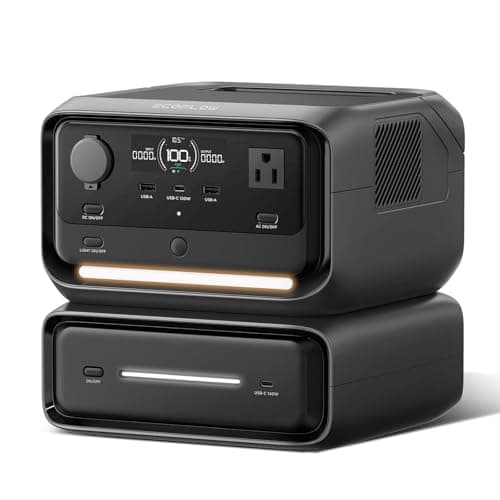
EcoFlow RIVER 3 Max

The sensible size

EcoFlow RIVER 3 Max

572Wh with 990W of output.

A television, the internet and the lights
$339.00 · Check price on Amazon

#ad how this is funded · price as of October 21, 2026 · $399.00 15% off

3
BLUETTI AC180

Television and the cold chain

BLUETTI AC180

1,152Wh, 1,800W continuous and 2,700W of surge.

Not choosing between comfort and the refrigerator
$449.00 · Check price on Amazon

#ad how this is funded · price as of October 21, 2026 · $499.00 10% off

4
Kasa KP125M Smart Plug

Find your own number

Kasa KP125M Smart Plug

A metering plug that logs real draw, including the standby load.

Replacing an 80-400W range with one figure
$29.99 · Check price on Amazon

#ad how this is funded · price as of October 21, 2026

Prices come from the retailer at page-build time and change constantly. Where no live price is available the button reads “Check price” rather than showing a number we cannot stand behind.

The picks in full

01 — An evening of television

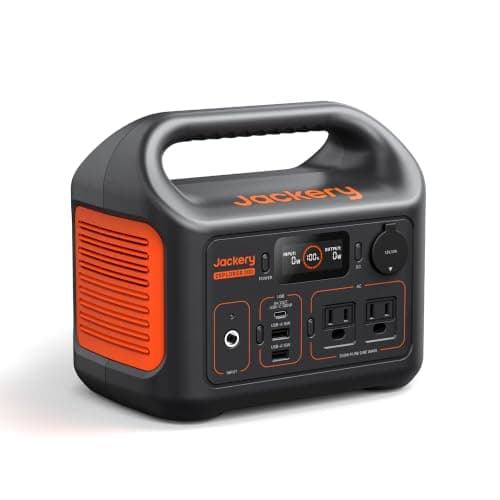
Jackery Explorer 300

292Wh and 300W — the smallest unit that runs a modern set.

A 100W set plus a streaming stick runs for about two and a half hours here, which is a film with the credits.

Eight pounds means it moves from the living room to the bedroom without ceremony.

The honest catch: 300W continuous is close to the line for a big set. Check the label on the back first.

Skip it ifyour television is a large plasma-era set or above 55 inches.

Jackery Explorer 300
$259.00 · Check price on Amazon

#ad how this is funded · price as of October 21, 2026 · $289.00 10% off

Published specifications for the Jackery Explorer 300
SpecificationPublished figure
Usable capacity292 Wh
AC output300 W
ClassSmall station for electronics, lights and a CPAP

Source: Jackery — Explorer 300 product page. These are the manufacturer's published figures, not ours — we have not tested this unit.

02 — The sensible size

EcoFlow RIVER 3 Max

572Wh with 990W of output.

Five hundred watt-hours is roughly four hours of a mid-sized TV plus a router, which covers an evening outage completely.

The one-hour refill means it is full again by morning if the grid returns at all.

The honest catch: 990W of output rules out anything with a heating element sharing the unit.

Skip it ifthe refrigerator also has to run from it.

EcoFlow RIVER 3 Max
$339.00 · Check price on Amazon

#ad how this is funded · price as of October 21, 2026 · $399.00 15% off

Published specifications for the EcoFlow RIVER 3 Max
SpecificationPublished figure
Usable capacity572 Wh
AC output990 W
ClassCompact station for electronics, lights and a CPAP

Source: EcoFlow — RIVER 3 Max listing. These are the manufacturer's published figures, not ours — we have not tested this unit.

03 — Television and the cold chain

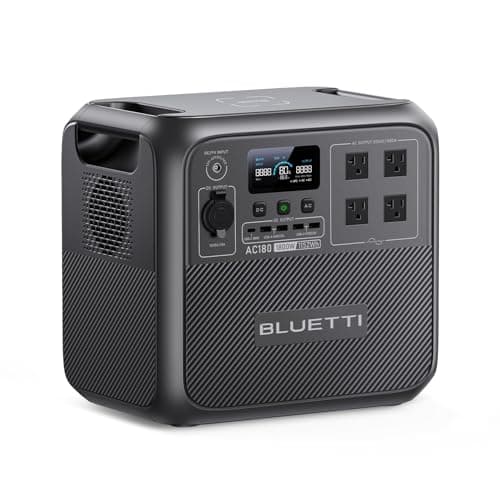
BLUETTI AC180

1,152Wh, 1,800W continuous and 2,700W of surge.

Most households that think they want a TV battery actually want a refrigerator battery that also runs the TV.

The surge headroom here covers the compressor, and a television is a rounding error beside it.

The honest catch: 35.3 lb and a price to match the capability.

Skip it ifthe TV is genuinely the only thing you want to run.

BLUETTI AC180
$449.00 · Check price on Amazon

#ad how this is funded · price as of October 21, 2026 · $499.00 10% off

Published specifications for the BLUETTI AC180
SpecificationPublished figure
Usable capacity1,152 Wh (32 V, 36 Ah)
Cell chemistryLiFePO4 (LFP)
AC output1,800 W continuous / 2,700 W surge, 4 outlets
Cycle life3,500+ cycles to 80% capacity
Weight35.3 lb
Fast charge0–80% in 45 min
Max solar input500 W
Warranty5 years on registration

Source: BLUETTI — AC180 product specifications. These are the manufacturer's published figures, not ours — we have not tested this unit.

04 — Find your own number

Kasa KP125M Smart Plug

A metering plug that logs real draw, including the standby load.

The published range is wide because screen size and technology vary enormously. An evening of logging gives you the actual figure.

It will also show the standby draw, which is the part of this page people find surprising.

The honest catch: one plug, one appliance. A whole media cabinet needs a strip and a different measuring approach.

Skip it ifyour set is wall-mounted with the outlet buried behind it.

Kasa KP125M Smart Plug
$29.99 · Check price on Amazon

#ad how this is funded · price as of October 21, 2026

Published specifications for the Kasa KP125M Smart Plug
SpecificationPublished figure
Rating100-120 V, 15 A, 1,800 W maximum
MonitoringReal-time and historical consumption, per outlet
BillingRate entry for single or time-of-use estimates
ControlSchedules, auto-off timers and presets in the Kasa app
StandardsMatter, 2.4 GHz Wi-Fi, UL certified
VoiceAlexa, Google Assistant and Siri
Size2.6 x 1.5 x 1.6 in

Source: TP-Link — Kasa KP125M product specifications. These are the manufacturer's published figures, not ours — we have not tested this unit.

How these were chosen

We did not test these. Nobody at Watt & Warden has plugged one in. What we did instead: read the manufacturer's published specifications, compile them into a table where the figures line up, and compute the numbers manufacturers leave out — runtime against a real appliance load, and what an hour of running actually costs.

Anything that could not be sourced was left out rather than estimated, and every pick names the buyer who should skip it. The full method is here, including where it is weaker than a publisher with a test bench.

Questions people actually ask

How many watts does a TV use?

Champion's published wattage chart gives 80 to 400W for 32 to 55 inch televisions. In normal viewing a 32 inch LED is typically 30 to 60W, a 43 to 50 inch set is 60 to 120W, and a large 55 to 65 inch panel is 100 to 200W. Brightness settings move the figure more than anything else.

How long can a power station run a TV?

At about 110W for a mid-sized set plus a streaming box, a 572Wh battery gives roughly four hours and a 1,000Wh battery about seven and a half, planning at 85% inverter efficiency. A bright 65 inch panel with a soundbar roughly halves those figures.

Does a TV use power when it is off?

Yes -- typically half a watt to three watts continuously, for the remote receiver, HDMI handshake and update checks. That is trivial on the grid and a genuine leak on a battery: three watts for a day is 72Wh. Unplug the media cabinet when you are running on stored power.

Is a TV worth running during a power outage?

It is one of the cheapest comforts available -- an evening costs about half a kilowatt-hour, a fraction of what the refrigerator uses. The bigger question is whether it will show anything: cable and internet often fail with the grid, so keeping the router alive or owning a battery radio matters more than the set itself.

Do OLED and LED TVs use different amounts of power?

They behave differently rather than one always using more. An OLED lights individual pixels, so a dark film uses very little and a bright snowy scene can peak high. An LED panel with a backlight draws more steadily. For sizing backup power, use the label on the back of your own set and assume normal viewing sits well below it.

Sources

Every figure on this page comes from a published source. We have not tested this equipment, so the specifications are the manufacturer's and the statistics are the dataset's — the arithmetic on top of them is ours, and it is shown in full so you can check it. How we work this out.