Skip to content
Watt Warden

Scenarios

Portable Power for Tailgating and Outdoor Events

Most of what people bring to a tailgate draws almost nothing. The two exceptions - anything that heats and anything that cools - are what decide the purchase.

By Sawyer V.Updated Published How we work this out
A tailgate gathering outdoors with folding chairs.

Watt & Warden earns a commission on qualifying purchases made through links on this page, at no extra cost to you. It never changes a ranking, and our picks include products we tell you to skip. Full disclosure.

Check the venue rules first

This is the cheapest research in the purchase and the one people skip.

Many stadium and arena parking operations restrict or prohibit generators, and some restrict open flame as well. Municipal parks and festival grounds frequently have their own rules, and event organizers often have stricter ones than the venue.

Batteries are almost universally permitted, because they make no noise, produce no exhaust and store no fuel. If you tailgate at a venue with restrictions, that is not a preference — it decides the purchase for you.

Look up your specific venue's policy before comparing any specifications.

What an event actually draws

LoadTypical drawOver 5 hours
Phone and device charging10-20 W~75 Wh
Bluetooth speaker10-30 W~100 Wh
String lights, LED20-50 W~175 Wh
32 in TV40-80 W~300 Wh
Fan20-40 W~150 Wh
Electric griddle or hot plate1,200-1,800 WEmpties any battery in under an hour
Portable fridge or cooler, 12V40-60 W cycling~200 Wh

These are working estimates from typical equipment power-supply ratings rather than manufacturer measurements. The two marked rows are the ones that decide the purchase — one because it is impossible on a battery, the other because it is far cheaper than people assume.

Everything except cooking totals somewhere around 800Wh across a five-hour event. A kilowatt-hour battery covers it with margin, which is why this is one of the few scenarios on the site where a battery is simply the right answer with no caveats.

Cooking is the whole exception

Anything that makes heat with electricity is out of reach. A 1,500W griddle would empty a kilowatt-hour battery in about forty minutes, and a 2kWh one in ninety.

The answer is not a bigger battery. It is propane:

  • A propane griddle or stove does the cooking on a bottle of gas that costs almost nothing. The cooking guide covers the options and the safety rules.
  • A charcoal or propane grill for the same reason.
  • The battery does everything else — which is the division of labor that makes the whole setup light and quiet.

Cooking on fuel and everything else on a battery is the arrangement that works, and it is cheaper than either extreme.

Cold is cheaper than people think

The other surprise, in the useful direction. A 12V compressor cooler draws 40 to 60W while cycling — perhaps 200Wh across an event.

That is less than a TV, and it removes ice entirely: no melt water, no soggy food, no ice run halfway through, and genuine control over temperature. For a full day it is a better use of a battery than almost anything else you could plug in.

Etiquette, which is mostly noise

Events are dense. Whatever you bring sits ten feet from someone else's.

  • A battery is silent. That is worth more in a crowded lot than any specification on the box.
  • If you run a generator, run it at part load. An inverter throttles down and gets noticeably quieter.
  • Point exhaust away from every other pitch, not just your own — and observe the same twenty-foot discipline you would at home, because people sit and eat downwind of it.
  • Never run an engine inside or beside a closed vehicle, under a canopy, or in an enclosed tent. The safety guidance does not relax because it is a social occasion.
  • Secure it. Generators and batteries both walk from event parking. A cable lock is cheap.

Packing list for a full day

  1. A 1kWh battery, charged the night before. Charge to full rather than leaving it at storage level for this specific trip.
  2. A propane stove or grill and a spare cylinder.
  3. A 12V cooler, or a good cooler and ice if you prefer.
  4. A lantern for the pack-down after dark.
  5. A power bank so the station is not woken for a 5W phone — an inverter idling to charge a phone wastes more than the phone takes.
  6. Long enough cords that nothing has to sit next to the battery.

The unit that does this is the same one that runs your fridge at home in an outage, which is the strongest argument for buying at the kilowatt-hour tier rather than a cheap event-only box. The under-$1,000 bracket covers it.

Quick picks

#ProductBest forPrice
1
No photo

Best overall for an event

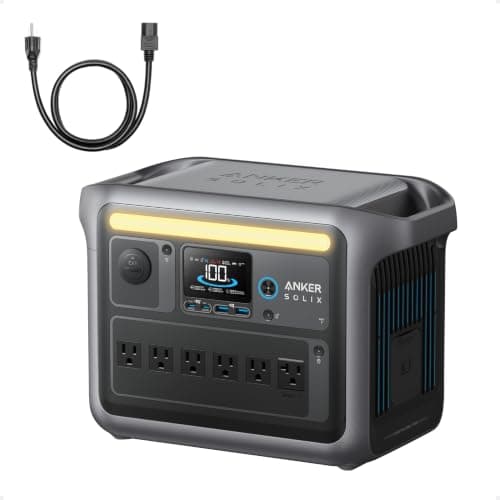
Anker SOLIX C1000

1,056Wh of LiFePO4 with 1,800W output and a fast recharge.

A full day of lights, screens and charging
2
No photo

If you need an engine

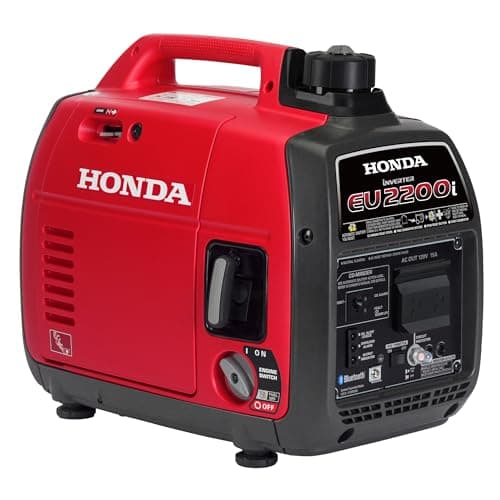
Honda EU2200i

2,200W at a published 48–57 dB(A), 47.4 lb, and 8.1 hours on 0.95 gallons.

All-day cooking or a long event
3
No photo

Smallest sensible unit

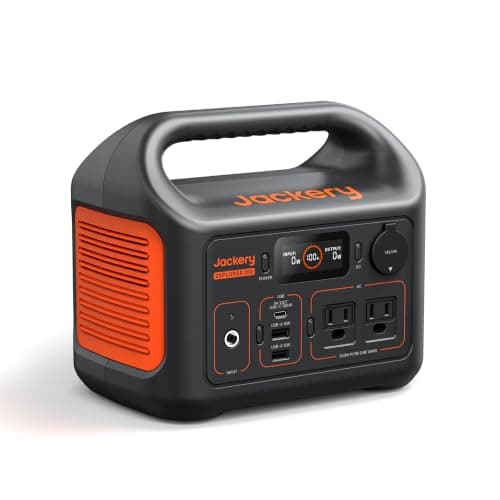
Jackery Explorer 300 Plus

A compact LiFePO4 station that covers the load most events actually have.

Charging, lights and a speaker
4
No photo

Light for the pack-down

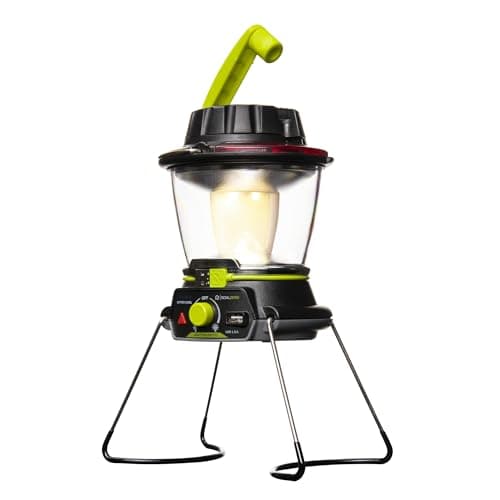
Goal Zero Lighthouse 600 lantern

Up to 600 lumens with a 5,200 mAh USB power bank and a hand crank.

After dark, when the event is over

Prices come from the retailer at page-build time and change constantly. Where no live price is available the button reads “Check price” rather than showing a number we cannot stand behind.

The picks in full

01Best overall for an event

Anker SOLIX C1000

1,056Wh of LiFePO4 with 1,800W output and a fast recharge.

A kilowatt-hour covers a four to six hour event comfortably: a TV, a speaker, string lights, phone charging and a small fan, with room left over.

1,800W of output also handles a blender or a coffee maker in short bursts, which is where most people actually hit a limit.

The real argument is that it is permitted everywhere. No venue bans a battery, and it makes no noise at an event where the point is conversation.

Skip it ifyou plan to run an electric griddle all afternoon. That is generator territory.

Published specifications for the Anker SOLIX C1000
SpecificationPublished figure
Usable capacity1,056 Wh
Cell chemistryLiFePO4 (LFP)
AC output1,800 W continuous / 2,400 W SurgePad
Cycle life3,000 cycles
Wall recharge80% in 43 min, full in 58 min
Max solar input600 W (full solar recharge ~1.8 h)
Ports11 total, including 6 AC on panel-equipped bundles

Source: Anker — SOLIX C1000 product specifications. These are the manufacturer's published figures, not ours — we have not tested this unit.

02If you need an engine

Honda EU2200i

2,200W at a published 48–57 dB(A), 47.4 lb, and 8.1 hours on 0.95 gallons.

Where fuel is genuinely needed, the published dB(A) range is what makes a generator tolerable in a lot full of people rather than the thing everyone moves away from.

0.117 gallons an hour means a single small can covers a whole day, which matters when the machine travels in the same vehicle as everything else.

Skip it ifthe venue bans generators, which many stadium lots do. Check first.

Published specifications for the Honda EU2200i
SpecificationPublished figure
Output2,200 W max / 1,800 W rated
TypeInverter (pure sine wave)
Noise48–57 dB(A)
Weight47.4 lb
Tank0.95 gal
Run timeup to 8.1 h on a full tank
FeaturesEco Throttle, CO-Minder, Bluetooth app monitoring

Source: Honda Power Equipment — EU2200i specifications. These are the manufacturer's published figures, not ours — we have not tested this unit.

03Smallest sensible unit

Jackery Explorer 300 Plus

A compact LiFePO4 station that covers the load most events actually have.

Honest sizing: if the list is phones, a Bluetooth speaker and some lights, this is enough and everything larger is carried for nothing.

Small enough to carry in one hand alongside a cooler, which at an event is the specification that decides whether it comes at all.

Skip it ifyou want to run a TV all afternoon. Go up a tier.

Published specifications for the Jackery Explorer 300 Plus
SpecificationPublished figure
Usable capacity288 Wh
Cell chemistryLiFePO4 (LFP)
AC output300 W continuous
Weight8.3 lb (3.75 kg)
Solar compatibilitySolarSaga 40/60/80/100 W panels
ControlWi-Fi and Bluetooth app monitoring

Source: Jackery — Explorer 300 Plus product specifications. These are the manufacturer's published figures, not ours — we have not tested this unit.

04Light for the pack-down

Goal Zero Lighthouse 600 lantern

Up to 600 lumens with a 5,200 mAh USB power bank and a hand crank.

Area light rather than a beam, which is what you want over a table and when finding things in a dark lot. Half-lantern mode roughly doubles the runtime and still lights one side of a table properly.

Skip it ifyou are packing up in daylight.

Published specifications for the Goal Zero Lighthouse 600 lantern
SpecificationPublished figure
OutputUp to 600 lumens, 360° or half-lantern
Battery5,200 mAh lithium with USB output
ChargingUSB, solar panel, or built-in hand crank
Hand crank1 W at 130 rpm — 1 minute gives about 10 minutes on low
Size4.5 x 5 x 6.5 in open, 1.1 lb
DesignCollapsible legs, built-in hanging handle

Source: Goal Zero — Lighthouse 600 product page. These are the manufacturer's published figures, not ours — we have not tested this unit.

How these were chosen

We did not test these. Nobody at Watt & Warden has plugged one in. What we did instead: read the manufacturer's published specifications, compile them into a table where the figures line up, and compute the numbers manufacturers leave out — runtime against a real appliance load, and what an hour of running actually costs.

Anything that could not be sourced was left out rather than estimated, and every pick names the buyer who should skip it. The full method is here, including where it is weaker than a publisher with a test bench.

Questions people actually ask

Can you use a generator for tailgating?

It depends entirely on the venue. Many stadium and arena parking operations restrict or prohibit generators, and organizers often have stricter rules than the venue. Batteries are almost universally permitted because they make no noise, produce no exhaust and store no fuel. Check your venue before comparing specifications.

What size power station do I need for tailgating?

A kilowatt-hour covers a five-hour event with margin -- phones, a speaker, string lights, a TV, a fan and a 12V cooler total roughly 800Wh together. If the list is just charging, lights and a speaker, a 300Wh unit is genuinely enough and anything larger is carried for nothing.

Can I cook on a portable power station at a tailgate?

Not electrically. A 1,500W griddle empties a kilowatt-hour battery in about forty minutes. Cook on propane and run everything else on the battery -- that division is lighter, quieter and cheaper than trying to do either job with the wrong tool.

Is a 12V cooler worth running from a power station?

Yes, and it is the best-value load on the list. A compressor cooler draws 40 to 60W while cycling -- perhaps 200Wh across an event, less than a TV -- and it removes ice entirely: no melt water, no soggy food, no mid-event ice run, and real temperature control.

How do I keep a generator from annoying people at an event?

Run it at part load so an inverter throttles down, point the exhaust away from every other pitch rather than just your own, and keep the same twenty-foot discipline you would at home -- people sit and eat downwind of it. Never run one beside a closed vehicle, under a canopy or in a tent.

Sources

Every figure on this page comes from a published source. We have not tested this equipment, so the specifications are the manufacturer's and the statistics are the dataset's — the arithmetic on top of them is ours, and it is shown in full so you can check it. How we work this out.