Hands free beats hand held
This is the whole argument, and it is obvious once someone says it.
List what you actually do in an outage: carry a fuel can and pour it, pull a garage door release and lift the door, find a breaker and reset it, check the oil on a generator, carry a child down stairs, cook on a camp stove outdoors.
Every one of those takes two hands. A flashlight becomes something to put down, hold in your teeth, or ask someone else to aim — and it usually ends up pointing at the wrong thing.
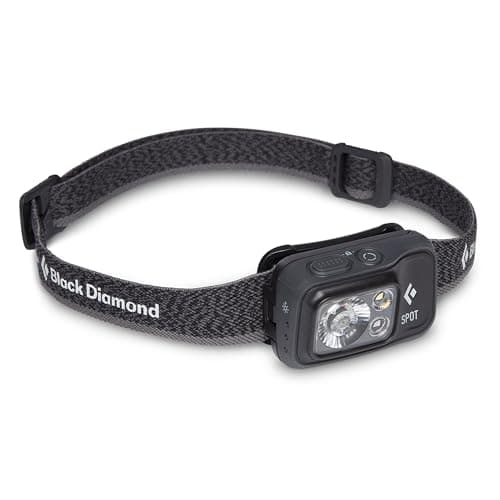
A headlamp points wherever you are looking, costs about the same, and is the item most households do not own and should.
Runtime is the specification, again
Same argument as lanterns, and the published numbers make it well.
| Setting | Output | Runtime | What it is for |
|---|
| High | 400 lumens | 2.5 hours | Outdoors, at distance, briefly |
|---|
| Medium | Dimmable | 5 hours | Working on something with your hands |
|---|
| Low | Dimmable | Up to 200 hours | Moving around a dark house — live here |
|---|
| Red | Low | Extended | Preserving night vision, and not waking people |
|---|
Black Diamond's published figures for the Spot 400 on AAA cells. The pattern across the category is the same: the low setting is the one that decides whether a light covers a multi-day outage, and the high setting is for brief tasks.
400 lumens is far more than a dark house needs. Your eyes adapt within minutes when there is no competing light, and running on high wastes cells and ruins the adaptation of everyone else in the room.
Red mode is not a gimmick
Two genuine uses, and both matter more in a multi-day outage than a single evening.
1. It preserves dark adaptation. White light resets your night vision every time it hits your eyes; red light largely does not. In a house with no lighting at all, being adapted to the dark is the difference between navigating comfortably and needing a light for every step.
2. It does not wake people. Checking on a child, finding the bathroom, going to look at a generator at 3am — red light does all of those without lighting the room.
It also draws far less power. Streamlight publishes 192 hours on its red LED against 7 hours on high, which on a multi-day outage is a genuinely different class of runtime.
Batteries, and the mistake people make
The same argument as the rest of the outage kit, with one addition specific to lights.
- Replaceable cells for outage use. You swap and continue; a rechargeable light with a dead battery and no power is a paperweight.
- Standardize the format. A house where the headlamps, the lantern and the radio all take AA or AAA is a house where one pack of cells covers everything. Mixing AA, AAA, C, D and proprietary packs is how you end up with the wrong ones.
- Store alkalines outside the light if it will sit for years. Leaking cells destroy contacts, and this is the most common way a drawer light dies.
- Use the lockout. Digital lockout prevents a light switching on in a bag and draining. If yours has it, use it.
- Rotate the cells twice a year, alongside exercising the generator. Put the old ones in a TV remote.
How many, and where
More than you think, and placed rather than stored.
- One headlamp per person, in a known place. This is the single most useful line on the page.
- One at the top and bottom of the stairs. Falls are the most common outage injury and stairs are where they happen.
- One by the electrical panel, because that is where you go first and it is usually the darkest corner of the house.
- One in each vehicle. Different failure, same solution.
- One with the generator, so refueling and oil checks in the dark are not a two-person job.
- Somewhere findable by feel. A drawer you can open without seeing it, not the back of a closet.
What to look for
- A published runtime table at every level. If a manufacturer will not state hours at each setting, that is the answer.
- A water rating. IPX7 or IPX8. Outage tasks happen in rain, and this is where cheap lights fail.
- Dimming, and a red mode. Both save cells and both matter over days.
- A battery indicator. Knowing before it dies rather than after is worth a surprising amount.
- A lockout. Prevents the drawer-drain failure.
- A strap you can adjust with gloves on. A small thing until it is February.
Never candles
Worth repeating on any lighting page. Candle use spikes during outages and so do house fires, always by the same mechanism: an unwatched flame near something flammable, in a dark house, in a household that has stopped paying attention because the outage has become normal.
A headlamp costs less than a month of candles, produces more usable light exactly where you are looking, cannot be knocked into a curtain, and consumes no oxygen in a house that may already be sealed against cold.
The lantern page makes the same case for area light, and the full accessory list ranks lighting against the rest of the kit.