Skip to content
Watt Warden

Sizing

How Many Watts Do Christmas Lights Use?

A 100-light incandescent set is published at 40.8 watts. The same count in LED is published at 4.8. That one difference decides how many sets you can safely chain together, and it is a factor of five versus forty-three.

By Sawyer V.Updated Published How we work this out
A house outlined in colorful string lights on a dark winter night.

Watt & Warden earns a commission on qualifying purchases made through links on this page, at no extra cost to you. It never changes a ranking, and our picks include products we tell you to skip. Full disclosure.

The verdict, in one paragraph

A standard 100-count incandescent mini set is published at 40.8 watts (120V, 0.34A). The same count in LED is published at 4.8 watts (0.04A). Both sets carry the same printed instruction — do not exceed 210 watts in an end-to-end run — which is why the incandescent set says you may connect up to 5 sets and the LED set says up to 43. If you are planning a display, that is the whole decision: LED does not just cost less to run, it lets you build a run eight times longer from the same outlet.

The published figures

SetPublished wattsPublished ampsSets per end-to-end run
100-count incandescent mini, clear40.8 W0.34 A at 120 VUp to 5
100-count LED mini, red4.8 W0.04 A at 120 VUp to 43

Both figures are the retailer's published specifications for specific Northlight sets, cited under Sources. Both listings print the same ceiling for a connected run: not to exceed 210 watts. Five incandescent sets is 204 W and forty-three LED sets is 206.4 W — arithmetic of ours, not a manufacturer claim, but it shows the printed set limits are simply the 210 W cap divided by the set wattage.

Why 210 watts, and why it is not your circuit limit

The 210-watt figure is a limit on the chain, not on the socket. It exists because the wire inside a light set is sized for the current of the sets connected after it, and the first set in a chain carries everything downstream. Exceeding it overheats the first set, not the breaker.

The outlet limit is a separate and much larger number. The outdoor 7-day timer in the timer roundup publishes 15 A / 1,875 W, which is the standard household branch circuit. So the practical arrangement is several short chains, each inside 210 W, all fed from one outlet that can carry far more.

  • Five incandescent sets on one chain: 204 W. At the limit, and one more set is a fire-safety problem rather than a tripped breaker.
  • Nine chains of five incandescent sets: 1,836 W. Inside a 1,875 W timer rating, and the thing that will complain is the circuit, not the lights.
  • The same 1,836 W in LED: roughly 380 sets, or 38,000 bulbs. Most households run out of house before they run out of circuit.

How much less LED actually uses

ENERGY STAR publishes the comparison directly: a certified decorative light string “uses approximately 92% less energy than conventional incandescent lights strings”, and certified products must meet an efficiency limit of no more than 0.2 W per bulb. The same page offers the clearest single illustration of the gap:

“the amount of electricity consumed by just one 7-watt incandescent bulb could power 140 LEDs — enough to light two 24-foot (7.3-meter) strings.”

That 7-watt figure is a single larger bulb, not a mini light. It is the reason a C7 or C9 roofline display built from incandescent bulbs is in a different load class from a tree wrapped in minis, and why a roofline is the first thing worth converting.

What a display costs to run

Watts times hours divided by a thousand is kilowatt-hours, and a kilowatt-hour is what the bill charges for. Using the published set figures and a six-hour night:

DisplayLoadPer night, 6 hOver 30 nights
One 100-count incandescent set40.8 W0.24 kWh7.3 kWh
One 100-count LED set4.8 W0.03 kWh0.9 kWh
A full 5-set incandescent chain204 W1.2 kWh36.7 kWh
Twenty LED sets96 W0.6 kWh17.3 kWh

Arithmetic of ours from the published set wattages above. We do not publish a cost in dollars because electricity rates vary by an order of magnitude across the United States — multiply the kWh column by your own rate from your bill. Live prices on the hardware above sit inside the buy buttons, each with the date it was last refreshed.

Can you run Christmas lights on a power station?

Yes, and the arithmetic is unusually friendly for once. A full five-set incandescent chain at 204 W drawn from a BLUETTI Elite 200 V2, published at 2,073.6 Wh, is roughly ten hours before conversion losses. The same battery running twenty LED sets at 96 W is better than twenty hours.

That is not a reason to buy a battery for decorations. It is a reason to know that if you already own one for outages, a porch display on a balcony with no outlet is trivially within its means — unlike almost every heating load on this site. What size power station you need covers the loads that are not.

The one thing to avoid is running decorations from a battery you are holding in reserve for a storm. December is the month the lights go out, and a flat battery on the night of an ice storm is an expensive ornament — the winter storm kit is the competing claim on that capacity.

Four things that change the number

  1. Bulb size, not bulb count. A 100-count mini set and a 25-count C9 set are not comparable. ENERGY STAR's own example uses a 7-watt incandescent bulb, which is more than a whole LED mini set.
  2. Inflatables and projectors are motors and lamps. They are not light strings and the 210 W chain limit says nothing about them. Give each one its own outlet.
  3. Chains are cumulative, outlets are not. Splitting a display across three outlets on one cord does not reduce the total load, but it does keep each chain inside the limit printed on the box.
  4. Old sets are not published sets. A strand with a missing tag has no figure. That is what the meter above is for.

The short version

100 incandescent minis is a published 40.8 W; 100 LED minis is a published 4.8 W. Both carry the same printed 210-watt ceiling on any end-to-end run, which is why one allows five sets and the other allows forty-three. Build in short chains, feed them from a multi-outlet outdoor cord, put the whole thing on a timer, and the only number left to find is your own rate per kilowatt-hour.

Quick picks

#ProductBest forPrice
1
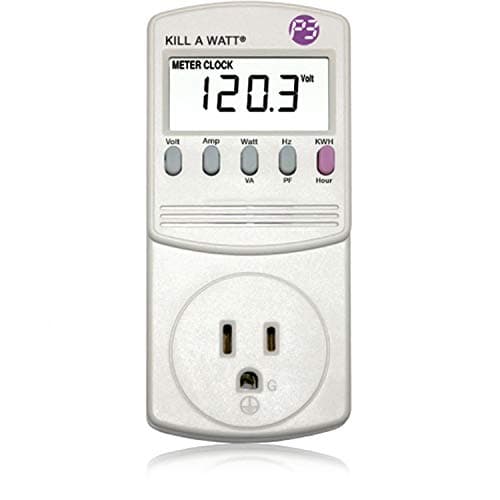
P3 P4400 Kill A Watt electricity usage monitor

The only way to stop guessing

P3 P4400 Kill A Watt electricity usage monitor

A plug-in meter that reads the real watts your run draws, which matters because a mixed display has no published figure.

A display assembled from sets bought over several years
$28.48 · Check price on Amazon

#ad how this is funded · price as of October 20, 2026 · $31.39 9% off

2
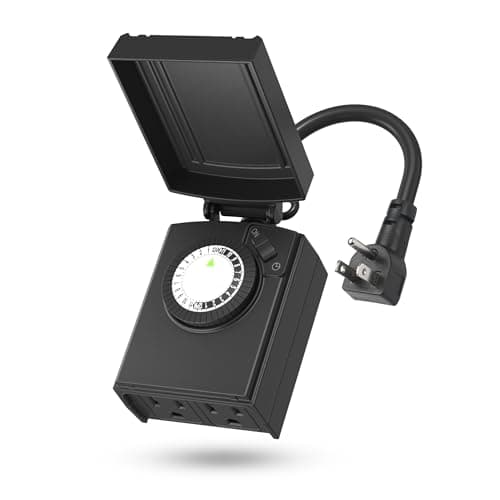
BN-LINK outdoor 24-hour mechanical timer, 2 outlets

What actually reduces the cost

BN-LINK outdoor 24-hour mechanical timer, 2 outlets

A weatherproof dial timer with 30-minute intervals and daily repeat, listed for Christmas lights specifically.

Anyone whose lights are on from dusk until morning
$11.89 · Check price on Amazon

#ad how this is funded · price as of October 20, 2026 · $14.86 20% off

3
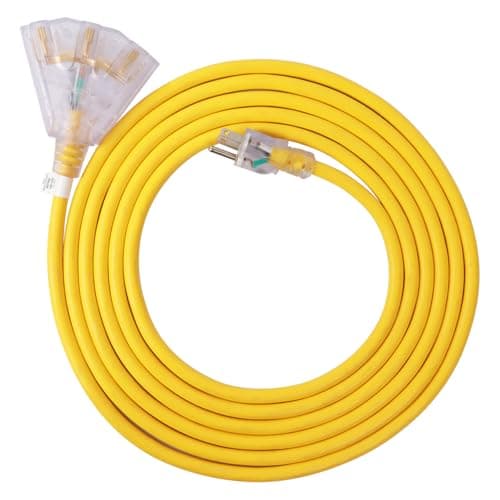
EP 25 ft outdoor extension cord, 14/3 SJTW, 3 outlets

The cord the run should start from

EP 25 ft outdoor extension cord, 14/3 SJTW, 3 outlets

25 ft of 14-gauge SJTW ending in three outlets, so three separate runs each stay inside their own published cap.

A display fed from one exterior outlet
$23.99 · Check price on Amazon

#ad how this is funded · price as of October 20, 2026

Prices come from the retailer at page-build time and change constantly. Where no live price is available the button reads “Check price” rather than showing a number we cannot stand behind.

The picks in full

01 — The only way to stop guessing

P3 P4400 Kill A Watt electricity usage monitor

A plug-in meter that reads the real watts your run draws, which matters because a mixed display has no published figure.

Every number on this page comes from a manufacturer's published figure for a specific set. The moment you chain a 2019 incandescent strand to a 2026 LED strand to a lighted inflatable, no published figure describes what you built, and a meter is the only honest answer.

It is also the device that settles the annual argument about what the display costs to run. Plug the extension cord into the meter, read the watts, and the arithmetic below becomes your arithmetic rather than a generic one.

The honest catch: the listing states batteries are not included, and the meter has to sit indoors at the socket end of the run, not out at the stake.

Skip it ifevery set you own is new and still has its box. The wattage is printed on the tag.

P3 P4400 Kill A Watt electricity usage monitor
$28.48 · Check price on Amazon

#ad how this is funded · price as of October 20, 2026 · $31.39 9% off

Published specifications for the P3 P4400 Kill A Watt electricity usage monitor
SpecificationPublished figure
FunctionElectricity usage monitor and power analyzer
DisplayLCD
MeasuresHousehold appliance energy use, per the listing
BatteriesNot included, per the listing
Pack1 unit

Source: P3 International — P4400 Kill A Watt retail listing. These are the manufacturer's published figures, not ours — we have not tested this unit.

03 — The cord the run should start from

EP 25 ft outdoor extension cord, 14/3 SJTW, 3 outlets

25 ft of 14-gauge SJTW ending in three outlets, so three separate runs each stay inside their own published cap.

The published 210-watt limit below applies to each end-to-end chain, not to the outlet. Three short chains fed from three outlets on one cord is a different and safer arrangement than one long chain, even though the total load is identical.

14 gauge is the point of this cord. Thinner outdoor cords exist and are fine for a single strand, but a run built to the published cap deserves conductor that is not working at its limit.

The honest catch: the listing title we checked does not state an amperage rating, so treat the per-chain caps printed on your light sets as the governing number, not the cord.

Skip it ifyou only have one strand. A 16-gauge cord is lighter and cheaper for that.

EP 25 ft outdoor extension cord, 14/3 SJTW, 3 outlets
$23.99 · Check price on Amazon

#ad how this is funded · price as of October 20, 2026

Published specifications for the EP 25 ft outdoor extension cord, 14/3 SJTW, 3 outlets
SpecificationPublished figure
Length25 ft
Gauge14/3 (14 AWG, 3 conductor)
JacketSJTW, rated for outdoor use
Outlets3
Plug3-prong grounded
RatingNot stated in the listing title we checked

Source: EP — 25 ft 14/3 outdoor extension cord retail listing. These are the manufacturer's published figures, not ours — we have not tested this unit.

How these were chosen

We did not test these. Nobody at Watt & Warden has plugged one in. What we did instead: read the manufacturer's published specifications, compile them into a table where the figures line up, and compute the numbers manufacturers leave out — runtime against a real appliance load, and what an hour of running actually costs.

Anything that could not be sourced was left out rather than estimated, and every pick names the buyer who should skip it. The full method is here, including where it is weaker than a publisher with a test bench.

Questions people actually ask

How many watts does a 100-count Christmas light set use?

A standard 100-count incandescent mini set is published at 40.8 watts, drawing 0.34 amps at 120 volts. The same 100-count in LED is published at 4.8 watts, drawing 0.04 amps. Those are retailer-published specifications for specific Northlight sets, cited on this page.

How many strands of Christmas lights can you connect end to end?

It depends on the set wattage, because the printed limit is a total of 210 watts for the connected run. A 40.8W incandescent set allows up to 5 sets connected end to end. A 4.8W LED set allows up to 43. Always use the figure printed on your own set rather than a general rule.

How many Christmas lights can you put on one outlet?

Far more than one chain. The 210-watt limit applies to each end-to-end chain, not to the outlet. A standard household branch circuit is 15 amps, and outdoor timers for this job publish a 15A/1,875W rating, so several separate chains can share one outlet as long as each chain stays inside its own printed cap.

How much less electricity do LED Christmas lights use?

ENERGY STAR states that a certified decorative light string uses approximately 92% less energy than a conventional incandescent string, and that certified products must use no more than 0.2 watts per bulb. Published set figures bear that out: 4.8W for a 100-count LED set against 40.8W for the incandescent equivalent.

How much does it cost to run Christmas lights?

Multiply watts by hours, divide by 1,000, and multiply by your own rate per kilowatt-hour. A single 100-count incandescent set run six hours a night for thirty nights is about 7.3 kWh. The same LED set is about 0.9 kWh. We do not publish a dollar figure because US electricity rates vary too widely for one to be useful.

Can a portable power station run Christmas lights?

Comfortably. A full five-set incandescent chain at 204 watts drawn from a 2,073.6Wh battery is roughly ten hours before conversion losses, and an LED display is far longer. The caution is not capacity, it is timing: December is outage season, and a battery flattened on decorations is not available for the storm.

Do Christmas lights use more power when they are on a timer?

No. A timer reduces consumption by reducing hours, which is the half of the equation most people ignore. A display left on overnight runs roughly fourteen hours instead of the five or six anyone actually looks at it, so a timer can cut the seasonal total by more than half without changing a single bulb.

Sources