Skip to content
Watt Warden

Power Stations

The Best Power Stations for CPAP (2026)

A CPAP without the heated humidifier is a small load that almost any battery covers. Turn the humidifier on and the draw can double or triple - that one switch is the whole sizing question.

By Sawyer V.Updated Published How we work this out
A bedside table lit softly at night.

Watt & Warden earns a commission on qualifying purchases made through links on this page, at no extra cost to you. It never changes a ranking, and our picks include products we tell you to skip. Full disclosure.

Quick picks

#ProductBest forPrice
1
No photo

Best for one night, humidifier off

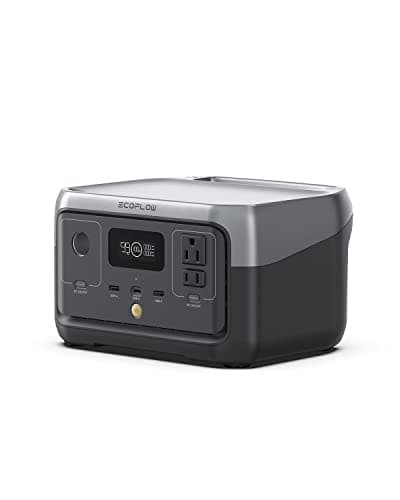
EcoFlow RIVER 2

256Wh at 7.7 lb with a full recharge in about an hour and 3,000+ cycles.

Travel and single-night outages
2
No photo

Best small alternative

Jackery Explorer 300 Plus

A compact LiFePO4 station with enough headroom for a CPAP and small devices together.

A night plus phones and a lamp
3
No photo

Best for humidifier use and multiple nights

BLUETTI AC180

A kilowatt-hour-class LiFePO4 station with fast recharge and enough output for anything a bedroom needs.

Heated humidity, or two nights unaided

Prices come from the retailer at page-build time and change constantly. Where no live price is available the button reads “Check price” rather than showing a number we cannot stand behind.

The humidifier decides everything

Champion's published wattage chart puts a CPAP at 30–60 watts. Over an eight-hour night that is roughly 240–480Wh — a genuinely small load that a modest battery covers.

A heated humidifier is a different thing. It is a heating element, and heating elements are among the largest loads in any house per unit of size. Manufacturers do not generally publish a combined figure, but the practical effect is that total consumption can double or triple.

So the first question is not which battery. It is: do you use heated humidity, and can you go without it for a few nights? If you can, the purchase gets much smaller and cheaper. That is a question for your clinician, not for us.

SetupDrawPer 8-hour night
CPAP, humidifier off30–60 W (published)~240–480 Wh
CPAP with heated humidifierSubstantially higherOften 2–3× the above
CPAP on DC input, no humidifierLower again — no inverter lossesCheck your machine's DC rating

The 30–60W figure is Champion Power Equipment's published range. The humidifier multiplier is a working characterization rather than a published number — we have not measured any machine, and your device's own label is the figure that counts.

Three things that change your real number

  • Pressure setting. Higher prescribed pressure means the blower works harder and draws more.
  • Altitude compensation. Machines that adjust for altitude run the blower faster to hold pressure.
  • Mask leak. A leaking seal makes the machine compensate continuously, which costs power all night.

None of these are large individually. Together they are why you should buy some margin rather than sizing exactly to a calculation.

Use the DC input if your machine has one

Many CPAP machines accept 12V DC directly, and most power stations have a 12V output. Going DC-to-DC skips the station's inverter, and inverter conversion is a real loss — commonly in the region of 10–15%.

On a load this small that is meaningful: it can be the difference between one night and one night with margin, from the same battery, for the cost of a cable. Check your machine's manual for the DC input specification and use the manufacturer's own cable rather than a generic one.

Why recharge speed beats capacity here

This is the argument this page exists to make. Most outages are short, and power often returns intermittently before it returns for good.

A battery that refills in an hour turns every brief restoration into a full reset. A battery with twice the capacity but a six-hour recharge does not — it can arrive at the second night still half empty.

For a nightly medical load with a predictable daily cycle, fast recharge is worth more than raw watt-hours. The charging options cover AC, solar and car charging.

Test it before you need it

Plug your actual machine into the actual battery and run it for a full night. Two things get discovered this way and only this way:

  • What your device really draws, at your pressure, with your mask, with your humidifier setting.
  • Whether the station's inverter idles down. Some stations power off an AC outlet that appears to be drawing nothing, which is a problem for a device that cycles.

Do it on an ordinary Tuesday. Discovering either of those at 3am in a storm is the situation the equipment was bought to prevent.

If the outage might run days

A battery alone has a ceiling. For multi-day coverage you want a recharge path — a folding panel, or a generator running outdoors in blocks to refill the battery that runs the bedroom.

The battery indoors is not optional in that arrangement: it is the only thing that can safely sit beside a sleeping person. Backup power for medical devices covers oxygen concentrators and refrigerated medication, which are much larger problems than a CPAP.
The picks in full

01Best for one night, humidifier off

EcoFlow RIVER 2

256Wh at 7.7 lb with a full recharge in about an hour and 3,000+ cycles.

Champion publishes 30–60W for a CPAP. At the top of that range, eight hours is about 480Wh — more than this holds — but with the humidifier off most machines sit nearer the bottom, and 256Wh covers a full night comfortably.

The specification that matters most here is not capacity, it is the one-hour recharge. An outage has to be long and completely unbroken to defeat a battery that refills in an hour from any brief return of power.

7.7 lb also makes it the one that actually travels, and LiFePO4 at 3,000+ cycles means it is still healthy after years of nightly use.

Skip it ifyou run the heated humidifier every night. 256Wh will not cover that.

Published specifications for the EcoFlow RIVER 2
SpecificationPublished figure
Capacity256 Wh
Output300 W continuous, 600 W X-Boost
ChemistryLiFePO4, 3,000+ cycles to 80%
AC recharge0–100% in about 1 hour
Weight7.7 lb
Solar inputup to 110 W

Source: EcoFlow — RIVER 2 published specifications. These are the manufacturer's published figures, not ours — we have not tested this unit.

02Best small alternative

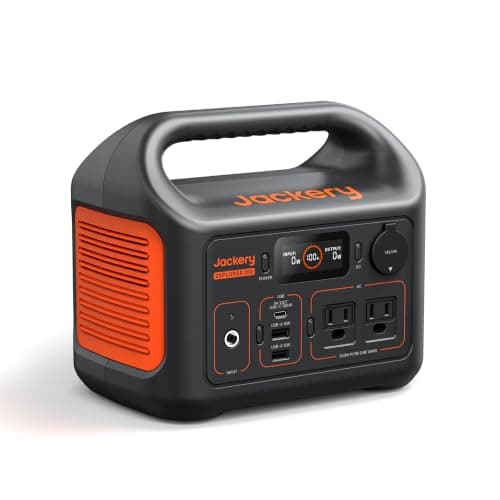
Jackery Explorer 300 Plus

A compact LiFePO4 station with enough headroom for a CPAP and small devices together.

The practical difference from the smallest units is margin: a CPAP plus a phone charger plus a bedside lamp is still comfortably inside what this holds for a night.

Worth checking whether your machine has a DC input. Running a CPAP from DC skips the inverter entirely and cuts consumption meaningfully, which no amount of extra capacity matches for value.

Skip it ifyou want multiple nights without a recharge. That needs a kilowatt-hour tier.

Published specifications for the Jackery Explorer 300 Plus
SpecificationPublished figure
Usable capacity288 Wh
Cell chemistryLiFePO4 (LFP)
AC output300 W continuous
Weight8.3 lb (3.75 kg)
Solar compatibilitySolarSaga 40/60/80/100 W panels
ControlWi-Fi and Bluetooth app monitoring

Source: Jackery — Explorer 300 Plus product specifications. These are the manufacturer's published figures, not ours — we have not tested this unit.

03Best for humidifier use and multiple nights

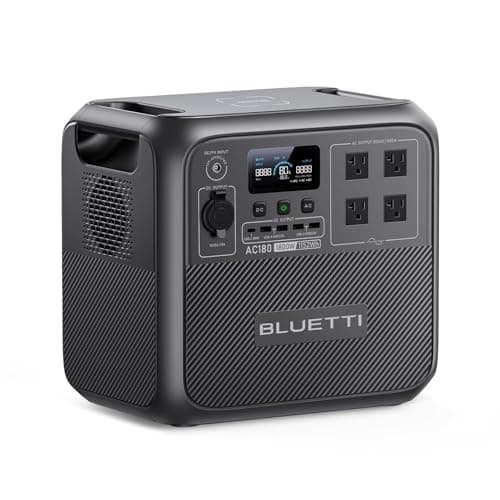
BLUETTI AC180

A kilowatt-hour-class LiFePO4 station with fast recharge and enough output for anything a bedroom needs.

The heated humidifier is what pushes people to this tier. A heating element is a real load, and running it all night can double or triple total consumption against the same machine with heat off.

A kilowatt-hour covers a humidified night with margin, or two or three nights with the humidifier off — which is the realistic multi-day outage answer.

LiFePO4 again, for the same reason: this is equipment that sits charged and must work in five years.

Skip it ifyou only need one night with the humidifier off. This is more battery than that requires.

Published specifications for the BLUETTI AC180
SpecificationPublished figure
Usable capacity1,152 Wh (32 V, 36 Ah)
Cell chemistryLiFePO4 (LFP)
AC output1,800 W continuous / 2,700 W surge, 4 outlets
Cycle life3,500+ cycles to 80% capacity
Weight35.3 lb
Fast charge0–80% in 45 min
Max solar input500 W
Warranty5 years on registration

Source: BLUETTI — AC180 product specifications. These are the manufacturer's published figures, not ours — we have not tested this unit.

How these were chosen

We did not test these. Nobody at Watt & Warden has plugged one in. What we did instead: read the manufacturer's published specifications, compile them into a table where the figures line up, and compute the numbers manufacturers leave out — runtime against a real appliance load, and what an hour of running actually costs.

Anything that could not be sourced was left out rather than estimated, and every pick names the buyer who should skip it. The full method is here, including where it is weaker than a publisher with a test bench.

Questions people actually ask

What size power station do I need for a CPAP?

With the humidifier off, Champion's published 30-60W means roughly 240-480Wh a night, so 250-500Wh covers one night. With heated humidity, consumption can double or triple, which pushes you to a kilowatt-hour-class battery for the same single night.

How long will a power station run a CPAP?

Divide capacity by draw and take about 15% off for inverter losses. A 256Wh station at 40W runs roughly five to six hours; at the same draw a 1,000Wh station covers two to three nights. Running the humidifier cuts all of those figures substantially.

Can I run a CPAP on 12V DC from a power station?

If your machine has a DC input, yes, and it is worth doing. Going DC-to-DC skips the station's inverter and its conversion losses, which on a load this small can be the difference between one night and one night with margin. Use the manufacturer's own cable.

Do I need to run the humidifier during a power outage?

That is a question for your clinician rather than for us. What we can say is that it is the single biggest factor in the size and cost of the battery you need -- if you can go without heated humidity for a few nights, the purchase gets much smaller.

Is recharge speed more important than capacity for CPAP backup?

Usually, yes. Most outages are short and power often returns intermittently first. A battery that refills in about an hour turns every brief restoration into a full reset, while a larger battery with a slow recharge can reach the second night still half empty.

Sources

Every figure on this page comes from a published source. We have not tested this equipment, so the specifications are the manufacturer's and the statistics are the dataset's — the arithmetic on top of them is ours, and it is shown in full so you can check it. How we work this out.